King Tutankhamun Collection at GEM
See all 5,398 treasures from Tutankhamun’s tomb at the Grand Egyptian Museum - gold mask, coffins, chariots, and more in two vast halls.
Booking choice: Private English-speaking Egyptologist and Cairo/Giza hotel transfers. Admission, lunch and tips are extra. Approximately 3.5 hours. Check Private GEM Egyptologist Visit Dates
Choose whether you want an Egyptologist to explain the collection or time to explore it independently.
TL;DR
The Grand Egyptian Museum holds all 5,398 objects from Tutankhamun’s tomb, displayed together for the first time in history across two dedicated halls covering 7,000 square meters. The golden death mask sits behind 40mm bulletproof glass near the gallery entrance. Photography with a phone is allowed inside, but cameras and video are not. Budget at least two hours for the Tutankhamun galleries alone, more if you want to slow down for the coffins, chariots, and objects that most visitors miss entirely.
Quick Facts: Tutankhamun Collection at GEM
| Total objects | 5,398 (complete tomb collection from KV62) |
| Gallery size | 7,000 square meters across two halls |
| Gallery floor | Second floor of GEM (accessible via Grand Staircase) |
| Photography | Mobile phones only (still photos). No cameras, no video, no flash, no tripods, no selfie sticks. |
| The death mask | 10.23 kg solid gold, 54 cm tall, 40mm bulletproof glass case near gallery entrance |
| Tut’s mummy | Remains in the Valley of the Kings. Not at GEM. Not moving. |
| First opened | November 4, 2025 (103rd anniversary of tomb’s discovery) |
| Suggested time | 2 hours minimum; 3 hours for serious visitors |
| Tickets | Included in standard GEM admission. Book at visit-gem.com only. (Verified March 2026) |
| Design firm | Atelier Brückner (Germany) – dual-narrative layout |
What Is the Tutankhamun Collection at the Grand Egyptian Museum?
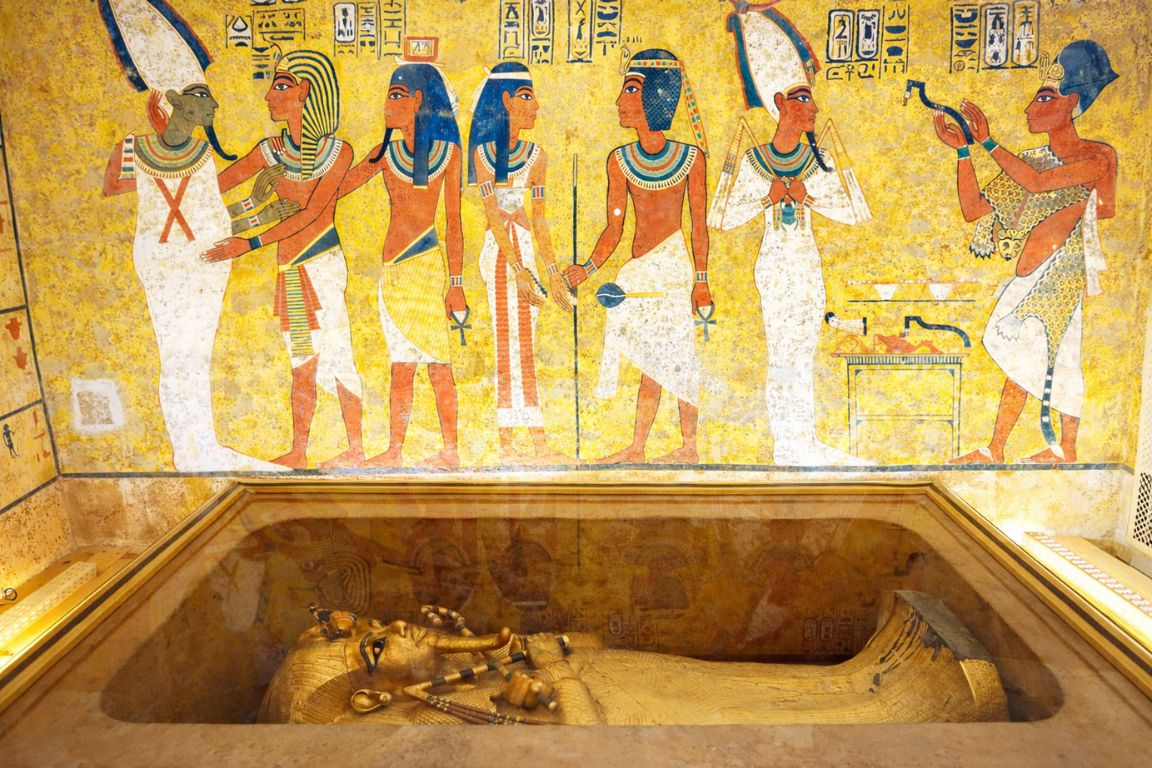 The Tutankhamun collection at GEM is the complete set of 5,398 objects found in his tomb in 1922, displayed together in one place for the first time in over 3,000 years. Two dedicated halls spanning 7,000 square meters hold everything: the coffins, the shrines, the golden mask, the chariots, the daggers, the board games, the sandals. Nothing has been kept back.
For a century after Howard Carter opened KV62, the collection was split. The golden mask went to the Egyptian Museum in Tahrir Square. Hundreds of other objects were scattered across storage rooms, conservation labs, and secondary display cases. Visitors to Tahrir saw maybe 1,800 pieces if they were lucky and knew where to look. The majority of the tomb had never been seen by the public at all.
That changed on November 4, 2025. The date was not accidental. It was the 103rd anniversary of the tomb’s discovery. The last pieces, including the death mask itself, had been transferred from Tahrir to GEM in the months before the official opening, completing a move that had taken years of careful conservation work.
The galleries were designed by German studio Atelier Brückner. Their layout does something most museums don’t attempt: it tells two stories at once, depending on which direction you walk. Go one way and you follow the narrative of Tutankhamun’s life and reign, the boy king who came to power at nine, ruled during a period of political turbulence after the Amarna revolution, and died at around eighteen or nineteen. Go the other way and you follow Howard Carter’s 1922 discovery, the sealed doorway, the antechamber packed to the ceiling, the ten years it took to document and clear the tomb. Both paths end at the same place: a full-scale reproduction of the tomb itself, with projections showing how every chamber looked before Carter ever touched it.
What Are the Most Important Objects in the Tutankhamun Galleries?
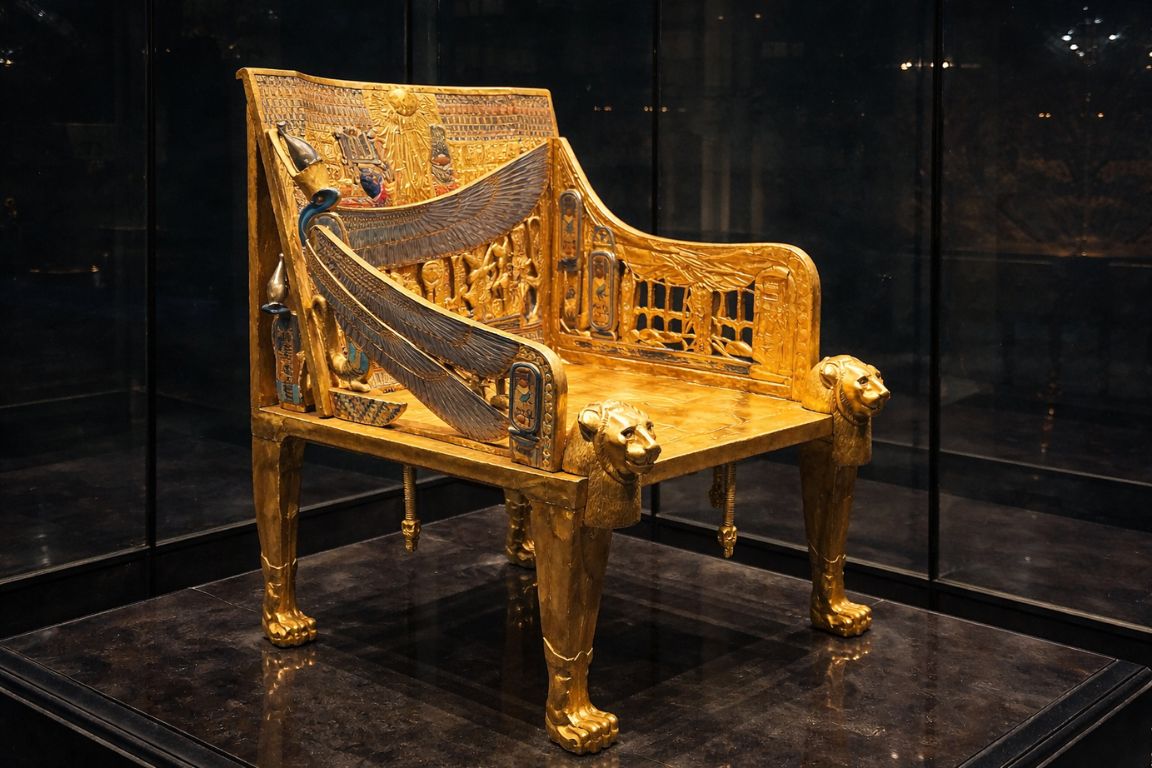 The core objects are the golden death mask, the three nested coffins (one solid gold at 110 kg), the four gilded wooden shrines, the Golden Throne, six ceremonial chariots, the meteorite-iron dagger, and the canopic shrine with its four protective goddess figures. These are the pieces every visitor should plan time for specifically, not assume they’ll absorb while walking through.
The list sounds manageable until you’re actually inside. 5,398 objects is not an abstract number in a press release. It’s forty-eight display cases. Jewelry that takes twenty minutes to look at properly. Furniture stacked with detail. Omar has watched hundreds of travelers get to the coffins at a reasonable pace, spend forty-five minutes there, and then realize they’ve given themselves fifteen minutes for everything else.
The smarter approach is to identify your priorities in advance and move to them first. Here’s how we break it down for our groups:
The golden mask should be the first stop, not because everything else is lesser, but because it’s near the entrance and the crowds thin out as you move deeper into the halls. The coffins and shrines are further in and require more time than most people budget. The chariots, particularly the restored harness panels with their Syrian botanical motifs, are almost always rushed. And the meteorite-iron dagger, one of the most scientifically significant objects in the entire collection, sits quietly in a case that most visitors walk past in under a minute.
We’ve mapped out what to see at the Grand Egyptian Museum because the collection is enormous and most visitors only have 3-4 hours before they hit museum fatigue.
What Is the Story Behind the Golden Death Mask?
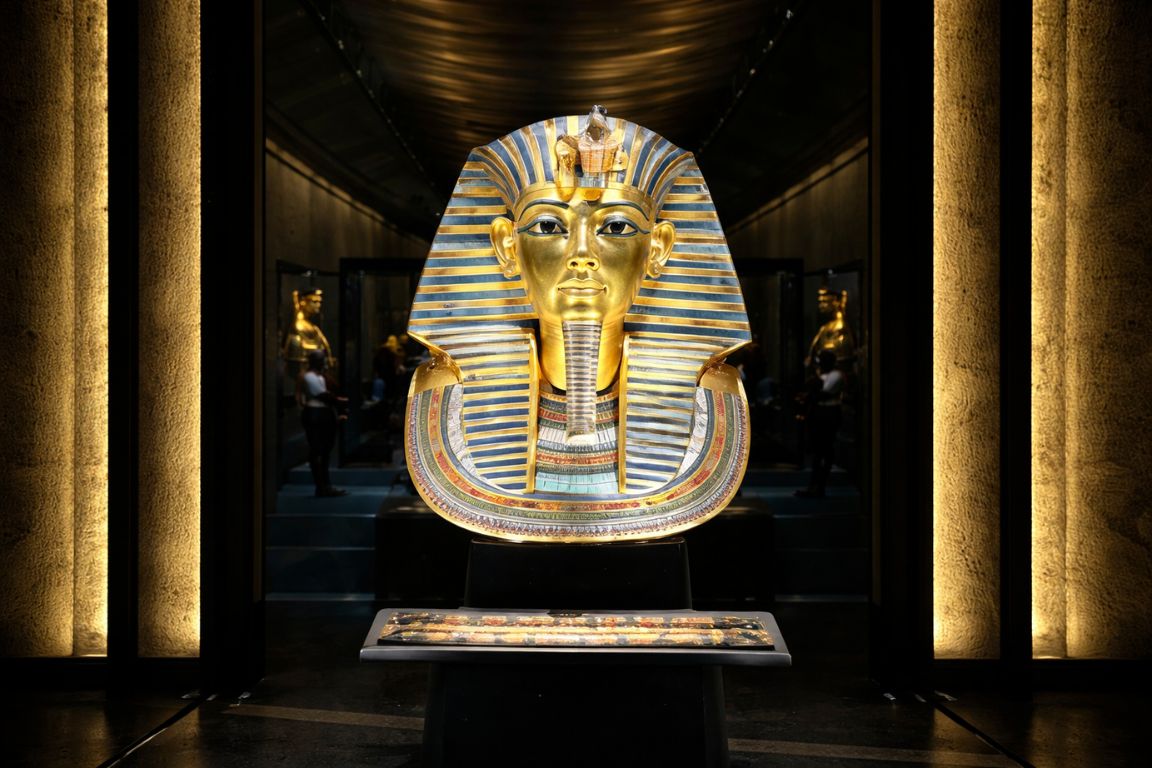 The golden death mask is 54 centimeters tall, weighs 10.23 kg, and was hammered from two sheets of high-karat gold joined by heat. It was placed directly over Tutankhamun’s mummified head and shoulders inside the innermost coffin, where it remained untouched for over 3,300 years. At GEM, it sits behind 40mm bulletproof glass near the gallery entrance, lit so that the lapis lazuli inlays catch the light the way they were designed to.
The mask is genuinely harder to describe than people expect. Photographs do not prepare you for the thing. The gold is not bright or flashy. It has weight to it, visually, the way very old gold always does. The lapis lazuli eyebrows and eyelids come from Afghanistan, brought to Egypt along trade routes spanning thousands of kilometers. The blue of lapis was, to the ancient Egyptians, the color of divine hair, the color of the gods. The stripes of the nemes headdress are blue glass imitating lapis, because lapis was too precious even for the headdress stripes. Lapis was reserved for what mattered most: the eyes and the brows, where a person’s spirit was understood to live.
On the back of the mask, running across the shoulders and down the reverse, is an inscription from Chapter 151 of the Book of the Dead. It’s a protective spell, each body part of the king mapped to a god. Your right eye is the night bark of Ra. Your left eye is the day bark. Your eyebrows are the Ennead of the Gods. The mask is not a portrait. It’s a piece of working theology, meant to guide a dead king through the underworld by surrounding him with divine protection on every surface.
One detail that comes up in conservation discussions but almost never makes it into visitor guides: Egyptologist Nicholas Reeves has argued that the face section of the mask was made separately from the rest and may have originally been crafted for a different pharaoh, possibly Neferneferuaten, who preceded Tutankhamun and may have been Nefertiti ruling as pharaoh. The slightly different gold composition of the face (23.2 karats vs. 23.5 for the rest) and the pierced ears, which in most surviving Egyptian art appear only on women and children, both point in this direction. The mask may have been repurposed. The cartouches show signs of alteration. It’s contested, and the mask is too precious for the invasive testing that would confirm it. But it means the most famous face in archaeology might not be Tutankhamun’s face at all.
At GEM, the mask is set close enough to be seen clearly. The bulletproof glass is thick but the lighting is carefully managed so that the inlays read the way they’re supposed to. Take your time here before the tour groups arrive. Omar’s advice to every traveler we work with: stand in front of it long enough that it stops being something you recognize and starts being something you actually see.
If you’d rather have someone walk you through what you’re looking at instead of reading labels, the private GEM Egyptologist visit with hotel transfers includes a guide in the Tutankhamun halls.
What Makes the Coffins, Shrines, and Canopic Equipment So Significant?
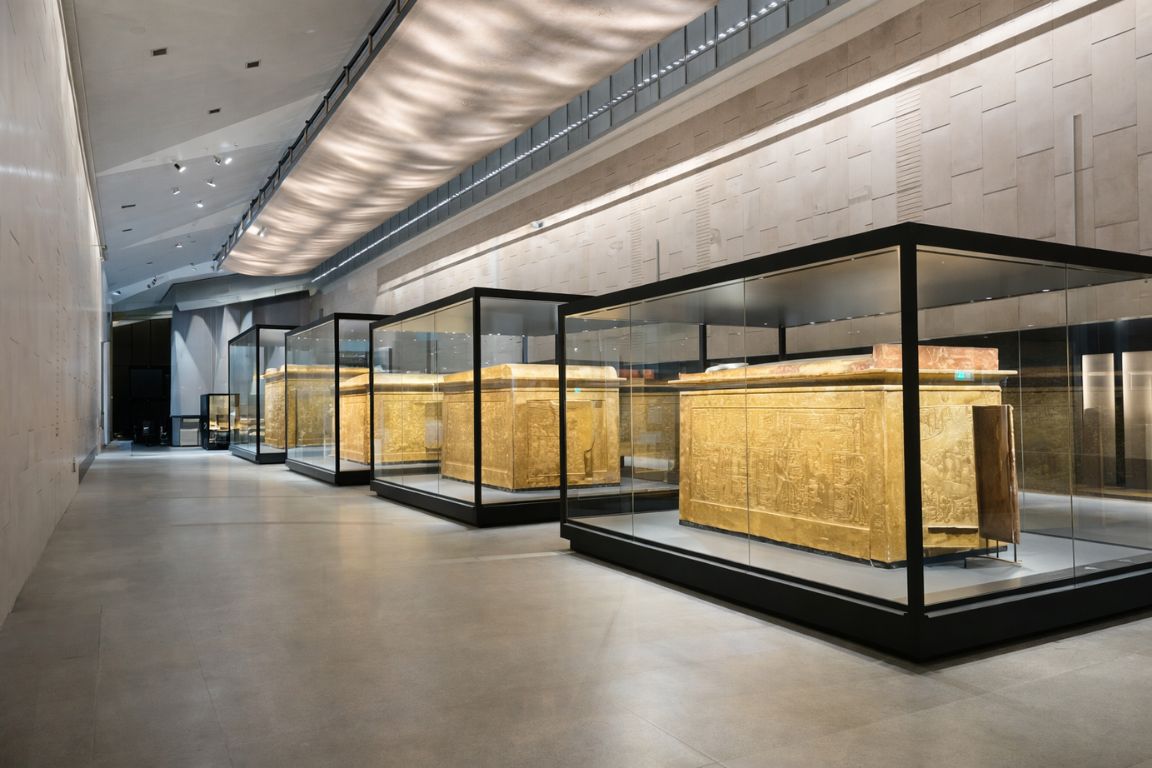 Tutankhamun’s burial system used four nested gilded wooden shrines, a stone sarcophagus, and three coffins: two of gold-plated wood and one of solid gold weighing 110 kg. The innermost gold coffin held the mummy and the death mask. The canopic shrine held his preserved organs in four alabaster jars protected by four gilded goddess figures. At GEM, the entire system is displayed so visitors can understand how all the layers worked together.
The logic of Egyptian royal burial was concentric protection. Each layer wrapped around the last. The four shrines were dismantled to fit through the tomb’s passages and reassembled inside the burial chamber. They were so large and fit together so precisely that Carter’s team had less than two inches of clearance between the outermost shrine and the chamber walls. Working inside that space, taking apart each layer with the care they required, took Carter and his team nearly a decade.
The solid gold inner coffin is often described in terms of its weight (110 kg) because that’s the fact that lands. But weight misses the point. The workmanship is what stops people. Every surface is covered in incised feather-like decoration, a pattern called rishi, meaning “feathered” in Arabic. The goddesses Nekhbet and Wadjet stretch across the torso, their wings spread in protection. The gold is dark in places from the anointing oils poured over it during the funeral, oils that hardened and stuck the coffin shut so thoroughly that Carter had to use extreme care to open it without damage.
The canopic shrine and equipment are often overshadowed by the coffins, and that’s a mistake. The canopic shrine is four meters tall, gilded and painted, with four goddess figures (Isis, Nephthys, Neith, Selket) standing at each corner, arms outstretched, turning slightly inward in protection. Inside were four calcite jars holding Tutankhamun’s liver, lungs, stomach, and intestines, each stopper carved as a portrait head of the king. The detail on those stoppers is extraordinary and they sit close enough to examine properly at GEM, unlike their previous display at Tahrir.
What Everyday Objects Did Tutankhamun Take Into the Afterlife?
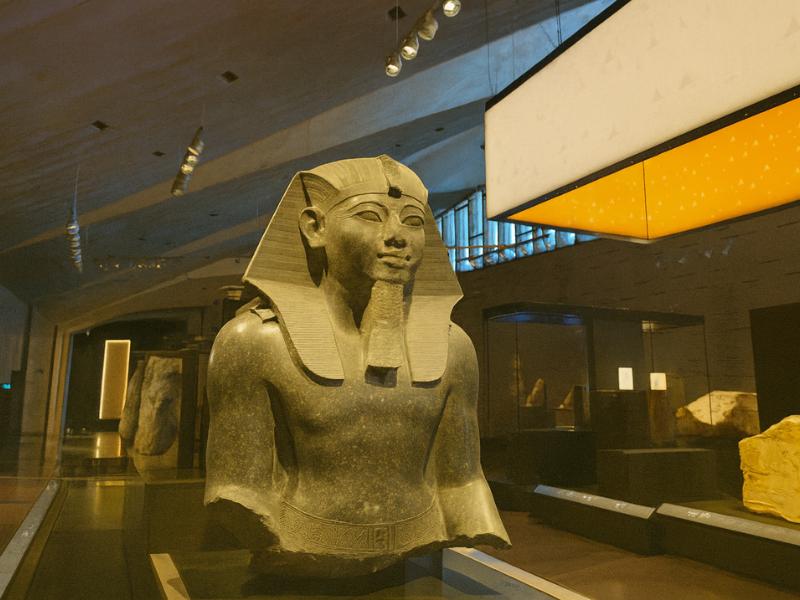
Beyond the gold and the shrines, Tutankhamun’s tomb contained the full equipment of a royal life: six ceremonial chariots, hunting bows and throw sticks, board games including Senet and Mehen, clothing and sandals with visible wear, cosmetic kits with residue still in the containers, furniture, beds, chairs, musical instruments, and food and wine. These objects are often the most revealing, and at GEM they finally have enough space to be displayed with real context.
The chariots are among the most underappreciated objects in the collection. Six of them were found in the antechamber, dismantled and stacked. The gold overlay is impressive, but what the GEM’s display adds is the restored harness panels. Carter found roughly 1,500 gold flakes under the chariots, boxed them up, and they sat in storage for nearly a century. In recent years, conservators reassembled those fragments into about 70 panels that once decorated the leather harnesses. The decoration shows Syrian plants, Aegean spiral motifs, and a range of imagery that tells you Tutankhamun was ruling at the center of a Bronze Age trading world where goods and artistic ideas moved across enormous distances. His burial equipment is partly a record of Egypt’s diplomatic connections at their peak.
The personal objects are the ones that shift something in visitors who take time with them. Sandals with wear patterns preserved. Linen tunics with stitching optimized for the Egyptian climate. A writing kit with a pen case and palette. Board games from a royal household. Cosmetic jars still holding residue. These are not objects made for a tomb. They were used. They were Tutankhamun’s things before they were artifacts.
The GEM’s display gives them breathing room that the old Tahrir layout never could. The cases are lit for detail, the labels explain what you’re actually looking at, and the positioning of objects next to each other tells you something about how they were found and why they matter together rather than as isolated pieces.
From Our Travelers: What They Noticed and What They Wished They’d Known
Based on feedback collected from travelers we’ve guided through the Tutankhamun galleries since the November 2025 opening, these are the patterns we see most consistently:
| Golden death mask | 50-65% | 35-50% | “Rushed because of a crowd building behind me” |
| Gold inner coffin | 45-60% | 40-55% | “Didn’t read about the rishi pattern before going” |
| Meteorite iron dagger | 30-45% | 55-70% | “Walked past it — no one pointed it out” |
| Chariot harness panels | 25-40% | 60-75% | “Didn’t know these were recovered fragments — thought they were decorative” |
| Personal objects (sandals, games, cosmetics) | 20-35% | 65-80% | “Got to them with ten minutes left” |
| Tomb-scale reproduction at the end | 40-55% | 45-60% | “Almost skipped it, thinking it was a replica” |
What New Discoveries Are Being Revealed for the First Time at GEM?
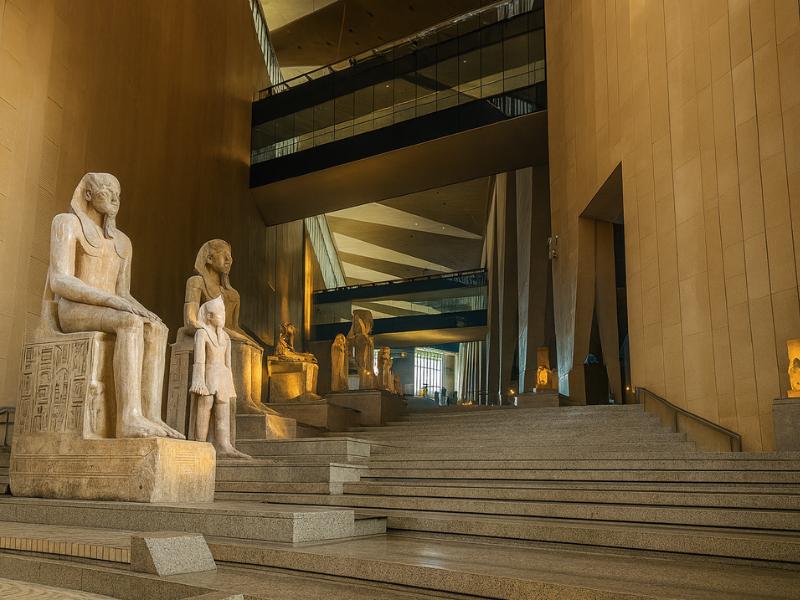
Several significant objects from Tutankhamun’s tomb have never been publicly displayed before GEM’s opening. These include the restored chariot harness panels reassembled from 1,500 loose gold flakes found under the chariots in 1922, never-before-exhibited objects from the tomb’s inner rooms, and a fresh look at the meteorite-iron dagger that most previous displays failed to contextualize properly. GEM also provides the first opportunity to see the full collection as an interconnected whole rather than individual highlights.
The dagger is worth its own discussion. Tutankhamun was buried with two daggers. The gold-bladed one gets mentioned in textbooks. The iron-bladed one is what should stop you in your tracks. Its blade contains more than 10% nickel and 0.58% cobalt, a composition that matches iron meteorites, not terrestrial iron ore. At the time of Tutankhamun’s death, around 1323 BC, iron smelting did not exist in Egypt. Iron was rarer than gold and used only for ritual, ceremonial, and diplomatic purposes. This blade was made from metal that fell from the sky.
The Amarna letters, diplomatic correspondence from the 14th century BC, mention an iron dagger in a gold sheath given as a royal wedding gift from the king of Mitanni to Tutankhamun’s grandfather, Amenhotep III. Many scholars believe the meteorite dagger passed from Amenhotep III to his heir and eventually to Tutankhamun as a family heirloom. It was found wrapped against his abdomen, closer to his body than any other object in the tomb. The ancient Egyptian phrase for iron, “iron of the sky,” appears in texts from around this period and suggests the Egyptians understood these rare metal objects had a celestial origin. The dagger at GEM has the full label context explaining all of this. At Tahrir, it was displayed like any other artifact.
The chariot harness panels are a different kind of revelation. Carter found roughly 1,500 gold flakes scattered under the chariots in the antechamber. He boxed them up and they sat in storage for nearly a century. In the years before GEM’s opening, conservators painstakingly pieced the fragments back together, reconstructing around 70 panels that once decorated the leather harnesses. The motifs include Syrian botanical patterns, Aegean spirals, and imagery from cultures far beyond the Nile Valley. Displayed together now, the harnesses are a physical record of Bronze Age diplomacy. Tutankhamun was buried in a chariot decorated with goods from the edges of the known world.
How Is the Tutankhamun Collection Displayed Differently at GEM vs. the Old Museum?
At the Egyptian Museum in Tahrir Square, Tutankhamun’s collection was spread across multiple rooms, partially in storage, and displayed with limited space and older labeling. At GEM, the complete 5,398-object collection occupies 7,000 square meters with custom climate control, modern lighting designed for each specific object, full conservation-quality cases, and a narrative flow that helps visitors understand the collection as a whole rather than as disconnected pieces.
| Objects on display | Approximately 1,800 (partial collection) | 5,398 (complete tomb assemblage) |
| Gallery space | Multiple rooms, cramped configuration | 7,000 sq meters across two dedicated halls |
| Climate control | Limited. No dedicated temperature/humidity system for Tut objects. | Purpose-built climate control for gold, wood, and fabric objects |
| Death mask | Standard case, mixed lighting, accessible from multiple angles | 40mm bulletproof glass, purpose-lit, near gallery entrance |
| Narrative structure | Objects displayed by room, minimal context between them | Dual-narrative layout (life of Tut / Carter’s discovery), both paths end at tomb reproduction |
| Previously unseen objects | Most of collection not publicly displayed | Hundreds of objects exhibited for the first time, including restored harness panels |
| Tomb reproduction | None | Full-scale tomb reproduction with chamber projections showing original configuration |
| Photography | Restricted, variable by room | Mobile phone still photos allowed. No cameras, no video. |
| Audio guide available | Limited | Yes. Arabic, English, Japanese. 100+ stops. No internet required. |
The practical difference is space. At Tahrir, the coffin room was famous for being overwhelming in the wrong way: too much gold in too little room, people pressed against the cases, lighting that bounced around and made things harder to read. At GEM, the same objects have room around them. You can walk around the outer coffin. You can see the rishi feather pattern from different angles. The canopic shrine stands in an area sized for it. This sounds like a small thing until you’re actually inside and you realize you can actually look at what you’re looking at.
What Should You Know Before Entering the Tutankhamun Galleries?
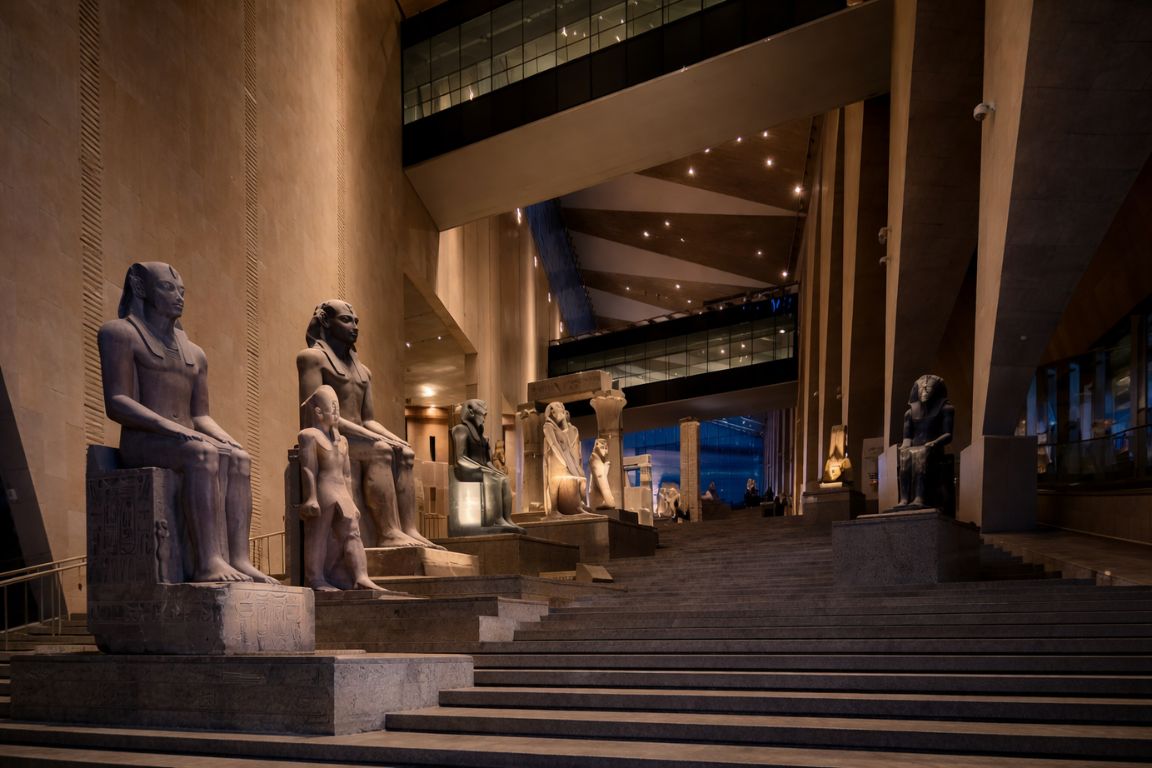 The Tutankhamun galleries are on the second floor, accessed after the Grand Staircase. Photography with a mobile phone is allowed for still images only, but cameras (including mirrorless and DSLRs), video recording, selfie sticks, tripods, and flash are all prohibited. The official audio guide covers 100+ stops and is worth renting. Budget at least two hours; three if you’re visiting without a guide. Do not arrive at the galleries with less than 90 minutes left before closing.
The photography rule catches people off guard more than anything else. The rest of GEM allows full camera use. The Tutankhamun galleries are the exception: mobile phone still photos only. Guards enforce it. If you bring a camera into the galleries and try to use it, it will be noticed. The reason is protection of the collection, not restriction for its own sake. Many of the objects that have spent three millennia in sealed conditions are sensitive to certain types of light and the conservation standards at GEM reflect that.
Want to get the planning right? This breakdown of how to visit the Grand Egyptian Museum covers all the details most visitors only figure out after they’ve already arrived and dealt with the chaos.
For most visitors, the mobile restriction doesn’t actually affect the experience. Phone cameras are capable of capturing real detail in good lighting, and the gallery lighting is designed to be photographable. What it does mean is that your phone is more important than usual. Make sure it’s charged before you enter the galleries.
The audio guide is 100 stops, which sounds like a lot, but the Tutankhamun section has more of them than any other part of the museum. It covers the death mask, the coffins, the shrines, the chariots, the dagger, and a range of smaller objects that would otherwise need a lot of label reading to appreciate. It’s available in Arabic, English, and Japanese, runs on a portable device with headphones, and requires no internet connection. If you’re visiting independently rather than with a guide, it’s genuinely worth the rental cost.
One more thing that matters more than most visitor guides mention: do not skip the tomb reproduction at the end of the galleries. It’s easy to assume it’s decorative, a mock-up, and keep moving toward the exit. It’s not decorative. It’s a full-scale model with projections showing exactly how each chamber was arranged before Carter opened it. Standing inside it and looking at the projections of the antechamber packed floor to ceiling with 3,000-year-old objects is the moment when the scale of what was found stops being a number and starts being real. Every group we take through the Tutankhamun galleries, Omar ends there for a reason.
We’ve broken down guided vs non-guided tickets in Grand Egyptian Museum so you can figure out which makes sense – the place is huge and context matters for Egyptian history.
Frequently Asked Questions
Is Tutankhamun’s mummy at the Grand Egyptian Museum?
No. Tutankhamun’s mummy remains in his tomb in the Valley of the Kings at Luxor. It has not been moved to GEM and there are no current plans to move it. The collection at GEM is the 5,398 objects from his tomb, not his physical remains.
Can I take photos in the Tutankhamun galleries?
Mobile phone still photography is allowed. Cameras (DSLR, mirrorless, compact), video recording, flash, tripods, selfie sticks, and external lighting are all prohibited in the Tutankhamun galleries specifically. The rest of GEM allows full camera use. This rule is enforced by gallery staff.
How long should I spend in the Tutankhamun galleries?
Budget a minimum of two hours. Three hours if you want to work through the collection methodically. First-time visitors who arrive with less than 90 minutes before closing consistently report feeling rushed. The galleries are on the second floor and a standard guided tour covering the Tutankhamun halls takes approximately two hours.
What is the most important object to see in the Tutankhamun collection?
The golden death mask is the centerpiece, but “most important” depends on what you’re interested in. The solid gold inner coffin, the meteorite-iron dagger, the canopic shrine with its four goddess protectors, and the restored chariot harness panels are all significant for different reasons. Omar always tells travelers to see the mask first, then the dagger, then give the rest of the time to the coffins and shrines.
Were all 5,398 objects actually found in Tutankhamun’s tomb?
Yes. All 5,398 objects in the GEM collection were discovered by Howard Carter and his team during the excavation of tomb KV62 in the Valley of the Kings between 1922 and 1932. The count is precise because Carter documented every single object as it was removed. Many were in pieces and required conservation work before they could be displayed.
What is the meteorite dagger and why does it matter?
One of the two daggers found with Tutankhamun’s mummy has an iron blade with more than 10% nickel content, consistent with meteorite iron rather than smelted terrestrial iron. At the time of his death (approximately 1323 BC), iron smelting did not exist in Egypt. The dagger may have originated as a diplomatic gift to Tutankhamun’s grandfather from the king of Mitanni, passed down as a royal heirloom. Ancient Egyptians described all iron as “iron of the sky.” This dagger lived up to that description literally.
Ready to See the Collection in Person?
Written by Omar Khalil
Egyptian tour guide since 2013 · Founder, The Grand Egyptian Museum Tickets
Omar has guided over 7,200 travelers through the Grand Egyptian Museum and Cairo’s ancient sites since founding the agency.