What to See at the Grand Egyptian Museum
Inside the Grand Egyptian Museum: 100,000+ artifacts, Tutankhamun’s full collection, the Khufu Solar Boat, and colossal statues - here’s what to prioritize.
Keep your museum route independent, or add a private guide and hotel pickup if they serve your day.
GEM at a Glance: What’s Inside
| Tutankhamun Galleries (2 halls) | Golden death mask, gold coffin, chariots, canopic jars, 5,398 objects total | 60 to 90 min | Essential |
| Grand Hall and Grand Staircase | Ramses II statue (11m, 83 tons), 60+ colossal pharaoh statues, Pyramid views from top | 30 to 45 min | Essential |
| Khufu’s Boats Museum | First solar boat (142 ft, intact), live restoration of second boat | 30 to 45 min | Essential |
| Main Exhibition Halls (12 total) | Prehistoric to Greco-Roman era, organized by period and theme | 60 to 180 min | High (selective) |
| Hanging Obelisk (exterior) | World’s only suspended obelisk, Ramesses II cartouche on underside | 10 min | Worth a look |
| Children’s Museum | Interactive AR/VR exhibits for ages 6 to 12 | 30 to 60 min | Families only |
Exhibit information verified March 2026. Ticket purchase required via visit-gem.com. All tickets online only, no walk-up sales.
What Are the Must-See Exhibits at the Grand Egyptian Museum?
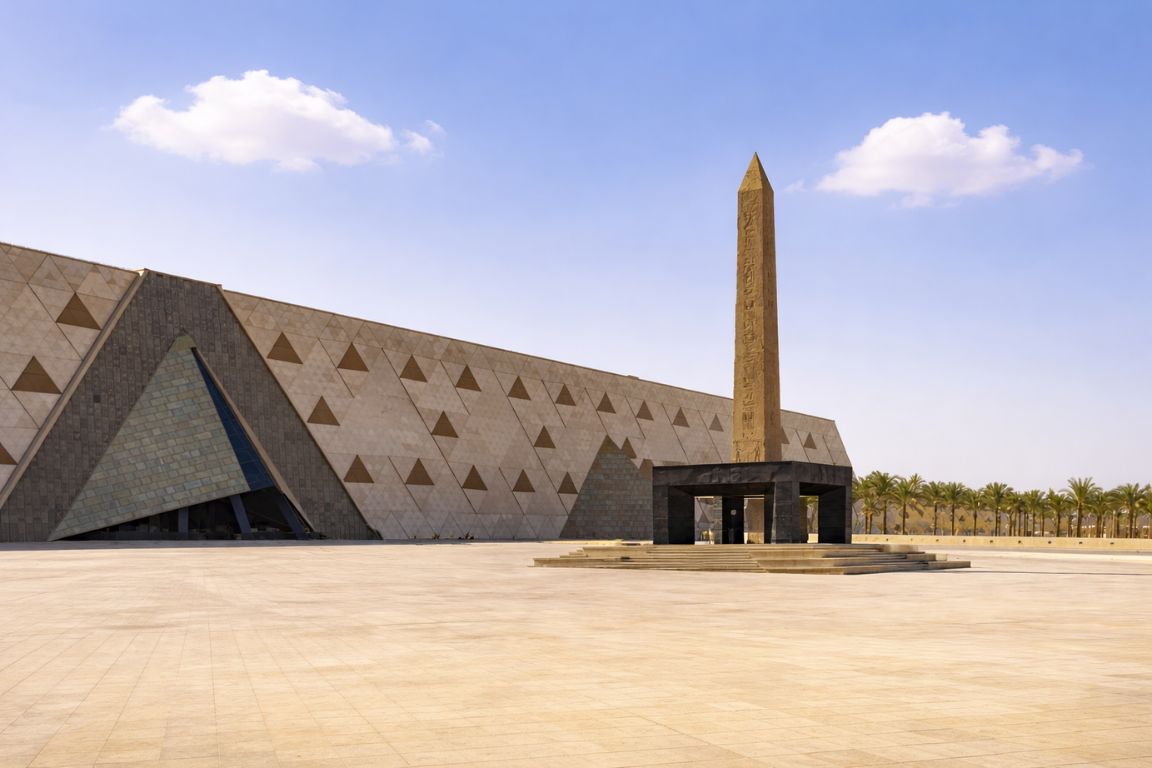 Three sections define the GEM visit for most travelers: the Tutankhamun galleries, the Grand Staircase and Grand Hall, and Khufu’s Boats Museum. Everything else, all twelve main exhibition halls and the Children’s Museum, builds on these three anchors. A visitor who sees only these core sections and nothing else has not missed GEM. A visitor who skips them for the chronological galleries has missed the point entirely.
There is a pattern Omar has noticed across thousands of guided visits. People arrive at GEM having read that it holds 100,000 artifacts, and something about that number makes them want to see all of it. They scatter. They spend forty minutes on a gallery of Old Kingdom pottery and then rush through the Tutankhamun rooms because they’ve run out of time. The number is impressive. The approach it inspires is usually the wrong one.
GEM rewards focus. The building is large enough that the artifacts you run past still get lost. Better to see three sections well than twelve sections badly. What follows is an honest account of what each major section actually delivers, what makes certain artifacts worth pausing for, and what can genuinely be deprioritized without loss.
If you want a guide who knows which rooms to enter first and which panels to skip, a private GEM Egyptologist visit with hotel transfers puts someone with you in the rooms this page treats as essential. A private GEM Egyptologist visit with hotel transfers handles the route so you handle the experience.
If you need a priority list, here are the top 10 must-see artifacts in Grand Egyptian Museum based on historical significance, visual impact, and what everyone regrets missing.
What Is Inside the Tutankhamun Galleries at GEM?
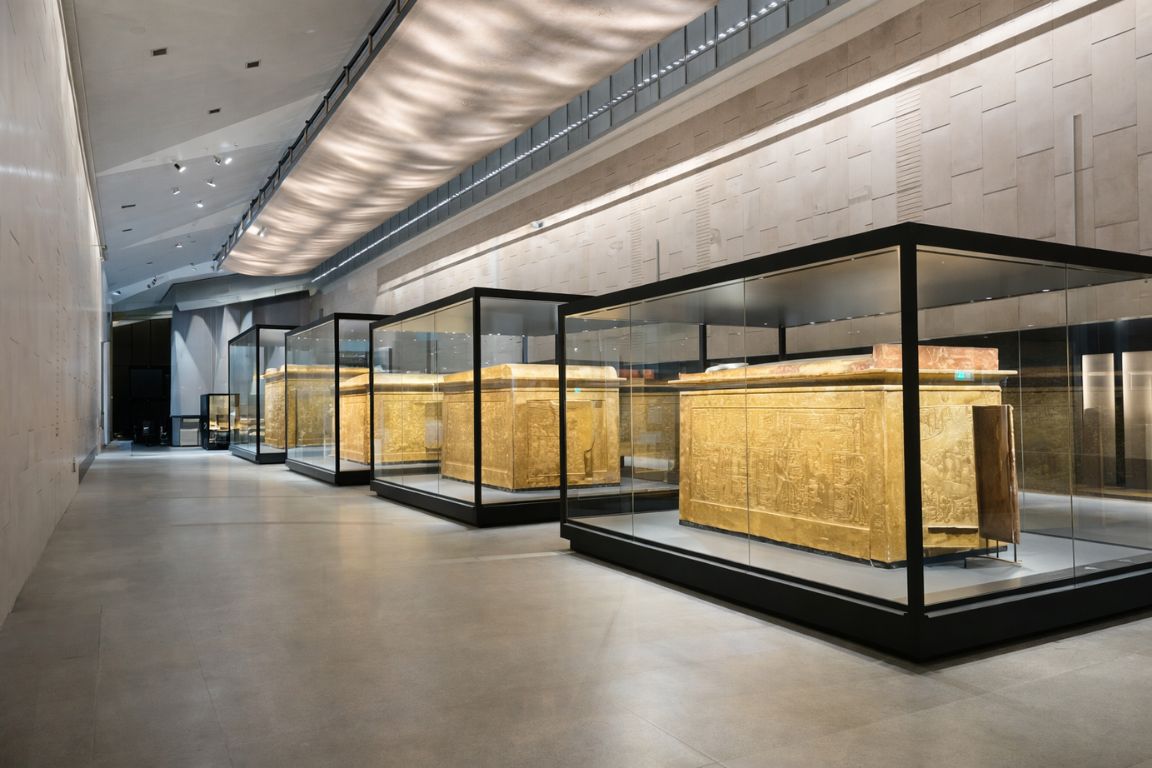 The Tutankhamun galleries hold all 5,398 objects from the 1922 discovery of Tomb KV62, displayed together for the first time in history. The centerpiece is the golden death mask. But the full scope of what surrounds it, chariots, shrines, a 110-kilogram solid gold coffin, canopic jars, weapons, beds, and over 400 ushabti figurines, is what actually overwhelms people. Two dedicated halls cover 7,000 square meters. Budget 60 to 90 minutes here.
Most visitors have seen photographs of the death mask before arriving. Almost none of them are prepared for the experience of being in the same room with it. The photographs never get the scale right. They don’t show how the gold reads under proper lighting, or the level of detail in the inlaid glass and lapis lazuli at the eyes. Omar has guided thousands of people into that room. The ones who rush in expecting a quick photo are the ones who leave most unsatisfied. The ones who stand still for a few minutes, just looking, walk out changed.
Beyond the mask, the exhibits that consistently surprise people are the chariots. Two of them are on display, elaborately gilded and surprisingly preserved. Tutankhamun was buried with six chariots total, and the question of whether he died in battle aboard one has been reopened by recent analysis. Standing next to a vehicle built 3,300 years ago that may have been functional raises different questions than a glass case of jewelry does.
There is one object that gets far less attention than it deserves: a dagger with an iron blade. The handle is ornately decorated in gold. The blade is what matters. Iron was extraordinarily rare in ancient Egypt at the time. New elemental analysis confirmed the blade was smelted from meteorite iron, not terrestrial ore. A king buried with a weapon forged from a fallen star. The GEM gives it proper display. Most visitors walk past it on the way to the mask.
One photography rule applies here that catches people off guard: video recording is not permitted in the Tutankhamun galleries. Still mobile photography is allowed. Cameras and professional equipment are restricted. Know this before you walk in. Staff enforce it firmly, and being corrected mid-visit breaks the rhythm of what should be the best hour of the museum.
We’ve covered the King Tutankhamun collection at the Grand Egyptian Museum in detail because it’s the world’s most complete pharaonic collection and the museum’s biggest draw.
What Makes the Grand Staircase and Grand Hall Worth Your Time?
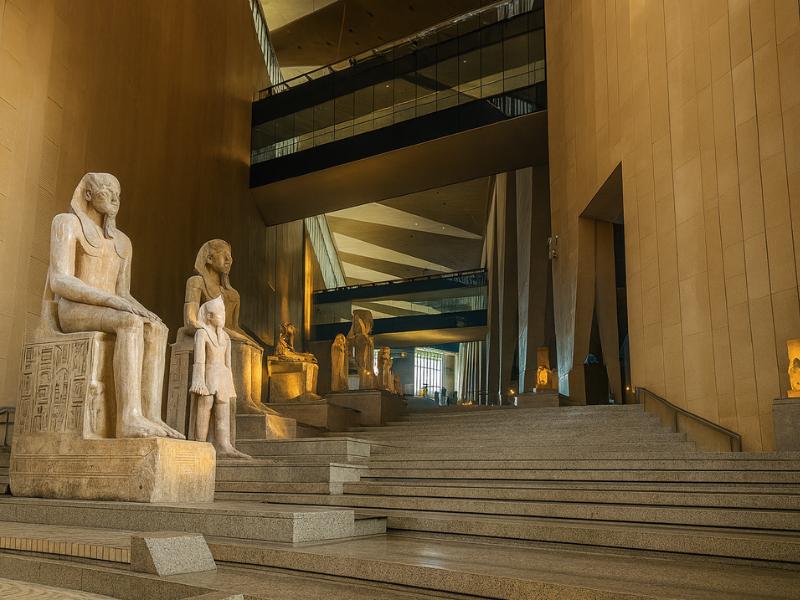
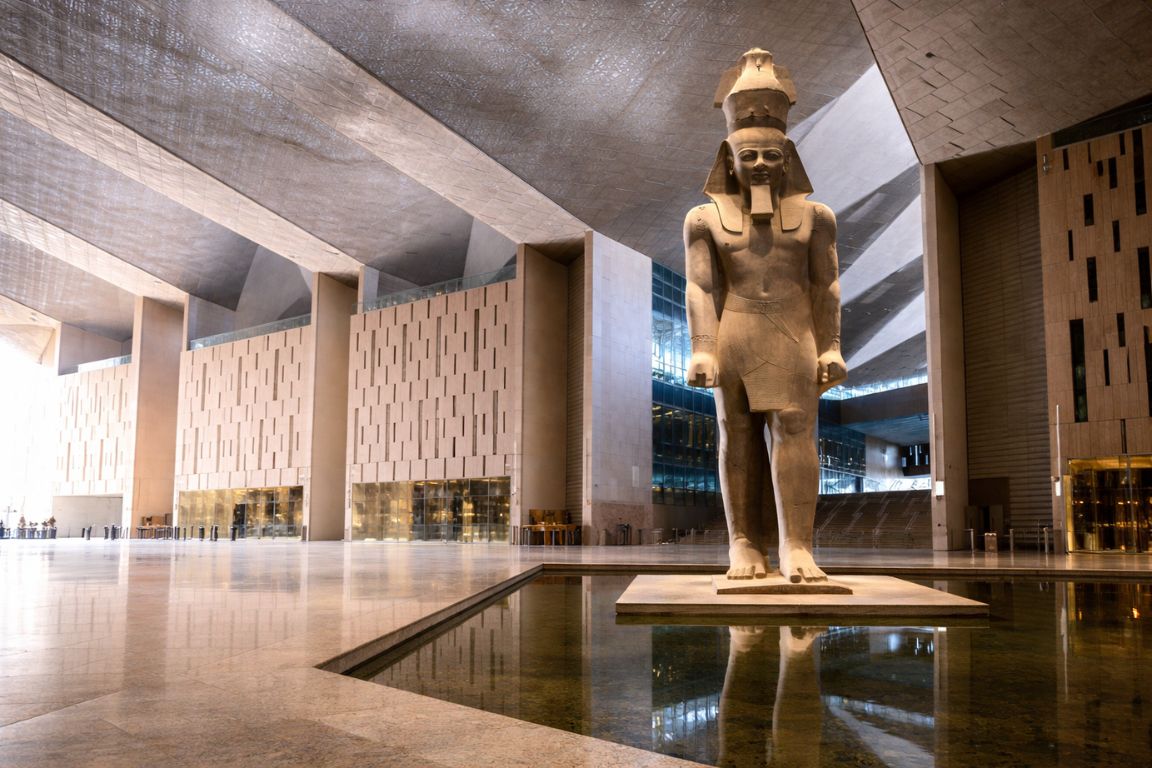
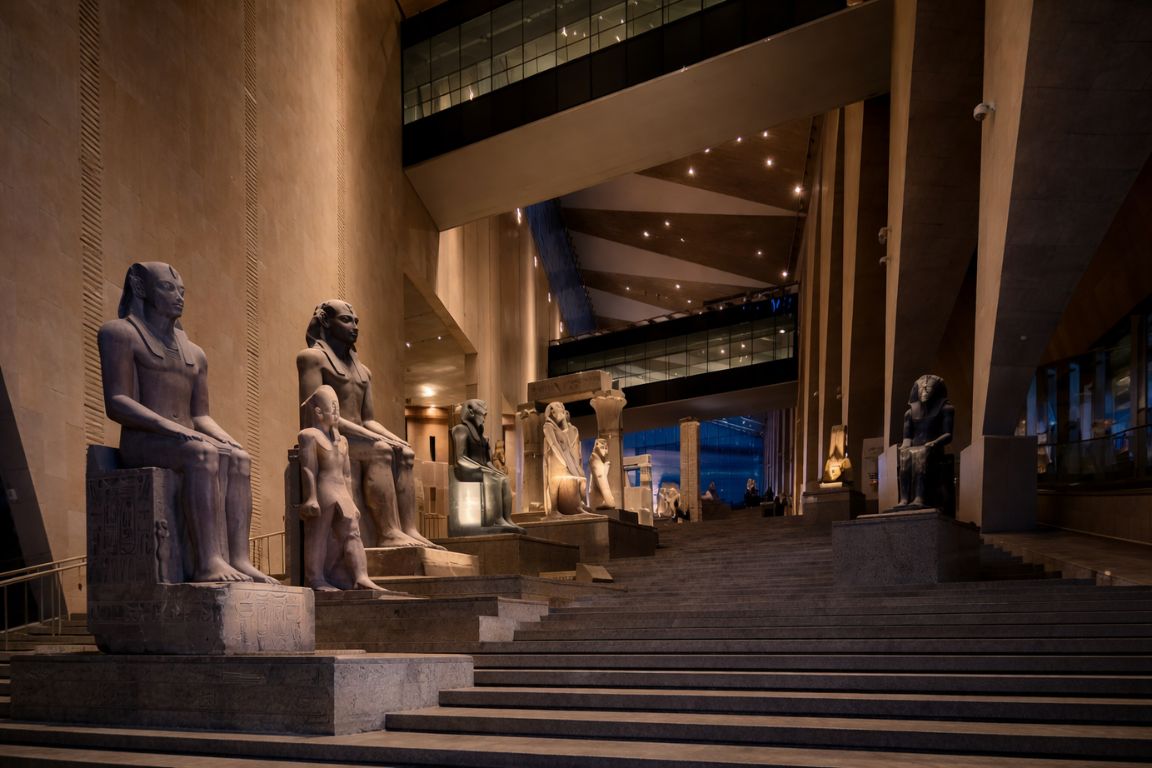 The Grand Hall and Grand Staircase are GEM’s architectural prologue. The Grand Hall houses the 11-meter Ramses II statue and 20 to 30 large artifacts from across Egypt’s dynasties, including the Ptolemaic colossi recovered from the submerged city of Heracleion. The Grand Staircase lines both sides with more than 60 colossal statues and royal monuments, culminating at the top in a panoramic view of the three Giza Pyramids through glass. Allow 30 to 45 minutes.
The Ramses II statue is the first thing you see inside the building. Eleven meters tall. Eighty-three tons of red granite. It was moved from Ramses Square in Cairo in 2006 and spent years in storage before being installed in the Grand Hall in 2018. The statue dates to around 1280 BCE. At Ramses Square, it sat at street level surrounded by traffic. Here it sits elevated in a glass atrium where light falls across it from above. They’re different experiences of the same object.
What fewer visitors notice in the Grand Hall: two Ptolemaic colossi, each about five meters tall, recovered from Thonis-Heracleion. This was an ancient port city that sank into the Mediterranean roughly 1,200 years ago. Egyptian and French archaeologists have been excavating it underwater since the 1990s. These statues spent over a thousand years at the bottom of the sea before restoration. They now stand in permanent dry display less than two kilometers from the Giza Pyramids. The story behind them is genuinely extraordinary, and most visitors walk past without knowing it.
If you’re torn between the two, here’s our honest comparison of Grand Egyptian Museum vs Pyramids of Giza based on what each delivers and how much time you need.
The Grand Staircase is worth taking slowly. It runs the full height of the building and is lined on both sides with royal statuary spanning Egypt’s major dynasties. Ten statues of Senusret I alone. Colossal heads of Akhenaten, the heretic king who briefly abolished Egypt’s entire pantheon of gods. Seated Ramessides. The escalator runs alongside the stairs if the climb is too much. At the top, the Pyramid view through the glass facade is the most photographed moment in the building. Take it. It’s earned.
The Hanging Obelisk at the entrance deserves a mention before you go inside. It’s the world’s only suspended obelisk, lifted off the ground so its base is exposed. The reason matters: the cartouche of Ramesses II is carved on the underside of the base, a signature placed somewhere no one was ever supposed to see. Turned upside down after 3,500 years and lifted into the air, that hidden inscription is now visible for the first time. Walk beneath it and look up.
What Is Khufu’s Boats Museum and Why Does It Matter?
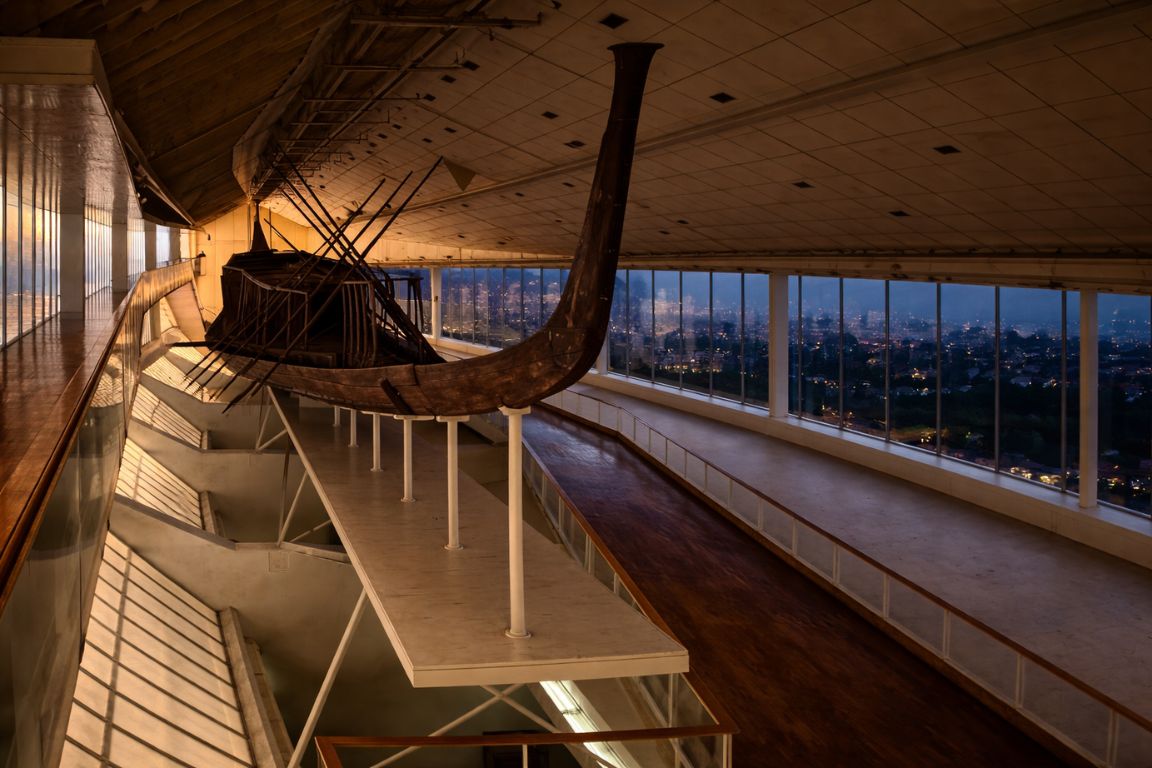 Khufu’s Boats Museum is a separate building within the GEM complex, dedicated to the two solar boats buried beside the Great Pyramid around 2500 BCE. The first boat, 43.4 meters long, is the world’s oldest intact ship. It is fully restored and on display. The second boat, discovered in the same pit in 1954 but left sealed until 2021, is currently being reassembled in front of visitors in a live restoration that could take several more years to complete. Nothing like this exists anywhere else.
The first boat was found disassembled into 1,224 pieces of cedar wood in a sealed limestone pit beside the Great Pyramid in 1954. The cedar still held its scent when excavators opened the pit. Restoring it took fourteen years of work. The result, a vessel built without a single metal nail, held together by rope and wooden pegs, is now suspended in the Khufu Boats Hall for visitors to walk around at multiple levels. It is 142 feet long and 19 feet wide. It has five pairs of oars and two steering oars. It has been described as a masterpiece of woodcraft precise enough that it could still sail today if placed on water.
Whether it was ever actually used on water is genuinely debated. There is evidence suggesting it was, including mud found on its hull planks. But there’s also the question of why a seaworthy vessel would be disassembled and buried beside a pyramid. The most widely held interpretation is that it was a ritual barque, built to carry the king’s soul into the afterlife alongside the sun god Ra. The museum doesn’t resolve this debate. It presents both interpretations, which is actually more interesting.
The second boat is the part that no other museum can replicate. The restoration process is happening right now, in front of visitors, on a viewing platform inside the hall. Egyptian and Japanese conservators are piecing together 1,650 wooden fragments extracted from a second sealed pit. The work is expected to continue for three to five more years. Visitors who come today will see something different from visitors who came six months ago, and different again from visitors who come next year. This is live archaeology, not recreation. The second boat, when complete, will stand beside the first. Two 4,500-year-old ships. No other museum in the world has one.
What Will You Find in the Main Exhibition Halls?
GEM’s 12 main galleries trace Egyptian civilization from prehistory through the Greco-Roman period across three organizing themes: Society, Kingship, and Beliefs. The halls are divided into four broad time periods. The Old Kingdom and New Kingdom galleries contain the densest concentration of significant artifacts. The Predynastic and Late Period halls are thinner and can be covered quickly. For most visitors with limited time, focusing on the New Kingdom galleries is the highest-value use of time in this section of the museum.
The layout sounds more complex than it is inside the building. GEM’s wayfinding is clear, with maps at regular intervals. The galleries flow chronologically, so if you enter at one end and move through, you’re moving through Egyptian history in sequence from its earliest evidence to the Roman period. The building descends from the Pyramid-level plateau at the entrance down toward the Nile valley as you go deeper. The architecture is doing the same work as the chronology.
A few specific halls are worth singling out. The New Kingdom galleries are the richest. This is Egypt’s golden age, the period of Tutankhamun, Ramses II, and Hatshepsut, and the artifacts from this era are the most numerous and the most visually striking. The Old Kingdom section has impressive monumental statuary but fewer objects overall. The Greco-Roman galleries at the far end tend to get skipped by visitors who are running low on time. They’re worth at least a pass-through if you have the energy, because the artifacts in these halls document the moment when Egyptian, Greek, and Roman visual cultures collided and merged in genuinely strange ways.
One section of the main galleries that consistently surprises visitors: the display of items that have never been publicly shown before. GEM opened with roughly 20,000 artifacts on display for the first time. Some of these are in dedicated cases marked as first exhibitions. Most visitors don’t notice them because they’re not labeled in an attention-grabbing way. A guide or audio guide is genuinely useful here, not because the content is inaccessible without one, but because knowing which objects you’re looking at for the first time in human history changes the experience.
How Do You Plan Your Route Through GEM Without Getting Lost?
 The most efficient route for a first-time visitor: enter the Grand Hall, walk past the Ramses II statue, go directly to the Tutankhamun galleries before other groups arrive. Spend 60 to 90 minutes there. Exit and go to Khufu’s Boats Museum while the main galleries are filling up. Return to the Grand Staircase and the main exhibition halls after the first wave of visitors has moved through. Finish at the Pyramid-view level of the Staircase before you leave. This route puts the most crowded sections at the beginning when they’re quietest.
| 9:00 AM entry | Brief stop at Grand Hall (Ramses II statue), then straight to Tutankhamun galleries | Tutankhamun rooms are emptiest in the first hour; tour groups catch up by 10:30 |
| 10:30 AM | Khufu’s Boats Museum | Separate building, less affected by crowd surges; second boat restoration is best seen without crowds |
| 11:30 AM | Grand Staircase, full ascent | Groups that arrived early are now in the main galleries; the staircase clears somewhat |
| 12:15 PM | Main exhibition halls (New Kingdom priority) | Start with the densest galleries while you have energy |
| 1:30 PM | Lunch break at museum cafe | Midday is peak crowd time anyway; taking a break here loses less than it costs |
| 2:15 PM | Remaining galleries or revisit favorite sections | Afternoon crowd is lighter as tour groups complete their visits |
Route based on observed visitor flow patterns from our 2025 guide operations. Adjust based on your available time and physical pace.
Two practical notes on the building’s physical reality. First, the distances are genuinely large. Walking from the entrance to the far end of the main galleries and back is several kilometers of movement. Comfortable shoes are not a suggestion. Second, the escalators run alongside the Grand Staircase for the full height of the building. There is no shame in using them. The statues are visible from the escalator. The view at the top is the same. Use them on the way up and walk down if you want to read the exhibit labels properly.
If you’re trying to figure out the details, here’s how to visit the Grand Egyptian Museum so you don’t waste time at this brand-new attraction that’s still getting organized.
What Can Families and First-Time Visitors Skip Without Missing Much?
 Visitors with three hours or less can skip the Predynastic and Early Dynastic galleries, the Late Period galleries, and most of the Greco-Roman halls without losing anything central to the GEM experience. The Children’s Museum is purpose-built for ages 6 to 12 and is worth the time for families, but it does not contain significant ancient artifacts. First-time visitors on a tight schedule should treat the main exhibition halls as supplementary to the three core sections, not as equal priorities.
This is the section most travel writers avoid writing. Nobody wants to tell you what to skip at a museum that took twenty years and over a billion dollars to build. But the reality is that GEM is too large to do thoroughly in one visit, and the traveler who tries to see all twelve galleries equally almost always leaves feeling they didn’t see any of them well.
The Predynastic galleries have important artifacts from Egypt’s earliest history, the period before the pharaohs, but they’re thin compared to the dynastic periods and the objects are often less visually immediate. If you have the time and the curiosity, they’re worth visiting. If you don’t, they’re the easiest cut to make.
The Late Period and Greco-Roman halls at the far end of the museum get the fewest visitors and the least attention from tour guides. Some of the artifacts there are fascinating, including the documentation of Alexander the Great’s incorporation of Egyptian religious symbolism. But first-time visitors running behind schedule should know that skipping these halls loses the least of what makes GEM exceptional.
The Children’s Museum is genuinely well done. It covers 5,000 square meters and uses augmented reality, interactive screens, and hands-on activities. Children aged 6 to 12 engage with it in a way they don’t engage with the main galleries, which are display-only. For families, it’s worth building into the schedule. For adults traveling without children, it’s the easiest skip in the building.
If you’re planning a family visit, here’s the honest take on visiting Grand Egyptian Museum with kids based on what actually keeps them engaged and when they hit the wall.
How Does GEM Compare to the Egyptian Museum in Tahrir Square?
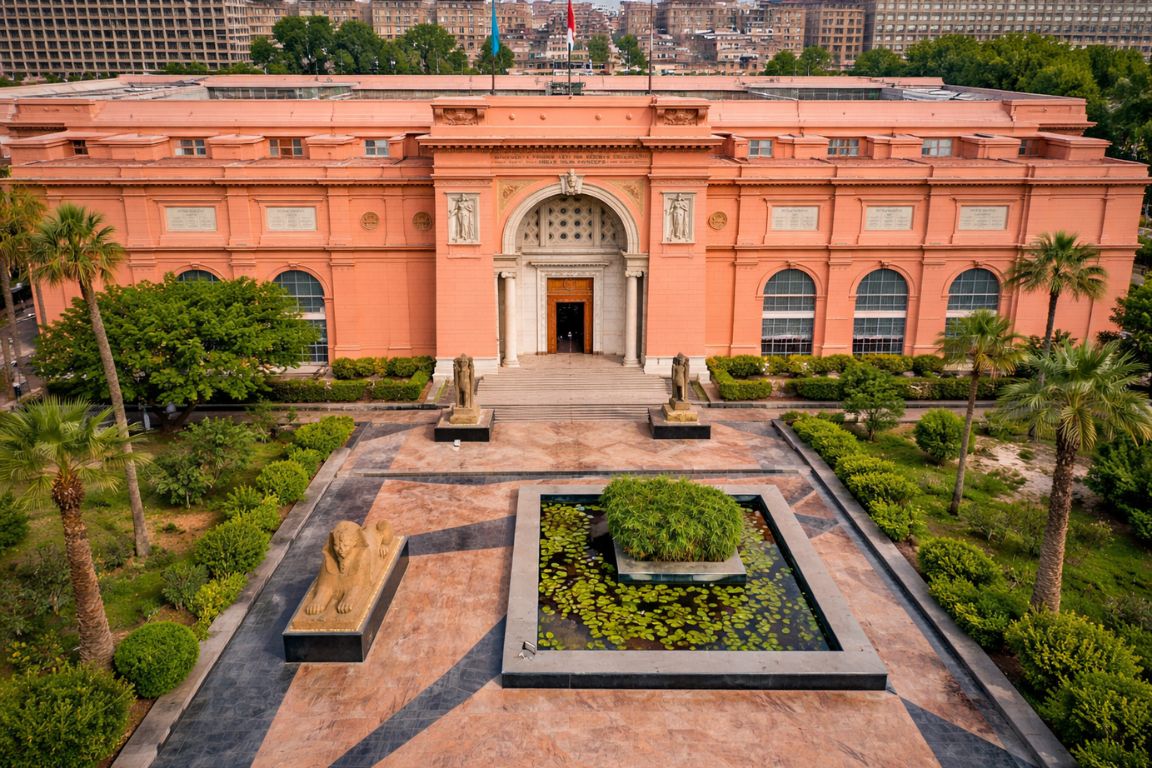 GEM and the Egyptian Museum in Tahrir Square are not competitors for the same visit. They hold different collections now, tell different stories, and offer fundamentally different atmospheres. GEM has the complete Tutankhamun collection, Khufu’s boats, and modern display conditions. Tahrir has the Narmer Palette, the Yuya and Thuya tomb treasures, Old Kingdom statuary that did not transfer, and a century-old atmosphere that GEM cannot replicate. If you can visit both, visit both. If you can visit only one, the decision depends entirely on what you’re looking for.
| Tutankhamun collection | Complete: all 5,398 objects | Selected pieces remain during transition |
| Khufu’s Boats | Both boats, first fully restored, second being assembled live | Not present |
| Royal Mummies | Not at GEM (moved to National Museum of Egyptian Civilization) | Not at Tahrir (moved to NMEC) |
| Narmer Palette | Not present | Present at Tahrir |
| Air conditioning | Fully climate-controlled | Not air-conditioned |
| Location | Giza, 2 km from Pyramids | Tahrir Square, central Cairo |
| Atmosphere | Modern, monumental, designed for scale | 1902 neoclassical building, dense, historic |
| Ticket price (foreign adult) | 1,450 EGP (~$30 USD). Verified March 2026 | Lower; check egyptianmuseumcairo.eg for current price |
The honest version of this comparison: GEM wins on breadth, condition, and the Tutankhamun collection. Tahrir wins on atmosphere and certain specific objects that did not transfer. A visitor who has never been to either should go to GEM first. A repeat visitor who saw Tahrir a decade ago will find GEM dramatically different and the old museum still worth returning to for what it retained.
One thing the comparison tables never capture: Tahrir has a texture that GEM cannot replicate. The artifacts are close. The light is imperfect. The crowd patterns are different. Some travelers have described it as feeling more intimate, as if the objects were less protected from you. GEM is spectacular. Tahrir is peculiar and irreplaceable. They’re both worth your time if Cairo gives it to you.
What Our Travelers Prioritized: Section Time Allocation
Based on feedback from our 2025 and early 2026 client groups at The Grand Egyptian Museum Tickets, here is how visitors actually distributed their time across GEM’s main sections.
| Tutankhamun galleries | 96% | Rushed through due to arriving late in the day |
| Khufu’s Boats Museum | 81% | Did not realize it was a separate building; almost missed it |
| Grand Staircase | 78% | Went too fast, missed individual statue labels |
| Main exhibition halls | 54% | Spent too long here early and had no energy left for Tutankhamun |
| Hanging Obelisk (exterior) | 34% | Did not know to look at the underside; missed the cartouche |
Frequently Asked Questions
What is the most important thing to see at the Grand Egyptian Museum?
The Tutankhamun galleries. All 5,398 objects from the tomb of Tutankhamun are displayed together for the first time in history, including the golden death mask. No other institution in the world holds this collection complete. Start here.
Is the Khufu Solar Boat at the Grand Egyptian Museum or the Pyramids?
Both boats are now at GEM’s Khufu Boats Museum, which is a separate building within the GEM complex. The first boat, fully restored, has been at GEM since 2021. The second boat is currently being assembled live in front of visitors, a process that may take several more years to complete. Neither boat is at the Giza Pyramid complex any longer.
Does GEM have the Tutankhamun golden mask?
Yes. The golden death mask of Tutankhamun was transferred from the Egyptian Museum in Tahrir Square and is now permanently displayed in GEM’s Tutankhamun galleries. It is the centerpiece of the two-hall Tutankhamun section.
How many artifacts are in the Grand Egyptian Museum?
Over 100,000 artifacts are housed at GEM, distributed across 12 main permanent galleries, the two-hall Tutankhamun collection, and the Khufu Boats Museum. Approximately 20,000 of these were displayed publicly for the first time at GEM’s opening.
Is it worth visiting both GEM and the Egyptian Museum in Tahrir Square?
Yes, if your schedule allows it. They hold different collections. GEM has the complete Tutankhamun treasures, Khufu’s boats, and monumental statuary in modern conditions. Tahrir retains the Narmer Palette, the Yuya and Thuya tomb treasures, and significant Old Kingdom pieces in a historic 1902 building. They tell different parts of the same story. Note: the Royal Mummies are at neither museum. They moved to the National Museum of Egyptian Civilization (NMEC).
Can you take photos at the Grand Egyptian Museum?
Personal photography and video with mobile phones and cameras is permitted throughout most of the museum. The exception is the Tutankhamun galleries, where only mobile still photography is allowed. No video, no camera equipment, no flash, tripods, selfie sticks, or drones anywhere in the museum. Live streaming is prohibited.
Omar and the team at The Grand Egyptian Museum Tickets have been running groups through this building since the soft opening in 2024; check the 4-hour visit with hotel pickup if you want that guided format. We know the rooms, the route, and the artifacts that reward time. Questions before you book? private Pyramids and GEM tour (choose your inclusions).
Written by Omar Khalil
Egyptian tour guide since 2013 · Founder, The Grand Egyptian Museum Tickets
Omar has guided over 7,200 travelers through the Grand Egyptian Museum and Cairo’s ancient sites since founding the agency.