Top 10 Must-See Artifacts in GEM
Top 10 must-see treasures at the Grand Egyptian Museum - from Tutankhamun’s golden mask to Khufu’s Solar Boat. Here’s what most visitors miss.
Keep your museum route independent, or add a private guide and hotel pickup if they serve your day.
| # | Artifact | Location in GEM | Age | Why It’s Unmissable |
|---|---|---|---|---|
| 1 | Golden Death Mask | Tutankhamun Galleries | ~3,300 years | Most recognized object in human history; 10.23 kg solid gold |
| 2 | Solid Gold Coffin | Tutankhamun Galleries | ~3,300 years | 110 kg solid gold; all three nested coffins together for first time |
| 3 | Golden Throne | Tutankhamun Galleries | ~3,300 years | Only surviving royal throne; uniquely intimate scene of king and queen |
| 4 | Meteorite Iron Dagger | Tutankhamun Galleries | ~3,300 years | Iron blade confirmed from a fallen meteorite; rarer than gold at the time |
| 5 | Colossal Ramses II Statue | Grand Hall Atrium | ~3,200 years | 11 meters, 83 tons; red granite; the first artifact to enter GEM in 2018 |
| 6 | Hanging Obelisk of Ramses II | Exterior Atrium (before entrance) | ~3,200 years | World’s only suspended obelisk; cartouche hidden for 3,500+ years now visible |
| 7 | Grand Staircase Colossi | Grand Staircase | Varies (Old Kingdom to Greco-Roman) | 60+ statues including 10 Senusret I, Akhenaten head, Hatshepsut |
| 8 | Khufu’s Solar Boat (Boat 1) | Solar Boats Hall | ~4,500 years | 43.6 meters; oldest intact ship on earth; 1,224 cedar pieces; no nails |
| 9 | Heracleion Colossi | Grand Hall | Ptolemaic period (~3rd-2nd c. BCE) | Raised from submerged lost city; only Ptolemaic colossi of their kind |
| 10 | Khufu Boat 2 (Live Restoration) | Solar Boats Hall | ~4,500 years | 1,650 fragments being reassembled live; the only restoration of this kind open to visitors worldwide |
What Are the Top 10 Must-See Artifacts in the Grand Egyptian Museum?
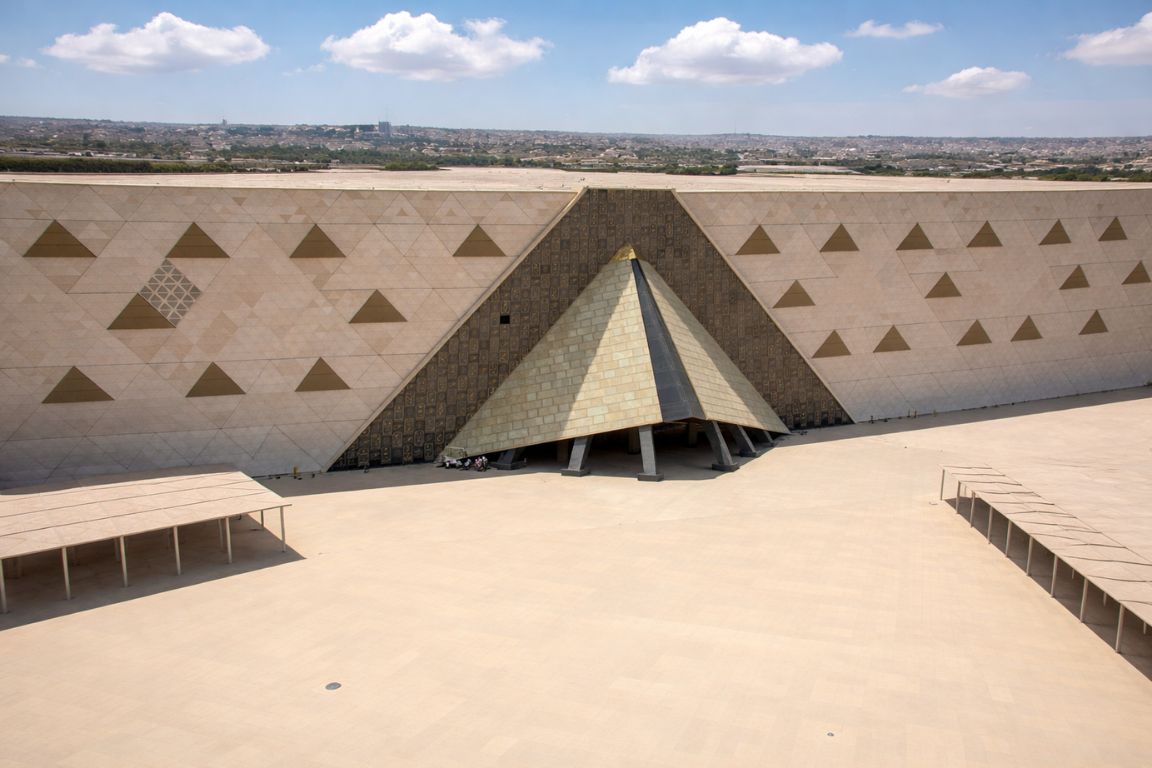 The Grand Egyptian Museum’s ten most important artifacts span 4,500 years and cover four separate areas of the museum. Six come from Tutankhamun’s tomb alone. The others are spread across the Grand Hall atrium, the exterior obelisk plaza, the Grand Staircase, and the Solar Boats Hall. Plan to visit in order: obelisk first (before you enter), then the atrium, then the staircase, then the main galleries including Tutankhamun, then the solar boats last.
There’s a reason we built this list around ten rather than five or twenty. Five is too short to do justice to a museum this size. Twenty becomes a checklist that you speed through without stopping. Ten gives you a genuine itinerary, one where you can slow down at each stop, understand what you’re actually looking at, and still get through the museum in a single day without feeling like you left something important behind.
Some of these you’ve heard of. Some you probably haven’t. Let’s work through all of them.
Need a priority list? Our guide on what to see at the Grand Egyptian Museum covers the unmissable exhibits and what you can skip if you’re short on time or energy.
Why Is the Golden Death Mask of Tutankhamun the Most Famous Artifact at GEM?
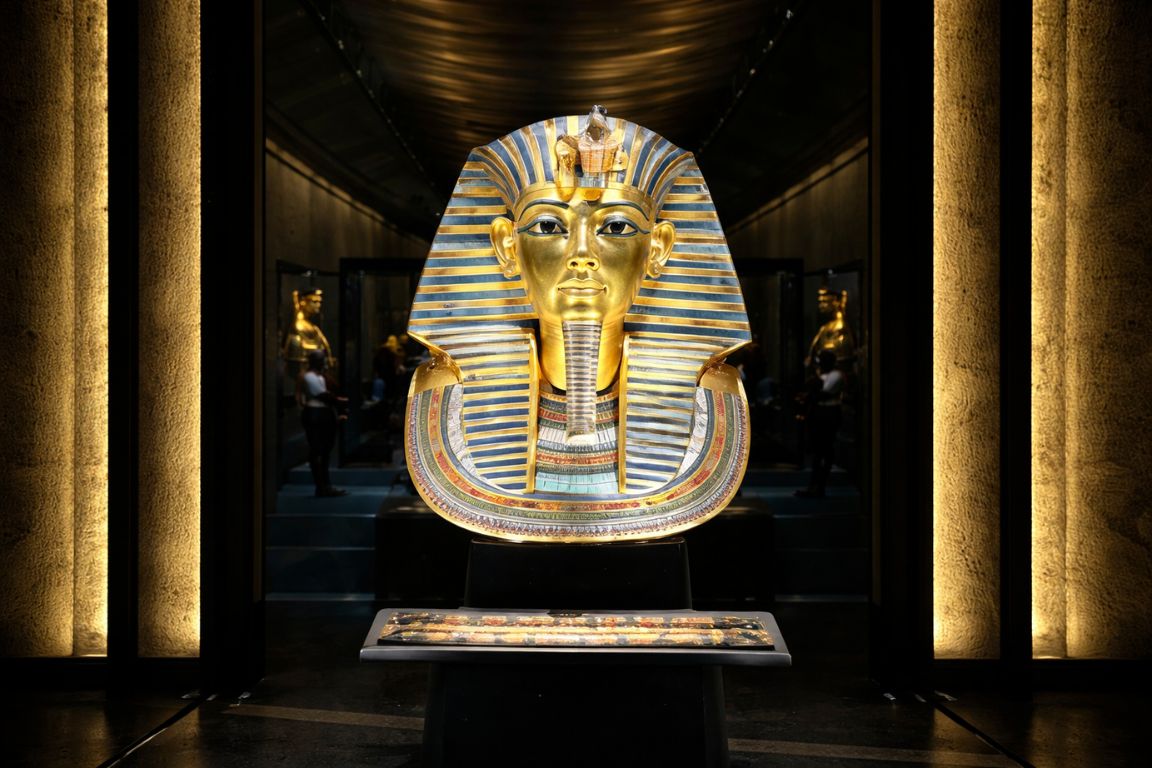
Tutankhamun’s golden death mask is the most recognized archaeological object on earth. Made from 10.23 kg of solid gold, inlaid with lapis lazuli, obsidian, and carnelian, and standing 54 cm tall, it sits in a purpose-built 40mm bulletproof case near the entrance to the Tutankhamun galleries. At GEM, unlike at the old Tahrir museum, photography of the mask is permitted using mobile phones.
I’ve watched thousands of people walk into the chamber where the mask is displayed. Most of them go quiet. Not because they’re being respectful, exactly. More because the object is smaller than they expected and more detailed than anything they’d seen in photos. The striped nemes headdress. The vulture and cobra at the brow. The hieroglyphic inscription across the shoulders, which is a protective spell from the Book of the Dead. The whole object reads as a face, unmistakably. A real person’s face.
What most visitors don’t know is that the mask may not have been made for Tutankhamun at all. Egyptologist Nicholas Reeves has argued that the face section shows evidence of alteration, that it may have originally been made for Neferneferuaten, who may have been the female pharaoh ruling before Tut. The ears are pierced, which in most Egyptian artistic contexts was reserved for women and children. The gold composition of the face is slightly different from the rest of the mask. And the cartouches show signs of having been altered.
Nobody has proven this. But nobody has disproven it either. The mask is 10.23 kg of solid gold, and it may be hiding someone else’s identity underneath Tutankhamun’s name.
GEM gives the mask the display it deserves. Bulletproof glass. Individual lighting. Space around the case so you can actually stop and look without being pushed forward by the crowd. The old Tahrir Museum crammed it into a room with thirty other objects. Here it gets a chamber.
If Tutankhamun is why you’re visiting, here’s everything about the King Tutankhamun collection at the Grand Egyptian Museum so you understand what’s moved from the Egyptian Museum and what’s brand new.
What Makes Tutankhamun’s Solid Gold Coffin Unique Among Ancient Burial Objects?
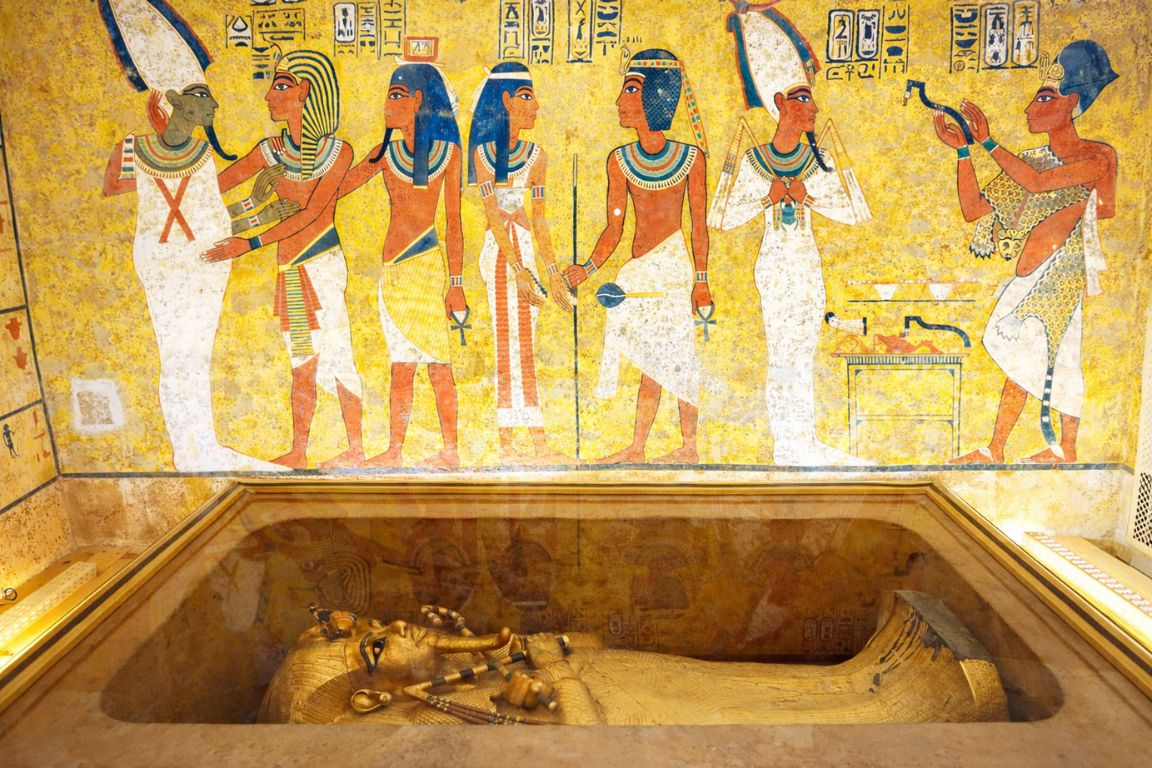 Tutankhamun’s innermost coffin is made from 110 kg of solid gold, making it the only solid gold royal coffin ever found in Egypt. Two outer coffins of gilded wood nest around it. For the first time since the tomb’s discovery in 1922, all three coffins are displayed together at GEM, allowing visitors to understand the original layered burial arrangement as Carter would have seen it.
The weight alone is hard to process. One hundred and ten kilograms of solid gold, shaped into the image of a young king with his arms crossed, hands gripping the crook and flail. The object was hammered, not cast. Ancient craftsmen physically beat sheets of gold into the contours of a human body and sustained that work long enough to produce something that has survived 3,300 years.
At the old Egyptian Museum, the three coffins were separated, displayed in different rooms on different floors. The gold one here, the gilded wood ones somewhere else. Seeing them together at GEM for the first time changes the whole thing. The nesting arrangement makes sense now visually in a way it never did from photographs. Each coffin slightly smaller than the last, each one an independent work of art, all three meant to be sealed inside a stone sarcophagus in a tomb chamber that was itself inside three nested golden shrines.
Tutankhamun was a nineteen-year-old king who ruled for fewer than ten years. He was not one of Egypt’s great pharaohs by any conventional measure. And yet his burial goods include a 110 kg solid gold coffin. It suggests that what we found in KV62 was not exceptional for a New Kingdom royal burial. It was probably standard. Everything that should have been in every royal tomb was already stolen by the time Howard Carter started digging.
What Is the Golden Throne of Tutankhamun and Why Does It Matter?
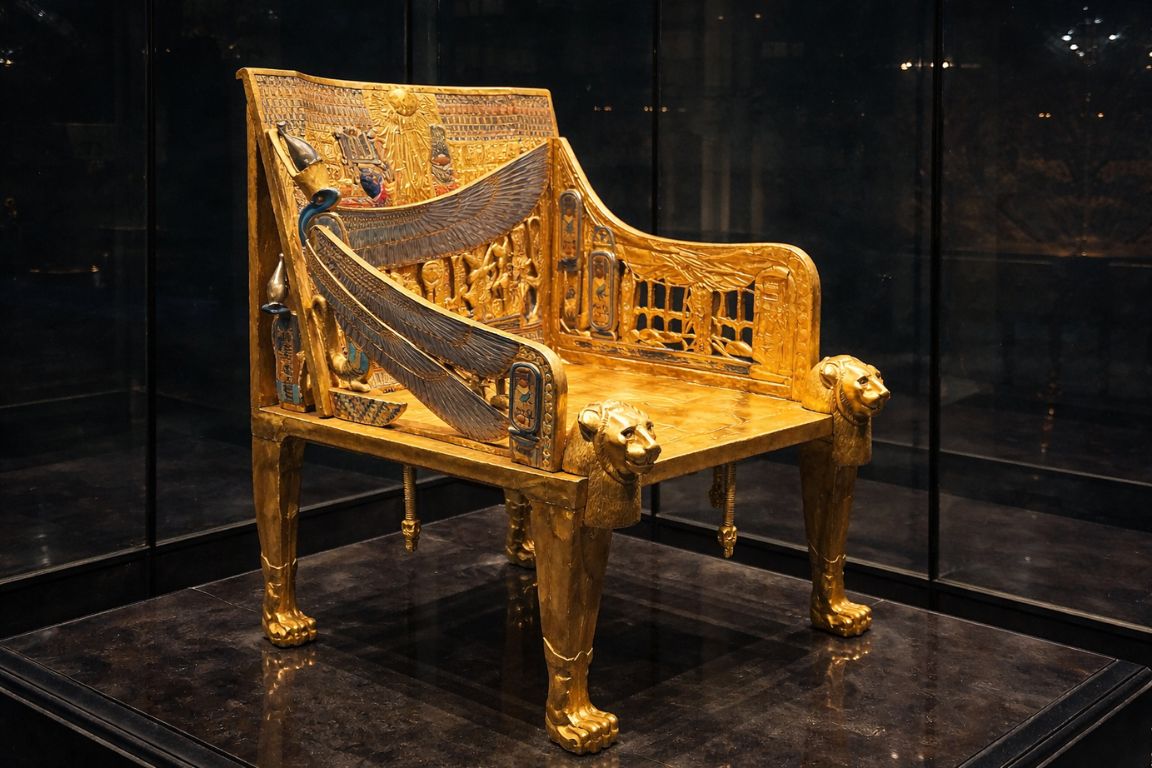 The Golden Throne is Tutankhamun’s royal chair, covered in gold and silver and inlaid with glass, faience, and semi-precious stones. It is the only surviving ancient Egyptian royal throne. The back panel shows Tutankhamun seated while his wife Ankhesenamun applies perfume to his shoulder under the rays of the sun disk Aten. This single image is one of the most intimate scenes surviving from any ancient civilization.
Every other object from ancient Egypt shows royalty performing functions: making offerings, defeating enemies, presiding over ceremonies. The Golden Throne shows a young man sitting while his wife tends to him. That’s it. The scene is domestic in a way that nothing else from this era is. It’s the reason Egyptologists refer to Amarna-period art differently from the rest of New Kingdom Egypt. Akhenaten and his family introduced this kind of private, almost casual royal imagery. Tutankhamun inherited it.
The throne is made from wood beneath all the decoration, which is easy to forget. Wood covered in gold sheeting, inlaid with colors that have held for 3,300 years. The winged cobras on the sides still bear Tutankhamun’s cartouche clearly. Carter found it in the antechamber, wrapped in linen. He nearly missed it under the pile of other furniture.
It takes time to absorb what you’re looking at. Don’t rush this one. People who slow down in front of the Golden Throne consistently describe it as one of the objects that actually got to them at GEM. The mask gets the gasps. The throne gets the stillness.
What Is the Meteorite Iron Dagger and Why Did Tutankhamun Have One?
The meteorite iron dagger is a short blade found in Tutankhamun’s wrappings, positioned over his abdomen. Scientific analysis confirmed the iron blade contains 10.8% nickel and 0.58% cobalt, a composition consistent only with meteoric iron. At around 1323 BCE, iron smelting did not exist in Egypt. Iron was rarer and more valuable than gold. Tutankhamun had one made into a dagger, likely inherited as a diplomatic gift from an earlier generation.
Ancient Egyptians called iron “iron of the sky.” The term bjꜣ-n-p.t appears in texts describing meteorite iron specifically, and scholars now believe they understood the material’s origin. When a piece of sky falls to earth, you don’t bury it. You make something worthy of it.
The dagger’s handle is gold, decorated with a granulation pattern and a crystal pommel. By the aesthetic standards of the tomb, it’s not the most visually striking object. But knowing what the blade is made from changes how you look at it. This was a piece of space, shaped into a weapon, placed against the body of a nineteen-year-old king for his journey into the afterlife.
One current theory is that the dagger was originally given as a diplomatic gift from the king of Mitanni to Tutankhamun’s grandfather Amenhotep III, and was passed down through the royal family as an heirloom. It’s a plausible story. Bronze Age diplomatic correspondence confirms regular exchanges of luxury objects between Egyptian and Mitanni courts, and meteorite iron objects appear in those gift lists.
At the old Tahrir museum, this dagger was underlit and easy to walk past. At GEM, it finally gets the attention it deserves. If you read one artifact label carefully in the Tutankhamun galleries, make it this one.
What Is the Colossal Ramses II Statue in the Grand Hall and How Did It Get There?
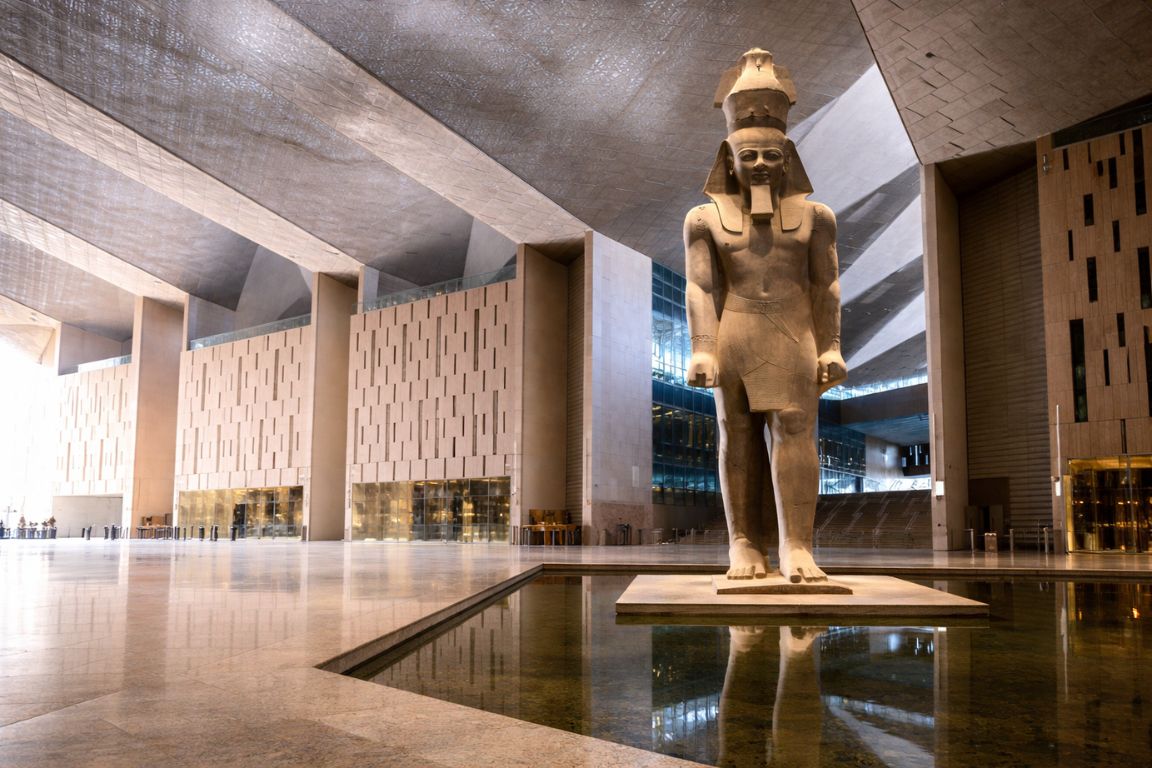 The Colossal Statue of Ramses II stands 11 meters tall and weighs 83 tons, carved from red granite around 1279 BCE. It was originally in the Temple of Ptah at Memphis, rediscovered in six pieces in 1820, moved to Ramses Square in Cairo in 1955, relocated to Giza in 2006, and permanently installed in GEM’s Grand Hall atrium in 2018. The museum was partially built around it. It was the first artifact to enter the permanent collection.
The statue is 3,200 years old and has now lived in four completely different places. Memphis, Cairo, Giza, and GEM. Each move was a significant engineering operation. The 2006 transport from Ramses Square took ten hours in a vertical position on two flatbed trucks, wrapped in rubber foam. The museum’s atrium was then built specifically to house it, which is why the ceiling there is as tall as it is.
What you feel standing under it is scale. Not the scale of a photograph, where the human figures around the base give you context. Real scale, where you tilt your head up and still can’t see the crown without stepping back. The atrium design lets sunlight hit the statue’s face at different angles throughout the day, and at certain hours the red granite glows in a way that feels almost planned. It was planned. The architects positioned the building so the rising sun aligns with the statue’s face on specific dates.
Ramses II ruled for 66 years, outlived at least twelve of his own sons, fought at the Battle of Kadesh, built Abu Simbel, and spent his entire reign constructing monuments to himself. The figure in front of you is wearing the double crown of Upper and Lower Egypt. On the base and body you can still read the hieroglyphic inscriptions that name him. After 3,200 years of travel, he is home.
What Is the Hanging Obelisk and Why Is It Displayed This Way?
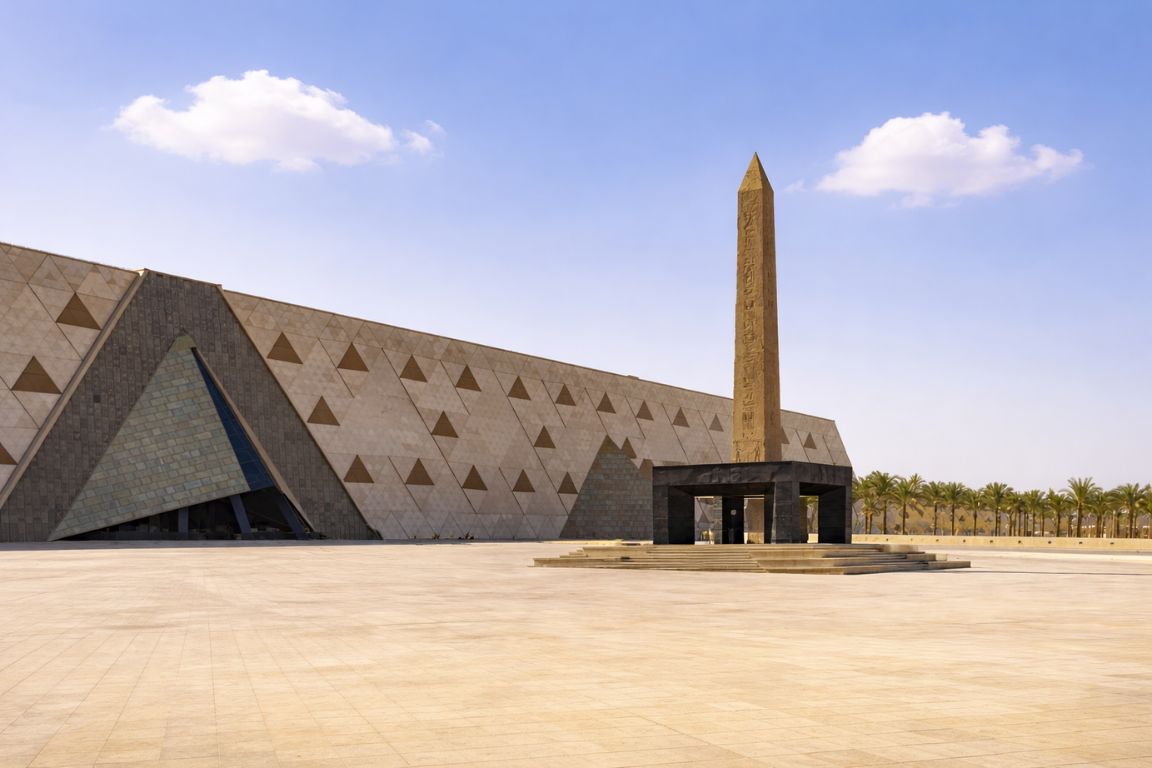 The Hanging Obelisk of Ramses II stands 16 meters tall and weighs 87 tons, raised on a steel platform supported by four massive pillars in GEM’s exterior atrium. It is the world’s only suspended obelisk. The display exposes the underside of the monument for the first time in over 3,500 years, revealing a cartouche of Ramses II that was originally meant to be hidden between the base and the ground, protecting the king’s name from future erasure.
Most visitors walk past this on the way into the museum and barely register it. That’s a mistake. The obelisk came from Tanis in the northeastern Nile Delta, ancient Tanis being the city where Libyan rulers moved many of Ramses II’s monuments from his original capital Pi-Ramesses in the 8th and 9th centuries BCE. The four sides carry the king’s Horus name, throne name, and birth name. These inscriptions were standard. The cartouche at the base was not.
Ancient Egyptians knew that future rulers would sometimes chisel out a predecessor’s name and replace it with their own. This happened constantly throughout Egyptian history. The hidden base cartouche was insurance. If the top three names were destroyed, the bottom one would survive, preserved between stone and earth. At GEM, you can stand on a glass floor beneath the suspended obelisk and look straight up at this hidden inscription, which hasn’t been visible since someone lowered it into a socket in the sand 3,500 years ago.
That experience, looking up through glass at a royal name that was deliberately concealed for millennia, is something you can’t get anywhere else on earth. Most people spend ninety seconds here and move on. I’d give it ten minutes.
What Are the Grand Staircase Colossi and Which Ones Should You Stop For?
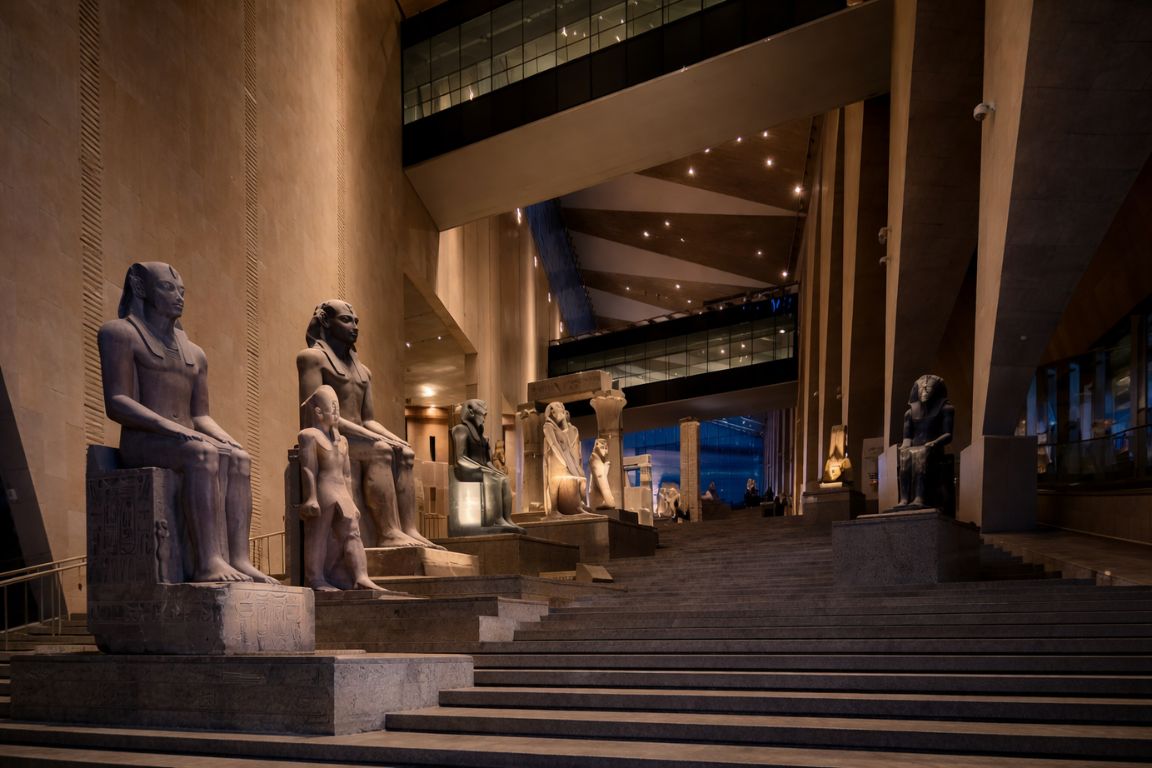 GEM’s Grand Staircase is a six-story open gallery holding over 60 colossal statues, sarcophagi, columns, and stelae arranged across four thematic sections: Royal Identity, Sacred Spaces, Gods and Kings, and Journey to Eternity. It covers 6,500 square meters and ends with a panoramic view of the Giza pyramids. The three most important stops are the ten Senusret I statues, the Akhenaten colossal head, and the side-by-side Hatshepsut and Thutmose III pairing.
Most tour groups take the escalator up and the staircase down. Walk it both ways if you have the energy. The statues are arranged so that certain faces catch the light differently depending on your angle and your direction of travel. The Senusret I statues at the first landing, ten of them in a triangular formation from his pyramid complex at Lisht, are painted limestone and still carry color after 3,900 years. The arrangement is not random. Four on the bottom row, then three, then two, then one at the peak.
The Akhenaten head sits on the western side near the escalator, deliberately placed some distance from the other New Kingdom pharaohs. Akhenaten’s face is elongated, the jaw is prominent, the eyes are almond-shaped. It’s the opposite of idealized Egyptian portraiture. Whether he actually looked like this or whether the Amarna style was a theological statement, nobody agrees. What’s certain is that after his death his monuments were dismantled and he was struck from the official king lists. He appears on the staircase as a head only, which somehow feels appropriate.
The Hatshepsut and Thutmose III pairing is placed so that Hatshepsut’s slightly lower position is compensated by a larger plinth, making her statue rise higher. This is not an accident. Someone made a deliberate choice in the display design. Hatshepsut ruled Egypt for over twenty years as female pharaoh, and Thutmose III later systematically erased her name from monuments. At GEM, she is placed so she looks him in the eye.
What Are Khufu’s Solar Boats and Why Are They in a Museum?
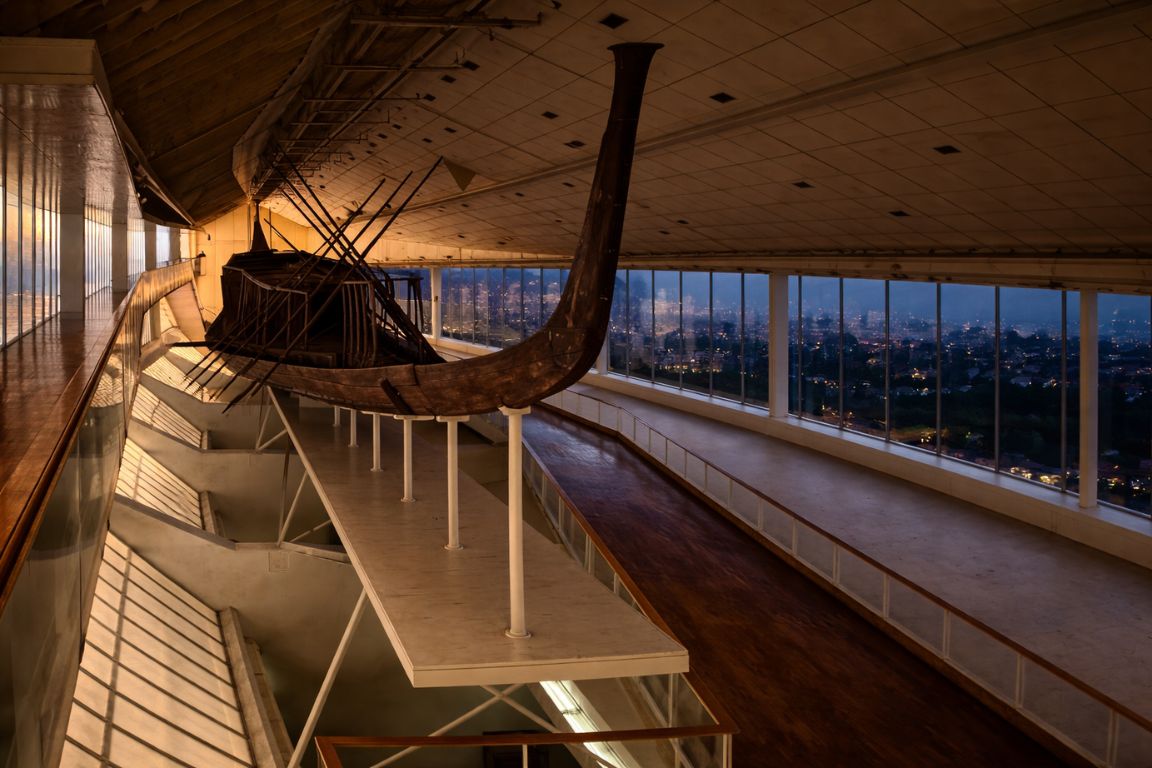 Khufu’s Solar Boat 1 is the world’s oldest intact ship: 43.6 meters long, 5.9 meters wide, built from Lebanese cedar in 1,224 interlocking pieces held together with rope and no metal fasteners. It was found sealed in a limestone pit at the base of the Great Pyramid in 1954, fully dismantled, and painstakingly reconstructed over several years. It was moved to GEM’s purpose-built climate-controlled Solar Boats Hall in 2021.
The object that stops people is its size. Nothing in the photographs prepares you for 43.6 meters of ancient ship. You walk into the hall and the ceiling feels low only because the boat under it is enormous. Ancient Egyptian shipbuilders constructed this from cedar imported from Lebanon, cut and shaped and lashed together with halfa grass rope in a configuration so precise that engineers today believe it would still float.
Why bury a working ship next to a pyramid? The most widely accepted explanation is that the boat was intended to carry the pharaoh’s soul across the sky with the sun god Ra in the afterlife. The ancient Egyptian cosmic model had Ra sailing a solar barque across the heavens each day, and a deceased pharaoh who became one with Ra would need a vessel. Some scholars believe the boat was used once, to carry Khufu’s body across the Nile from Memphis to Giza during the funeral procession, before being dismantled and sealed.
The boat was placed in 1,224 separate pieces in the limestone pit, arranged in 13 layers. The cedar wood, sealed from air and moisture for 4,500 years, was still faintly fragrant when Kamal el-Mallakh broke the seal in 1954. The scent of cedar that escaped that pit was 4,500 years old.
The Grand Egyptian Museum Experience with Hotel Pickup includes a guide and transport from your Cairo hotel, which is useful if you want to reach the Solar Boats Hall early. The difference between arriving there at 9:30 AM and at noon is significant. See dates for the Grand Egyptian Museum Experience with Hotel Pickup if you want pickup and a set morning start.
What Are the Heracleion Colossi and Why Are They Hidden in Plain Sight?
The Heracleion Colossi are two pink granite statues, each approximately five meters tall, recovered from the submerged ruins of Thonis-Heracleion, a Ptolemaic port city that sank into the Mediterranean near Alexandria around the 8th century CE. They likely represent Ptolemy II and his sister-wife Arsinoe II. They are the finest surviving Ptolemaic-era royal statues in the pharaonic style and are displayed in GEM’s Grand Hall, where most visitors simply walk past them.
Thonis-Heracleion was one of the most important port cities in the ancient Mediterranean world, a place where goods from Greece, Phoenicia, and the wider eastern Mediterranean passed through on their way into Egypt. It was mentioned in classical sources for centuries, described by Herodotus, referenced in inscriptions. Then it vanished. Subsidence and earthquakes sent the entire city into the sea, where it sat undiscovered for over a thousand years until French archaeologist Franck Goddio located it in 2000.
These two statues were found underwater in fragments, reassembled during conservation, and eventually installed at GEM. They traveled first as part of the “Sunken Cities” international exhibition that toured London, Paris, Geneva, and other cities before finding a permanent home here. The statues are not purely Egyptian in style. They represent the Ptolemaic blending of Egyptian and Greek traditions, a period when Macedonian rulers positioned themselves as pharaohs while maintaining their Greek cultural identity. Arsinoe II was worshipped as a goddess during her lifetime, one of the very few historical figures to achieve that status. She is also believed to have been a protector of sailors.
They stand in the Grand Hall near the Ramses II atrium. Most people look up at the Ramses colossus, which is understandable, but the Heracleion statues are at eye level, or close to it, and they reward attention. The surfaces carry the texture of 1,400 years underwater. The faces are intact. These are objects recovered from a city that was lost, found, and is now here.
What Is the Khufu Boat 2 Live Restoration and Why Is It Worth Seeing?
Khufu’s second solar boat was discovered in 1954 in a pit beside Boat 1 but remained sealed until 2009 to preserve its fragile condition. It is approximately 42 meters long and consists of around 1,650 fragments. Since 2023, it has been reassembled in full public view inside GEM’s Solar Boats Hall through an Egyptian-Japanese conservation project expected to take several years to complete. It is the only live ancient ship restoration open to visitors anywhere in the world.
Boat 1 is the finished product. Boat 2 is the process. And the process is genuinely worth watching.
The two boats differ in construction. Boat 2 has oars and structural elements that Boat 1 lacks, suggesting they may have served different symbolic functions or were built at different times during Khufu’s reign. As conservators work through the 1,650 fragments, each comparison reveals something new about Fourth Dynasty shipbuilding that a single intact example could never have shown.
Most visitors see this as background to the main event. I’d encourage you to flip that. Boat 1 tells you what the ancient Egyptians built. Boat 2 tells you how we know what we know, which is a different kind of knowledge and often more interesting. The conservation team works on a schedule visible to anyone standing in the hall. You can watch ancient wood being matched to other pieces of ancient wood by people who have spent years studying this single object. That is not something you see anywhere else.
The restoration will take several more years. If you visit now, you are seeing something that will look different on every subsequent visit as more of the boat takes shape. The Solar Boats Hall is part of a standard visit; a Grand Egyptian Museum entry ticket is enough to see the live restoration. It changes.
How Do You Plan Your Visit Around the Must-See Artifacts?
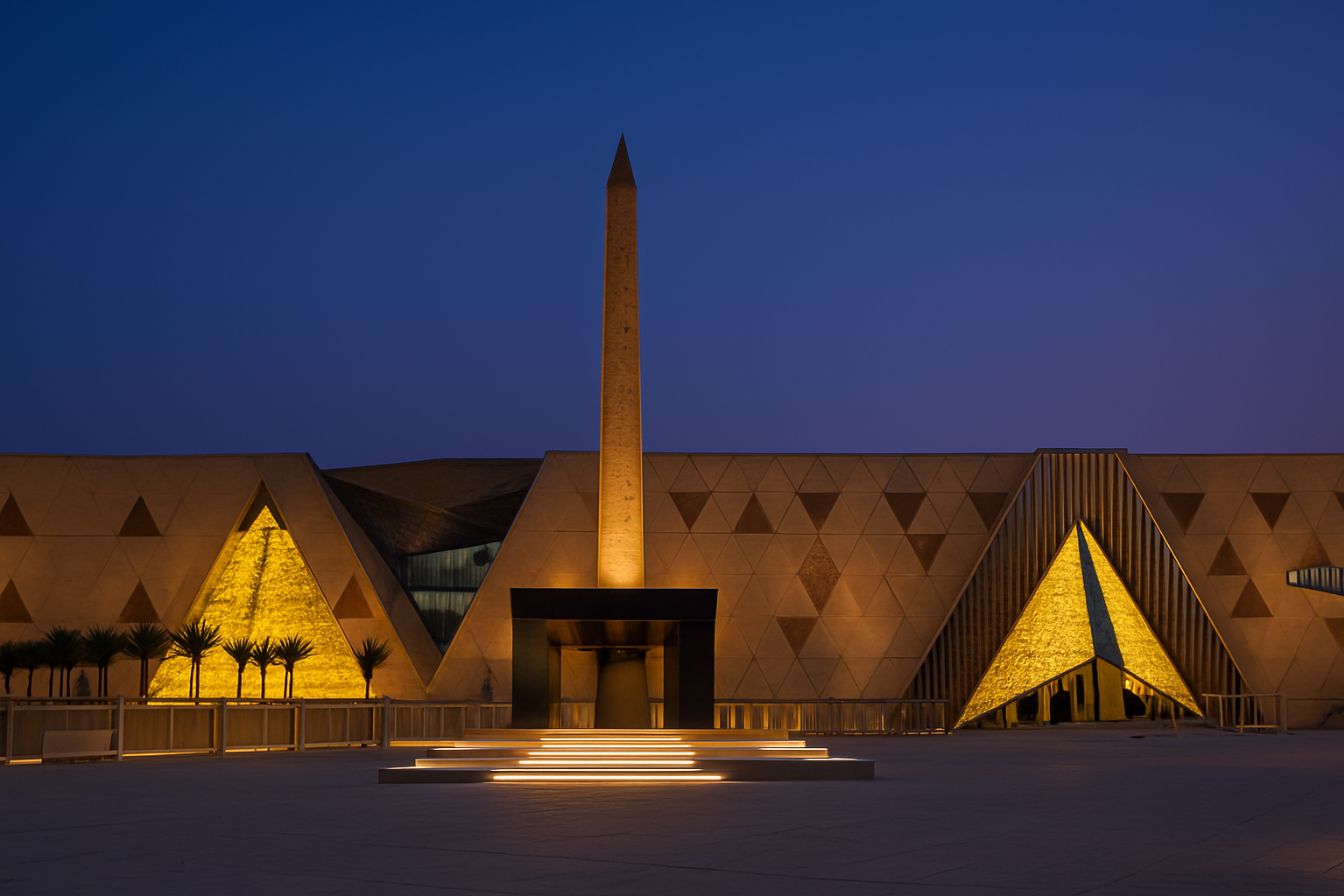 A focused visit covering all ten artifacts takes five to six hours at a comfortable pace. The optimal sequence is: Hanging Obelisk first (before entering), Grand Hall atrium for Ramses II and Heracleion statues, Grand Staircase colossi, Tutankhamun galleries for the mask, coffins, throne, and meteorite dagger, then Solar Boats Hall last. Arrive before 9 AM for the Tutankhamun galleries. Wednesday and Saturday evenings have extended hours until 9 PM for galleries.
The museum’s layout does not force you through in a single direction, which is both good and bad. Good because you can prioritize. Bad because people without a plan regularly spend three hours in the main galleries and then realize they’ve skipped the Tutankhamun collection, the Solar Boats, and the Grand Staircase. All three of those require separate legs. None of them are on the way to anything else.
The Tutankhamun galleries get crowded after 10:30 AM. The golden mask in particular attracts a queue by midday that significantly slows how long you actually spend in front of it. If you arrive at GEM when the galleries open at 9 AM and go directly to Tutankhamun first, you will stand in front of the mask with breathing room. That’s worth a lot.
The Solar Boats Hall stays quieter later in the morning. Go there after the Tutankhamun galleries. The Grand Staircase can be done at almost any point because the crowds on the staircase tend to flow upward and spread out naturally.
Need help planning your visit? Check out our breakdown on how to visit the Grand Egyptian Museum – from booking tickets to navigating this massive new complex.
| Artifact | Recommended Time | % Who Said They Spent Enough Time | Most Common Regret |
|---|---|---|---|
| Golden Death Mask | 10-15 min | 50-65% | Didn’t read the protective spell inscription on the shoulders |
| Solid Gold Coffin | 10 min | 45-60% | Rushed past it to get to the mask |
| Golden Throne | 10-12 min | 40-55% | Didn’t look at the back panel scene |
| Meteorite Dagger | 5-8 min | 30-45% | Walked past it without knowing what it was |
| Colossal Ramses II | 5-10 min | 55-70% | Only saw it from the front; missed the pool reflection angle |
| Hanging Obelisk | 8-10 min | 50-65% | Didn’t stand on the glass floor and look up at the base cartouche |
| Grand Staircase Colossi | 60-90 min | 60-75% | Took the escalator and missed key statues on the way up |
| Khufu Solar Boat 1 | 20-30 min | 65-80% | Didn’t walk the full length; stayed near the entrance |
| Heracleion Colossi | 5-8 min | 35-50% | Walked past them entirely while looking at Ramses II |
| Khufu Boat 2 (Live Restoration) | 10-15 min | 40-55% | Thought it was “under construction” and left without watching |
| Artifact | Peak Crowd Time | Best Time to Visit | Crowd Level |
|---|---|---|---|
| Golden Death Mask | 11 AM – 2 PM | 9-10 AM (first entry) | Very High |
| Solid Gold Coffin & Golden Throne | 11 AM – 2 PM | 9-10 AM or after 4 PM (Wed/Sat) | High |
| Meteorite Dagger | Same as Tut galleries | Any time; seldom crowded at case | Moderate |
| Colossal Ramses II Statue | 10 AM – 3 PM | Early morning or late afternoon | High (but space allows) |
| Hanging Obelisk | Midday (general arrival peak) | On arrival (before entering) | Low to Moderate |
| Grand Staircase Colossi | 10 AM – 1 PM | 9 AM or late afternoon | Moderate (spreads across 6 floors) |
| Khufu Solar Boat 1 | 11 AM – 1 PM | 9-10:30 AM | Moderate |
| Heracleion Colossi | Any time (rarely crowded) | Any time | Low |
| Khufu Boat 2 (Live Restoration) | Never significantly crowded | Any time | Low |
Ten years ago, Omar’s team started tracking which artifacts people regret not spending more time at. The consistent pattern: the meteorite dagger, the Hanging Obelisk base cartouche, and Boat 2 restoration. All three take very little time, cost nothing extra, and are consistently undervisited. All three are on this list for a reason. Don’t skip them.
We’ve answered is the Grand Egyptian Museum worth visiting with an honest assessment because not everyone needs to see 100,000 artifacts, and your Cairo time might be better spent elsewhere.
Frequently Asked Questions
Can you photograph the Golden Death Mask at GEM?
Yes. Mobile phone photography of the death mask is permitted at GEM. Video is not allowed inside the Tutankhamun galleries. No flash, no tripods, no selfie sticks. This is an upgrade from the old Tahrir Museum, where no photography of Tutankhamun objects was allowed at all.
Is Tutankhamun’s mummy on display at GEM?
No. Tutankhamun’s mummy remains in the Valley of the Kings in Luxor, in the original KV62 tomb. The mummies at GEM are other royal figures. If you want to see royal mummies, the National Museum of Egyptian Civilization (NMEC) in Cairo’s Fustat district holds those.
Do you need a separate ticket for the Tutankhamun galleries at GEM?
Ticket structure at GEM has evolved. As of the full opening in November 2025, the Tutankhamun galleries are included in the standard admission ticket. Confirm the current ticket structure when booking through The Grand Egyptian Museum Tickets or at visit-gem.com, as this can change.
How long does it take to see all ten artifacts properly?
A focused visit covering all ten without significant rushing takes five to six hours. If you want to read the labels, spend time at the Golden Throne and Akhenaten head, and watch the Boat 2 restoration for more than a few minutes, plan for a full day. Most visitors underestimate the walking distances between sections.
What is the best day to visit GEM to see the artifacts with fewer crowds?
Wednesday morning before 11 AM combines weekday crowd levels with the advantage of extended evening hours (galleries open until 9 PM). Tuesday and Sunday mornings are also consistently quieter. Friday and Saturday are the Egyptian weekend and significantly more crowded, particularly around the Tutankhamun galleries.
Are the Heracleion statues easy to find at GEM?
They are in the Grand Hall near the Ramses II atrium. Many visitors walk past them without realizing what they’re looking at because attention goes to the colossus above. Look for the two five-meter pink granite figures on the ground level. The labels explain both the Thonis-Heracleion discovery story and the identities of the figures.
The Grand Egyptian Museum has 100,000 artifacts. This list gives you the ten that anchor everything else. See them in order, slow down at the ones that get underestimated, and you will leave with a visit that actually made sense of the scope of this museum.
Written by Omar Khalil
Egyptian tour guide since 2013 · Founder, The Grand Egyptian Museum Tickets
Omar has guided over 7,200 travelers through the Grand Egyptian Museum and Cairo’s ancient sites since founding the agency.