Is the Grand Egyptian Museum Worth Visiting?
Is the Grand Egyptian Museum worth visiting? Yes, it’s the largest archaeological museum ever built, with Tutankhamun’s full collection displayed together.
Keep your museum route independent, or add a private guide and hotel pickup if they serve your day.
| Officially opened | November 1, 2025 (public entry from November 4, 2025) |
| Total artifacts | 100,000+ across 12 permanent galleries |
| Foreign adult ticket | EGP 1,450 (~$30 USD) |
| Foreign student / child (6-21) | EGP 730 (~$15 USD) |
| Children under 6 | Free |
| Gallery hours (standard days) | 9:00 AM – 6:00 PM (last ticket 5:00 PM) |
| Extended hours (Wed & Sat) | 9:00 AM – 9:00 PM (last ticket 8:00 PM) |
| Tickets | Online only – visit-gem.com (no gate sales since December 1, 2025) |
| Recommended visit length | 5-7 hours minimum; full day if possible |
| Location | Giza, ~2 km north of the Pyramids Complex |
What Exactly Is the Grand Egyptian Museum and Why Does It Matter?
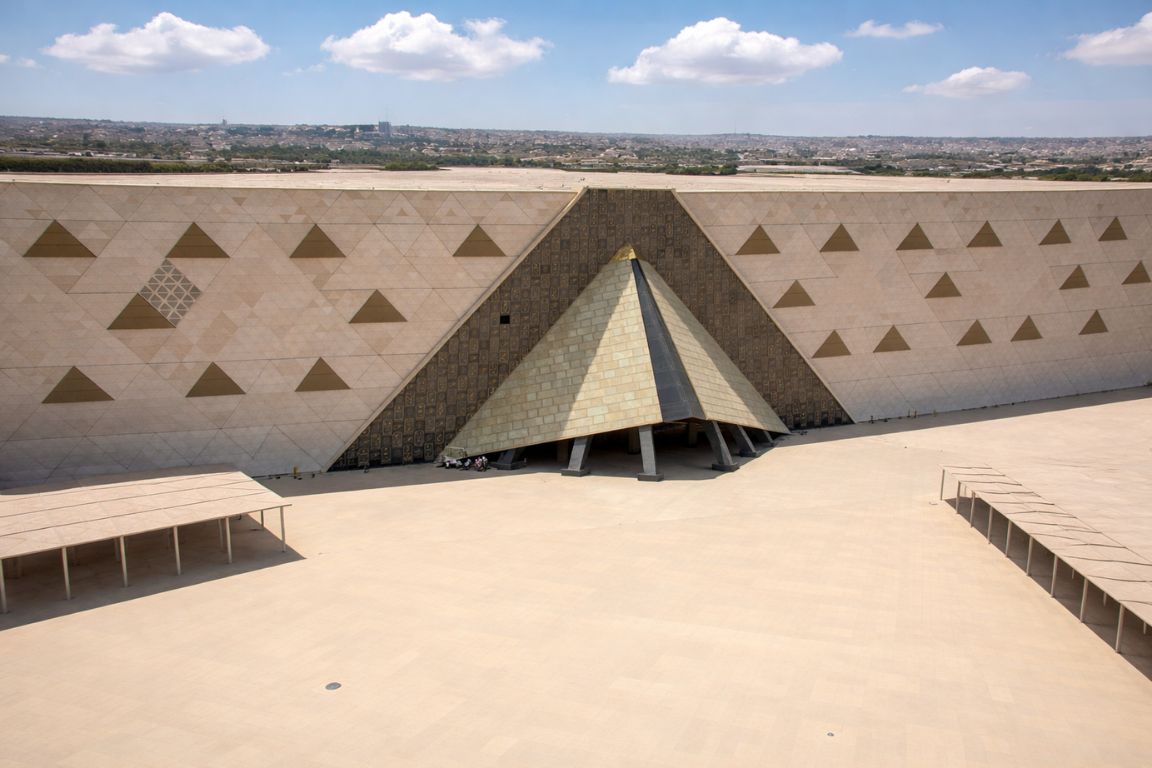 The Grand Egyptian Museum is the largest museum ever built for a single civilization. It sits 2 kilometers from the Pyramids of Giza, spans 500,000 square meters, and houses over 100,000 artifacts covering 7,000 years of Egyptian history. It cost $1.2 billion to build and took more than two decades from groundbreaking to full opening. There is no comparable institution on earth.
Twenty-three years. That is how long the Grand Egyptian Museum took from construction start to full public opening in November 2025. To put that in context, it is roughly the same amount of time it took to build the Great Pyramid of Giza next door. The comparison is not hyperbole. It is the scale of the ambition being spoken plainly.
For most of the 20th century, Egypt’s national story was told inside a pink neoclassical building in central Cairo that opened in 1902. That building was designed for a different era of archaeology and a much smaller collection. By the time GEM broke ground, the Tahrir museum held over 120,000 items in a space that was never meant to hold them, with limited climate control and almost no room to add context around what people were seeing.
GEM was built to fix all of that. The galleries are climate-controlled, the lighting is designed around specific artifact types, and the chronological layout gives visitors actual narrative structure. You walk from predynastic Egypt through to the Roman period in a sequence that makes sense. The floor-to-ceiling windows at the southeast end frame the Pyramids of Giza directly. That view is not accidental. It is architecture reinforcing the point.
Twenty thousand of the artifacts on display have never been exhibited publicly before. That number alone changes the calculation for anyone who visited Egypt years ago and assumes they have already seen the major pieces.
Wondering how they compare? Our guide on Grand Egyptian Museum vs Pyramids of Giza shows you exactly what sets each experience apart and which one resonates more with different travelers.
What Will You Actually See Inside GEM?
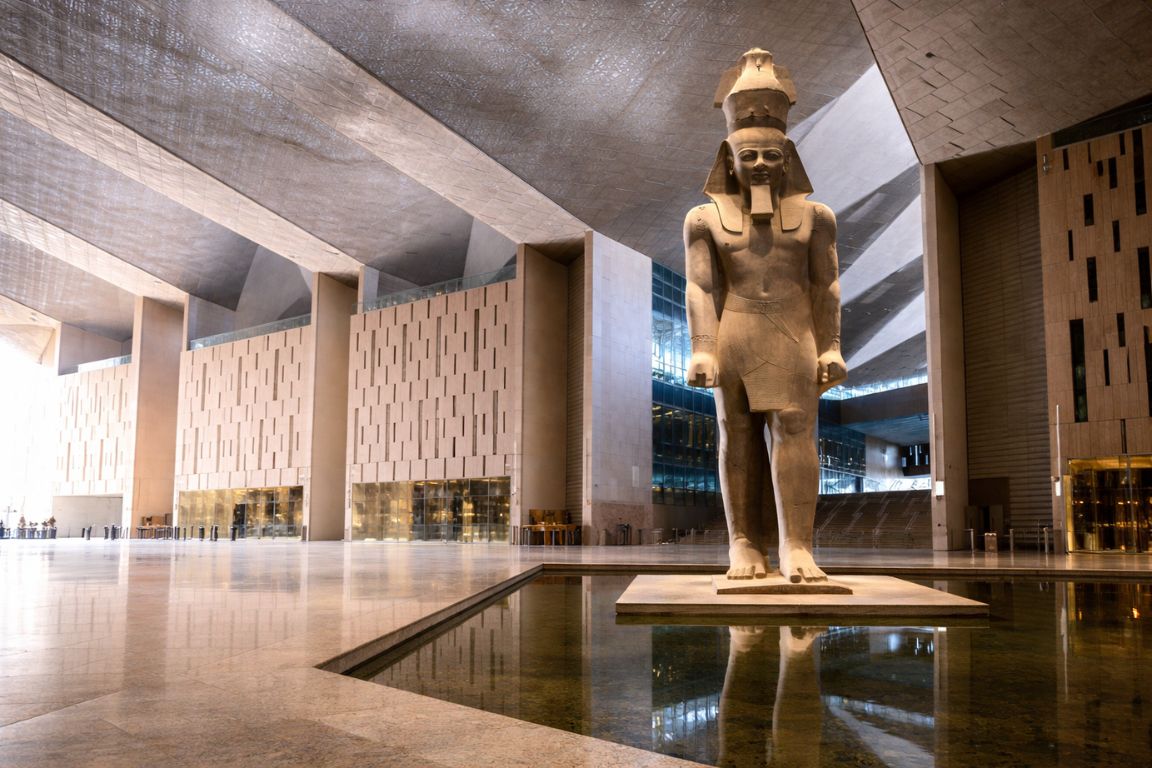 GEM’s 12 main galleries cover Egyptian history from around 6000 BCE through the end of Roman rule in 642 CE. The Tutankhamun collection, spanning 5,398 individual pieces across 7,500 square meters, is the centerpiece. The Grand Staircase lined with colossal pharaonic statues leads up to the main galleries. The Grand Hall houses an 11-meter, 83-ton statue of Ramesses II. Budget at least 5 hours; most visitors with guides spend 6-7.
The experience starts before you reach the galleries. Walk from the security checkpoint into the Grand Hall and you are immediately in front of one of the most imposing objects in any museum anywhere: the 11-meter statue of Ramesses II, moved from Ramesses Square in Cairo in 2006 and placed here to greet everyone who enters. People stop. They look up. Most of them have no frame of reference for how big it actually is until they are standing next to it.
The Grand Staircase comes next. It rises through multiple levels, lined on both sides with massive statues, stelae, and sarcophagi. Some travelers skip upward quickly because they are trying to reach the Tutankhamun galleries. That is a mistake we see often. Take the staircase slowly. The objects along it are not filler.
The twelve main galleries cover the full sweep of Egyptian civilization: the Predynastic and Early Dynastic periods, the Old Kingdom including the age of pyramid building, the Middle and New Kingdoms, the Late Period, and the Greco-Roman era. Thematically, the galleries also address religion, kingship, society, and daily life in a way the Tahrir museum never could with its denser layout.
Then there is Tutankhamun. His collection occupies 7,500 square meters. Three golden coffins, the golden funerary mask, four nested gilded shrines (the outer one alone is the height of a room), two gold-plated chariots, over 5,000 individual objects. All of them together for the first time since Howard Carter’s team packed them up in the 1920s for transport to Cairo. Omar has stood in that gallery hundreds of times. Travelers who consider themselves not particularly interested in ancient history still go quiet when they see the scale of it.
The Khufu Solar Boat has its own separate hall. It is a 4,500-year-old cedar vessel, 43 meters long, reassembled from 1,224 pieces discovered in a pit beside the Great Pyramid. Plan it as its own stop, not an afterthought at the end of your gallery walk.
If you don’t want to miss the best artifacts, here’s what to see at the Grand Egyptian Museum so you spend time on Tutankhamun and the iconic pieces instead of generic pottery.
How Does GEM Compare to the Egyptian Museum in Tahrir?
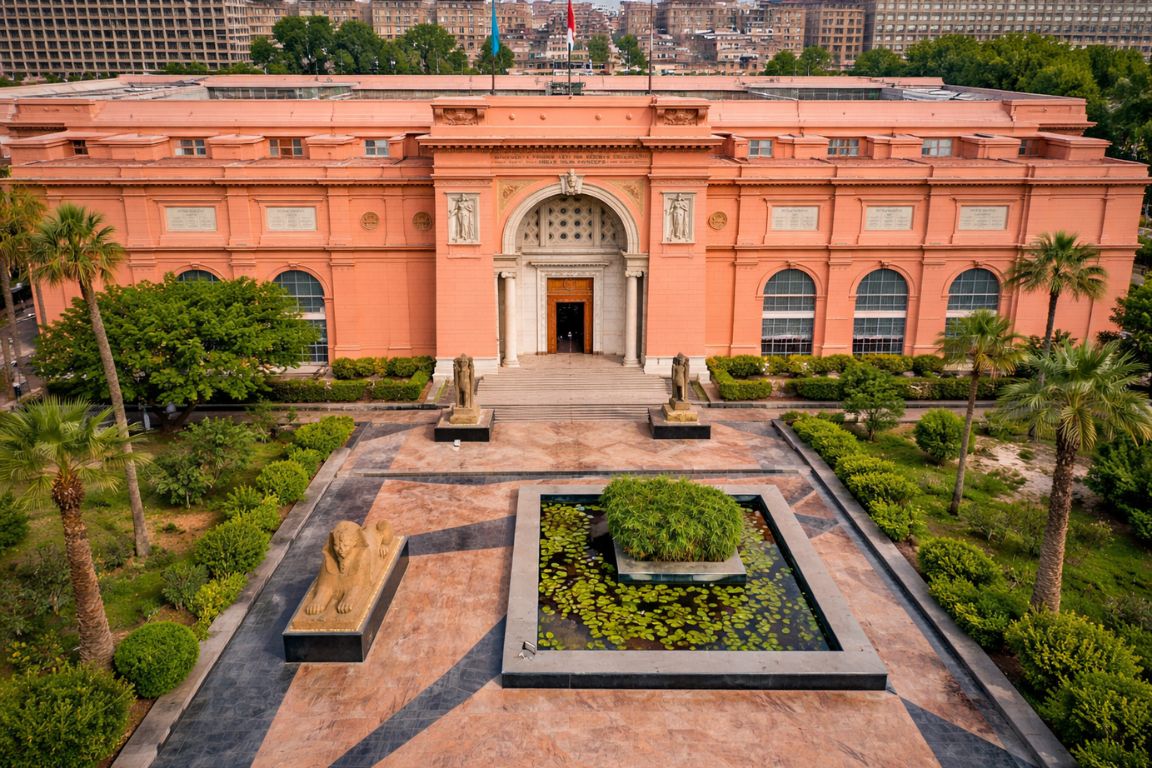 GEM and the Egyptian Museum in Tahrir are not the same experience and are not trying to be. GEM is larger, newer, climate-controlled, and tells Egyptian history as a structured narrative. Tahrir offers the original Egyptology atmosphere: dense, atmospheric, slightly chaotic. Tahrir still holds the Royal Mummies (22 of Egypt’s greatest pharaohs), the Tanis treasures, and its own massive collection. Visit both if your schedule allows. One day each.
| Opened | 2025 (fully) | 1902 |
| Tutankhamun collection | Complete – all 5,398 pieces | Transferred to GEM |
| Royal Mummies | Some; full collection at NMEC | Principal Royal Mummies collection at NMEC |
| Climate control | Fully air-conditioned | Limited; can be warm in summer |
| Layout | Chronological, clearly signposted | Dense, atmospheric, less structured |
| Location | Giza (requires dedicated trip) | Tahrir Square, central Cairo |
| Foreign adult ticket | EGP 1,450 | EGP 450-550 (general admission) |
| Atmosphere | Modern, grand, ambitious | Historic, layered, Indiana Jones energy |
| Time required | Full day (5-7 hours minimum) | Half-day to full day (3-5 hours) |
| Best for | First visits, families, scale and spectacle | Archaeology enthusiasts, historic atmosphere |
The practical reality: if you can only visit one, GEM wins for most first-time visitors, simply because it now holds the pieces that defined Egypt’s reputation globally, including the complete Tutankhamun collection and the Khufu Solar Boat. Tahrir still holds the Royal Mummies Hall, which requires a separate ticket and is genuinely worth it. If you have two full days for Cairo museums, split them evenly.
If you only have time for GEM and you leave wondering what all the fuss about Tahrir is, come back. The two museums were designed to complement each other, not compete.
Is GEM Worth It for First-Time Visitors to Egypt?
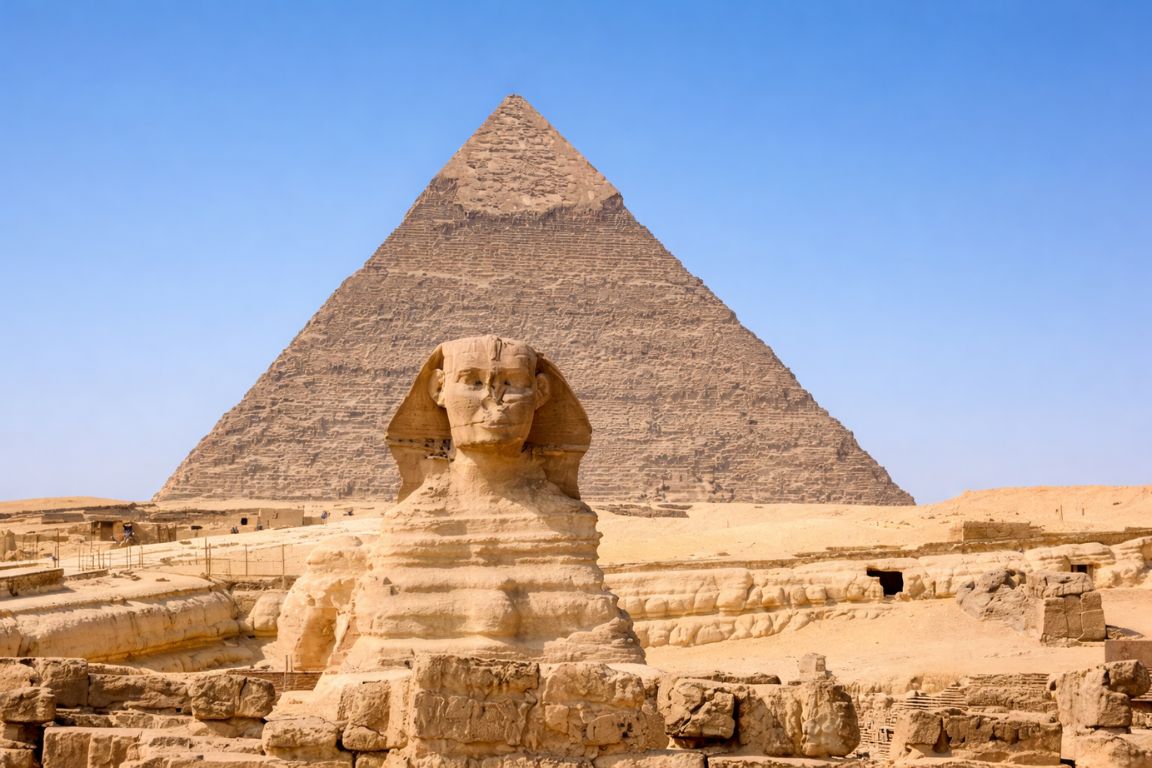 For first-time visitors, GEM is not optional. It holds the complete Tutankhamun collection, the Khufu Solar Boat, colossal royal statues, and 20,000 artifacts never previously displayed. The logical order is GEM in the morning when it is quieter, Pyramids of Giza in the late afternoon. That combination forms the core of what makes an Egypt trip distinctly Egyptian.
The question we get from first-timers is usually framed as a time concern. They have four days in Cairo. They want the Pyramids, the Sphinx, maybe a day trip to Luxor. Where does GEM fit?
It fits on day one, before you see the Pyramids, if possible. Standing at the base of the Great Pyramid without the context GEM provides is still extraordinary. But standing at the base of it after spending a morning inside the museum adds something that is hard to articulate. You have just seen the objects that came out of the tombs inside those structures. The relationship between the buildings and their contents becomes real in a way it cannot from photographs alone.
GEM is also logistically clean for first-timers because it is 2 kilometers from the Pyramids and easily combined into a single Giza day. Book the museum for the 8:30 AM complex entry slot, spend 5-6 hours inside, then walk or taxi to the Pyramid Complex in the afternoon. One full day and you have covered the two most significant sites in Egypt’s entire tourism offering.
If you are working with a guide for the Pyramids portion, that same guide can typically cover GEM as well. The private Pyramids and GEM tour (choose your inclusions) covers both in a single day. Having an Egyptologist with you inside the Tutankhamun galleries specifically changes the visit. The explanations of what each object was for, what was found where, what was missing and why, transform a walk through impressive objects into something closer to understanding a life.
First time visiting this new museum? Here’s how to visit the Grand Egyptian Museum so you don’t show up unprepared for the scale, the security, or the ticket system.
Is GEM Worth It If You’ve Already Visited Egypt Before?
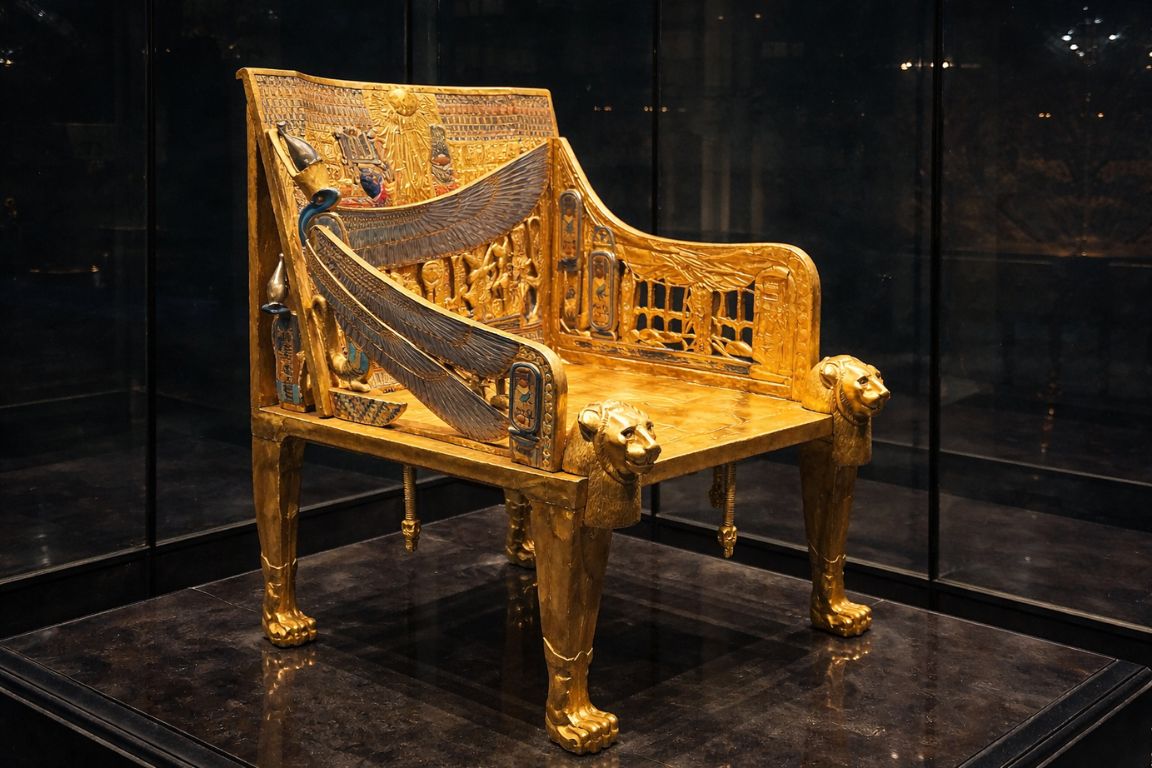 Yes, even if you visited Egypt years ago and thought you had seen the Tutankhamun treasures. The complete collection of 5,398 pieces was not previously displayed together, and 20,000 artifacts in the new galleries have never been on public exhibit before. Repeat visitors consistently report that GEM shows them a version of Egypt they have not seen.
This is one of the most common questions our team fields from return visitors who did Egypt five or ten years ago and are wondering whether another trip is warranted now that GEM is open. The short answer is yes, but the full answer is more specific than that.
If your previous visit included the Tutankhamun gallery at the Tahrir museum, you saw selected pieces from his collection, probably around 100-130 objects displayed with then-standard labeling. What is in GEM now is not a larger version of that. It is a qualitatively different experience. The scale of the four nested golden shrines alone, objects that could not properly be displayed in Tahrir, changes the emotional register of the collection. The beds, the miniature Canopic shrine, the wine and oil amphorae, the linen garments. These were the contents of a burial assembled for a teenage king 3,300 years ago and they are finally all in the same room.
Beyond Tutankhamun, the broader galleries include thousands of objects that were in storage for decades, never exhibited because the Tahrir museum simply could not fit them. The collection of Queen Hetepheres, mother of Khufu, is now fully displayed. The second Khufu Solar Boat, under active restoration in a separate building, is visible to visitors while the work continues. That is a working archaeological restoration being carried out in public, and nothing quite like it exists elsewhere.
Repeat visitors with a serious interest in ancient Egypt often find GEM demands a slower visit than first-timers give it. This is a museum that rewards more than one trip over time. The 100,000 artifacts in 12 galleries cover 7,000 years of history. One visit, even a seven-hour one, covers maybe 60-70% of what is there.
We’ve narrowed it down to the top 10 must-see artifacts in Grand Egyptian Museum because you can’t see everything and these are the pieces that define the collection.
What Do Real Visitors Say After Going?
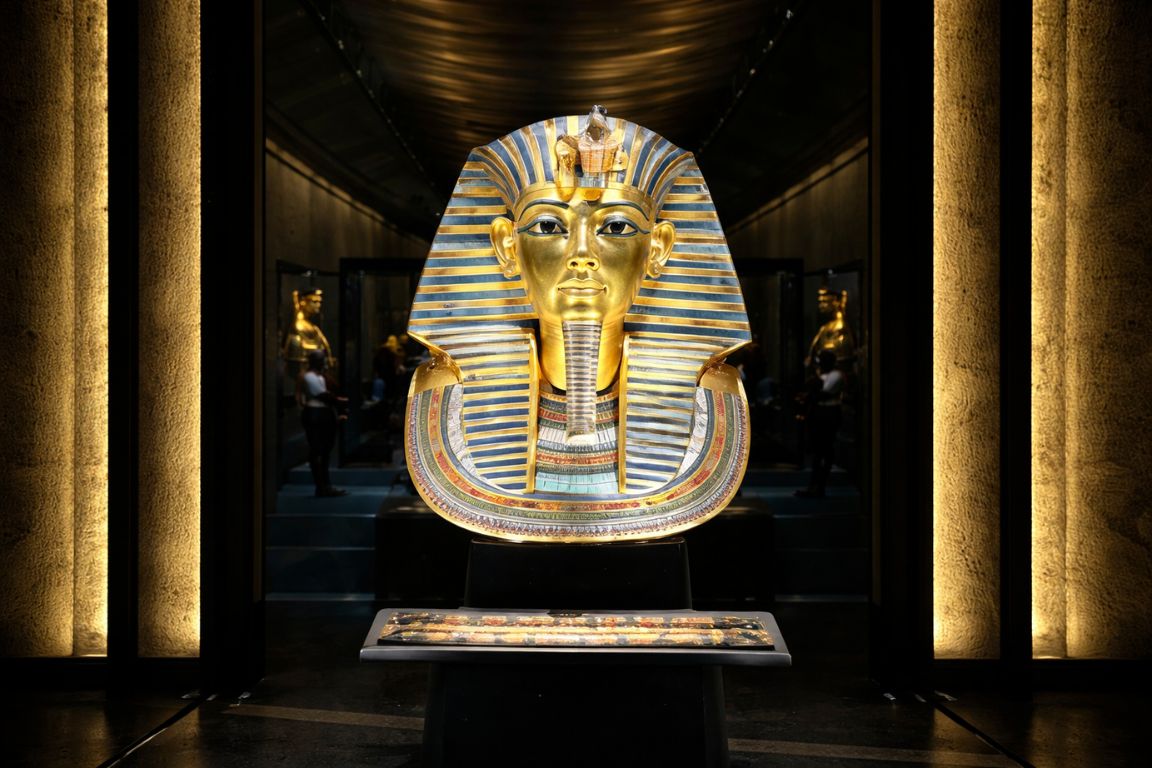 The overwhelming pattern from verified visitor reviews in 2025 and 2026 is positive, with particular emphasis on the scale, the Tutankhamun collection, and the quality of the building itself. The most common criticism is underestimating how much time is needed. Guided tours that feel rushed are the most frequently cited disappointment, not the museum itself.
After guiding thousands of travelers through this museum since its soft opening and now through its full 2025-2026 operation, the feedback pattern we see repeatedly is consistent with what shows up in broader review data.
Visitors who go in with realistic time expectations almost universally describe it as a highlight of their entire trip, often of their entire lives. The phrase “once in a lifetime” comes up in a notable share of reviews. One traveler from the January 2026 cohort spent seven hours inside and estimated they had seen 60-70% of the museum. They did not say they were disappointed. They said they needed to come back.
The visitors who leave disappointed almost always share one of three stories. They booked a group tour that moved faster than they wanted. They tried to do GEM and the Pyramids in a single morning. Or they arrived with no guide and found the scale overwhelming rather than rewarding. None of those outcomes are about the museum. They are about planning.
The quality of your guide matters here more than at almost any other site in Egypt. GEM is so large and so dense that a guide who is not engaged makes the visit feel like a march. The guide skill set required at GEM is different from a general Cairo tour. A private GEM Egyptologist visit with hotel transfers keeps an Egyptologist with you in the galleries. Knowing the artifacts is table stakes. Being able to sequence a six-hour visit so that the emotional arc builds correctly is what separates a good GEM guide from a great one.
Don’t miss the reason most people visit. This guide to the King Tutankhamun collection at the Grand Egyptian Museum shows you exactly where his treasures are and what makes this collection unprecedented.
What Are the Reasons Some Visitors Leave Disappointed?
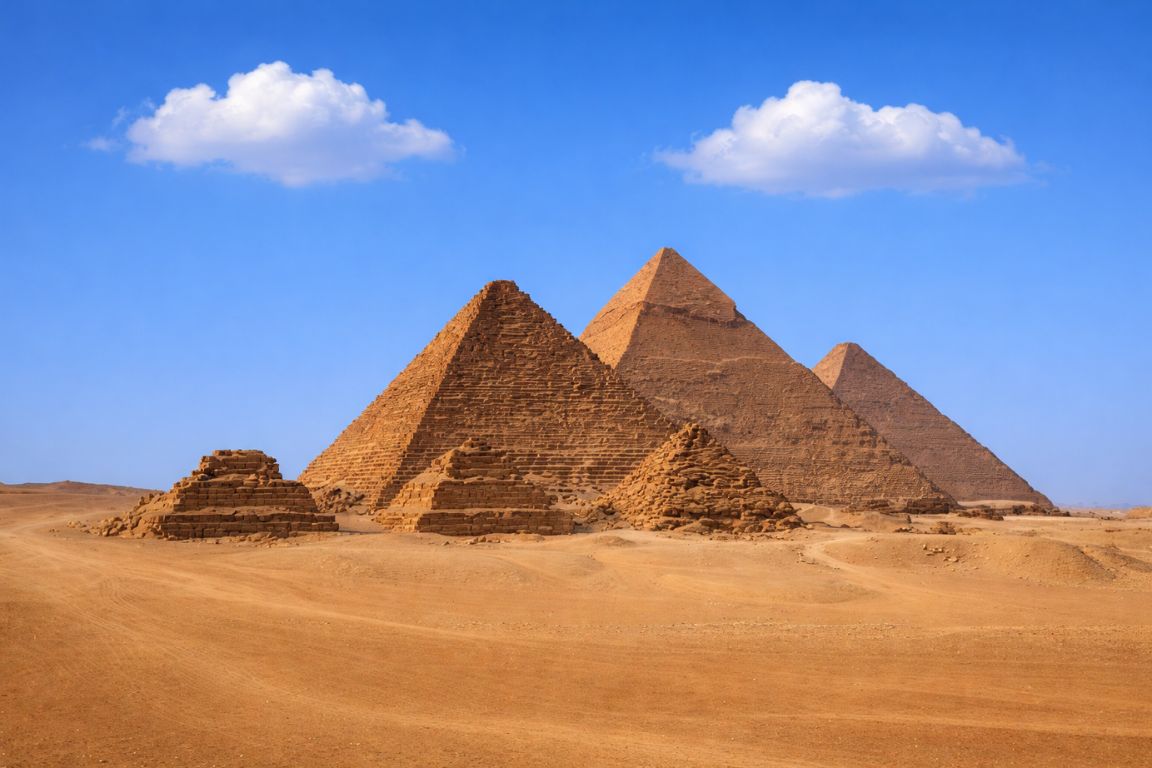 The most common reasons visitors are disappointed at GEM: underestimating the time needed, booking a rushed group tour, trying to combine GEM and the Pyramids in a single morning, arriving without a guide and feeling lost, or expecting something intimate when the museum is genuinely enormous. None of these are flaws in GEM. All of them are avoidable with the right preparation.
The museum is very, very large. This sounds obvious but it genuinely catches people off guard. The floor area is 81,000 square meters. Covering all 12 galleries on foot means walking somewhere between 5 and 7 kilometers depending on how you route through the building. Visitors who show up thinking this is a two-hour stop and then leave feeling rushed have usually not read the fine print on what they bought a ticket to.
If you’re trying to plan your schedule, here’s our honest comparison of half-day vs full-day at Grand Egyptian Museum based on what you can actually absorb before exhaustion sets in.
Group tours are a specific issue. The standard group tour at GEM runs 90 minutes to 2 hours and covers the Grand Hall, the Grand Staircase, and the Tutankhamun highlights at a pace determined by the size of the group and the guide’s efficiency, not your curiosity. Reviews where visitors describe feeling rushed almost always involve group tours of 25 or more people. The museum is not the problem. The format is.
Getting there is also harder than it looks on a map. GEM sits along a major highway with a one-direction approach from the north. Taxi drivers who are not familiar with the new road configuration can miss the entrance and add 20-30 minutes to a journey that should take 30 minutes from central Cairo. Coming from downtown Cairo, the access is from the Cairo-Alexandria Desert Road. Be specific with your driver and confirm the entry direction before you leave.
The early ticketing chaos from November 2025 is worth acknowledging. In the first week after opening, more than 27,000 tickets were sold for a day with a 20,000-person limit. That was fixed within weeks. The museum moved to a fully online-only system in December 2025, with timed entry slots that are strictly enforced. Buying tickets the day of your visit is now impossible. Book at visit-gem.com at least several days in advance, and further ahead during peak season (November through March).
One important note: Many travelers run into frustrations when trying to book tickets directly on the official Grand Egyptian Museum website, visit-gem.com. While this remains the only authorized platform for purchasing standard entry tickets, and the museum repeatedly warns against using any other sites to steer clear of scams or invalid bookings – the site itself can feel clunky or unreliable at times. That’s exactly why a lot of visitors end up preferring trusted third-party platforms like GetYourGuide or Viator. These alternatives tend to deliver a much smoother experience, especially for international travelers.
Need help with the purchase? Our guide on how to buy Grand Egyptian Museum tickets walks you through the official site, pricing tiers, and when to book versus just showing up.
None of these disappointments are about the artifacts. Every single one is an operational issue that a well-prepared visit avoids entirely.
From Our Travelers: What We See on GEM First Visits
Based on feedback from our 2025-2026 GEM client groups:
| Metric | What We Observe |
|---|---|
| Average time spent inside | 60-75% spend 5+ hours; 25-40% stay 7+ hours |
| Most cited highlight | Tutankhamun galleries (80-95% of post-tour responses) |
| Wish they had more time | 65-85% said they would return to see more |
| Preferred entry time slot | 8:30 AM on weekdays (70-90% of our bookings) |
| Combined GEM + Pyramids same day | 55-75% of our clients do both in one day successfully |
| Repeat visitors (came back to Egypt for GEM) | 20-35% of 2025-2026 bookings were return Egypt travelers |
Frequently Asked Questions
Is the Grand Egyptian Museum worth the ticket price?
At around $30 USD for a foreign adult, GEM offers access to 100,000 artifacts across 12 galleries, including the complete Tutankhamun collection. Compare that to major European museums where entry can run $25-$40 for a fraction of the collection size. For most visitors, the value is not the question. The question is having enough time to see it properly.
How long do you really need at GEM?
A minimum of 5 hours to cover the main galleries and the Tutankhamun collection at a reasonable pace. Museum enthusiasts and those with a guide who explains context routinely spend 6-7 hours. One traveler in our January 2026 group spent seven hours and estimated they saw about 65% of the museum. Plan for a full day. Do not try to squeeze GEM into half a morning.
Is GEM better with a guide or self-guided?
A good guide transforms the visit. The sheer volume of objects in GEM means that without context, many visitors move past extraordinary things without fully registering what they are looking at. A private guide who knows the collection allows you to spend time on the pieces that matter most and skip what is less relevant to your interests. Audio guides are available but do not replace that real-time dialogue.
Should I visit GEM or the Pyramids first?
GEM first, if possible. Seeing the objects that came out of the tombs before you see the monuments themselves adds a layer of comprehension that the reverse order does not. Logistically, GEM and the Pyramids are close enough to combine on the same day. Book the 8:30 AM complex entry at GEM, spend 5-6 hours inside, and then go to the Pyramids in the early afternoon.
Do I need to book GEM tickets far in advance?
Yes. The museum moved to online-only ticketing in December 2025, with no gate sales. Book through visit-gem.com. During peak season (November through March), popular time slots fill up several days or more in advance. Book before you need tickets, not the day before.
Can I visit GEM and the Egyptian Museum at Tahrir on the same trip?
Absolutely, and we recommend it if your schedule allows. They are different experiences and each holds things the other does not. GEM has the complete Tutankhamun collection and the Khufu Solar Boat. Tahrir has the Royal Mummies Hall and a density of objects that creates its own atmosphere. Budget one full day for each.
Planning a GEM visit and want it done properly?
Tickets, timing, and hotel pickup can be handled in one booking on the Grand Egyptian Museum experience with hotel pickup, so you are not refreshing a booking page the night before.
Written by Omar Khalil
Egyptian tour guide since 2013 · Founder, The Grand Egyptian Museum Tickets
Omar has guided over 7,200 travelers through the Grand Egyptian Museum and Cairo’s ancient sites since founding the agency.