What to Wear to the Grand Egyptian Museum
What to wear to the Grand Egyptian Museum? Dress modestly, bring good walking shoes, and pack a light layer - the galleries are cool inside.
Booking choice: Self-guided GEM admission including permanent galleries, Tutankhamun and the Solar Boat. No guide or transfers. Non-refundable; this provider listing is for ages 6 and above. Check GEM Admission Dates
Keep your museum route independent, or add a private guide and hotel pickup if they serve your day.
TL;DR
GEM has no enforced dress code, but “appropriate attire” is written into the official visitor regulations. In practice: covered shoulders and knees, comfortable walking shoes with real support, and a light layer you can tie around your waist. The museum is fully air-conditioned and the galleries run noticeably cooler than the outdoor esplanade you walk to reach them. In summer that temperature swing from 38°C outside to roughly 20°C inside catches more people off guard than anything else. Bags larger than 40×40 cm must be checked at the cloakroom. Umbrellas are not permitted in the galleries. Everything else is common sense and Cairo’s climate. You can buy entry ticket to GEM here.
GEM Dress and Entry Rules: Quick Reference (Verified March 14, 2026)
| Dress code | “Appropriate attire required at all times” – no strict enforcement, but modest dress expected | GEM official visitor regulations (visit-gem.com) |
| Shoulders and knees | Should be covered out of cultural respect; Egypt is a conservative Muslim-majority country | Standard practice for major Egyptian heritage sites |
| Shoes | No formal requirement – closed, supportive walking shoes strongly recommended for 4-8 hrs on hard floors | Omar’s experience, traveler consensus |
| Bag size limit | Maximum 40 × 40 cm inside galleries; larger bags must be stored in cloakroom | GEM official visitor regulations (visit-gem.com) |
| Umbrellas | Not permitted in the museum; leave at bag check | GEM official visitor regulations (gem.eg) |
| Food and drink | Small water bottles permitted in galleries; all other food/drink prohibited in exhibition areas | GEM FAQ (gem.eg) |
| Photography gear | No tripods, monopods, selfie sticks, drones, or external lighting; personal camera and phone fine | GEM official visitor regulations (visit-gem.com) |
| Indoor temperature | Galleries maintained around 20°C (68°F) – noticeably cool after outdoor heat in summer | GEM conservation standards, visitor reports |
| Cairo summer outdoor temp | 35-40°C (95-104°F) typical May–October | Egyptian Meteorological Authority |
| Cairo winter outdoor temp | 15-25°C (59-77°F) typical November-February; evenings can drop below 10°C | Egyptian Meteorological Authority |
Does the Grand Egyptian Museum Have a Dress Code?
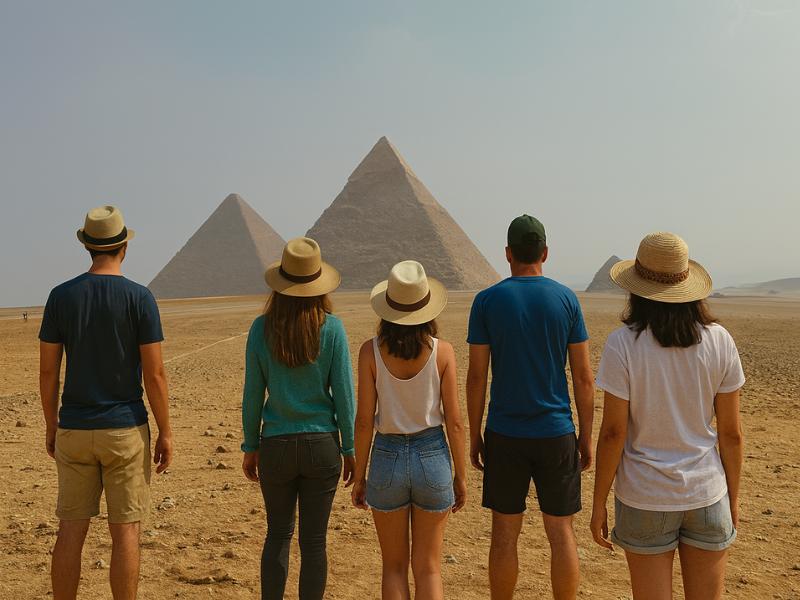
GEM’s official visitor regulations state that “appropriate attire is required at all times,” but the museum does not publish a list of specific garments that are permitted or prohibited. In practice, the expectation across all major Egyptian heritage sites applies here: cover shoulders and knees, avoid clothing that is tight, sheer, or revealing. There is no requirement to cover your hair, and no religious dress code of any kind is imposed on foreign visitors. The effective rule is modesty and common sense. You can buy entry ticket to GEM here.
Egypt is a conservative, Muslim-majority country and its major cultural institutions reflect that. GEM is a government-run national museum, not a European secular gallery where shorts and sleeveless tops are unremarkable. That doesn’t mean you’ll be turned away for wearing a sleeveless shirt. It means you’ll stand out, may attract more attention from vendors and touts in the surrounding area, and will generally have a smoother experience if your clothing signals respect for the setting.
A practical baseline that works everywhere at GEM and at the Pyramids next door: shoulders covered, knees covered, nothing tight or transparent. That’s it. Within those parameters you have enormous flexibility. Linen trousers and a loose cotton shirt in summer. Jeans and a sweater in winter. Lightweight travel pants and a breathable top in the shoulder seasons of October through April. None of this needs to be formal, conservative in a Western sense, or particularly Egyptian in style. Comfortable and modest is the whole brief.
The one thing the official GEM regulations do spell out explicitly is that visitors may not remove their shoes inside the museum, lie down on benches or floors, or “engage in behavior inconsistent with the dignity of the museum environment.” The last clause is deliberately broad. Wear clothes that you’d wear to a serious museum anywhere in the world and you’re fine.
What Should You Wear Inside GEM in Summer (May to October)?
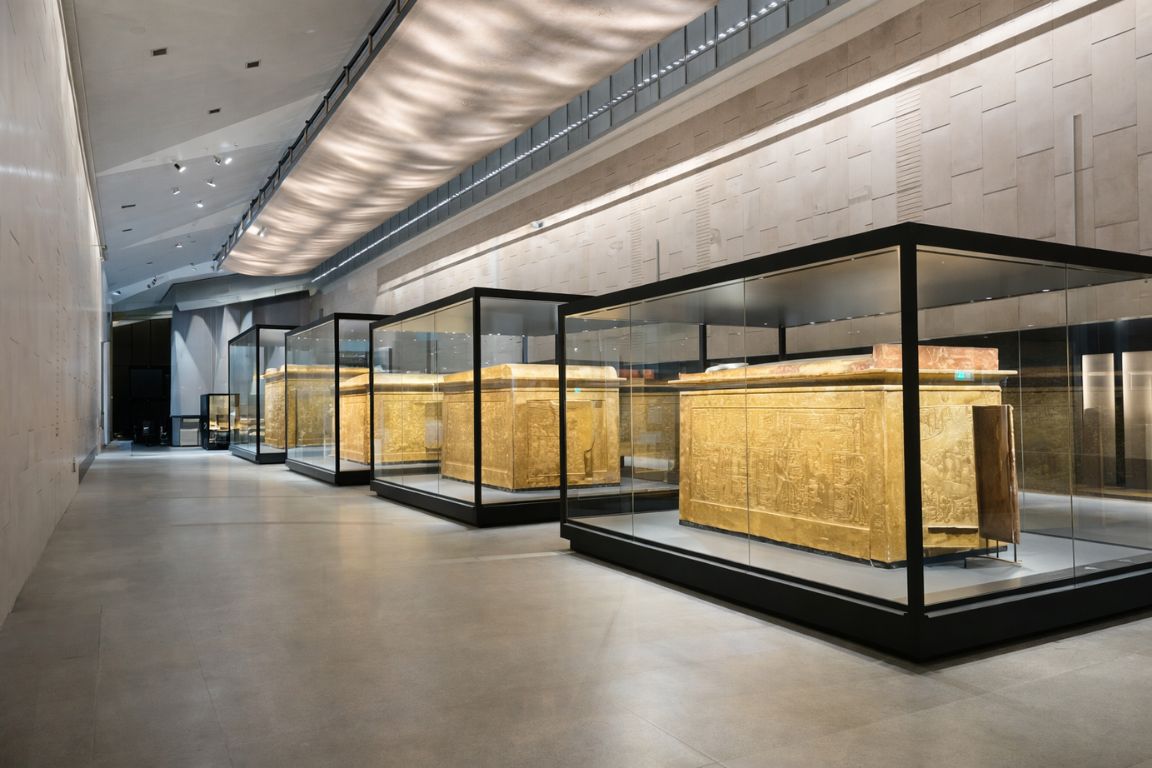 In Cairo summer, you’re managing two opposite environments in the same day. Outdoors at GEM and the Pyramids: 35 to 40°C, intense sun, dry heat, no shade on the esplanade approach. Inside the galleries: around 20°C, cool and still. The outfit that solves this is lightweight natural fabric covering shoulders and knees outdoors, plus one thin layer you can add inside. A cotton button-up shirt over a breathable top, a lightweight linen jacket, or even a scarf worn around the shoulders while inside all work. The trap is packing only for the outdoor half. You can buy entry ticket to GEM here.
The esplanade walk from the main gate to the museum building is 1.27 to 1.45 kilometers across an exposed pathway with almost no shade. In July at 10 AM, that walk is aggressive. You’ll want light colors because dark fabric absorbs heat and every degree matters. Cotton and linen breathe. Polyester traps moisture and makes Cairo’s dry heat feel worse than it is. A wide-brimmed hat and sunglasses are useful for this section specifically, even though you won’t need them inside. If you’d rather skip the esplanade walk, GEM runs an electric shuttle between the gate and the building.
Once you’re inside, the calculus flips. The Grand Hall, which is open and semi-atrium in design, runs slightly warmer than the enclosed main galleries. But once you enter the Tutankhamun Galleries or the Main Exhibition Halls, you’re in fully climate-controlled rooms maintained for artifact preservation. After 30 minutes of walking in those rooms on an August visit, a thin layer becomes genuinely welcome. After 90 minutes, it becomes necessary for many people, especially anyone who runs cold or anyone who came in overheated from the walk and has now cooled to still.
Don’t miss the reason most people visit. This guide to the King Tutankhamun collection at the Grand Egyptian Museum shows you exactly where his treasures are and what makes this collection unprecedented.
The practical solution is simple. A scarf is the best single item you can bring. It weighs almost nothing, packs to the size of a sandwich, works as sun protection on the esplanade, works as a wrap inside the galleries, and disappears entirely into a small bag when not in use. Omar has given this advice to approximately 7,200 travelers at this point. The number of people who regretted bringing a scarf is zero.
Footwear in summer deserves its own paragraph. The outdoor esplanade includes decorative stone paths and in summer that stone gets hot. Sandals are not banned at GEM, but they expose the tops of your feet to direct sun during the walk in, and they offer no support for four to eight hours on marble and polished stone gallery floors. Blisters from new sandals after a long museum day are one of the most consistent complaints we hear from travelers who came underprepared. A well-worn, supportive closed shoe or light trainer is better. If you want an airy option, Keens-style sandals with covered toes and ankle support split the difference reasonably well.
What to Wear at GEM by Season: Cairo Climate Context
| High summer | Jun-Aug | 35-42°C (95-108°F) | ~20°C (68°F) | Heat + gallery cold management | Thin layer or scarf for inside; light colors and hat for esplanade walk |
| Shoulder summer | May, Sep | 28-36°C (82-97°F) | ~20°C (68°F) | Comfortable warmth management | Light breathable layers; gallery cool is pleasant rather than cold |
| Peak tourist season | Oct-Apr | 15-27°C (59-81°F) | ~20°C (68°F) | Layering for outdoor swings | Light jacket or cardigan; evenings (especially Wed/Sat late) can be genuinely cool |
| Winter | Dec-Feb | 10-22°C (50-72°F) | ~20°C (68°F) | Cold mornings, warm museum afternoons | Mid-weight layer that comes off easily; museum interior will be warmer than 8 AM Cairo outside |
| Extended evening visits (Wed/Sat) | Year-round | Drops after sunset | ~20°C (68°F) | Plan for outdoor chill after 7 PM in winter | Jacket in bag for the walk back to the gate after 8 PM in cool months |
What Should You Wear to GEM in Winter (November to February)?
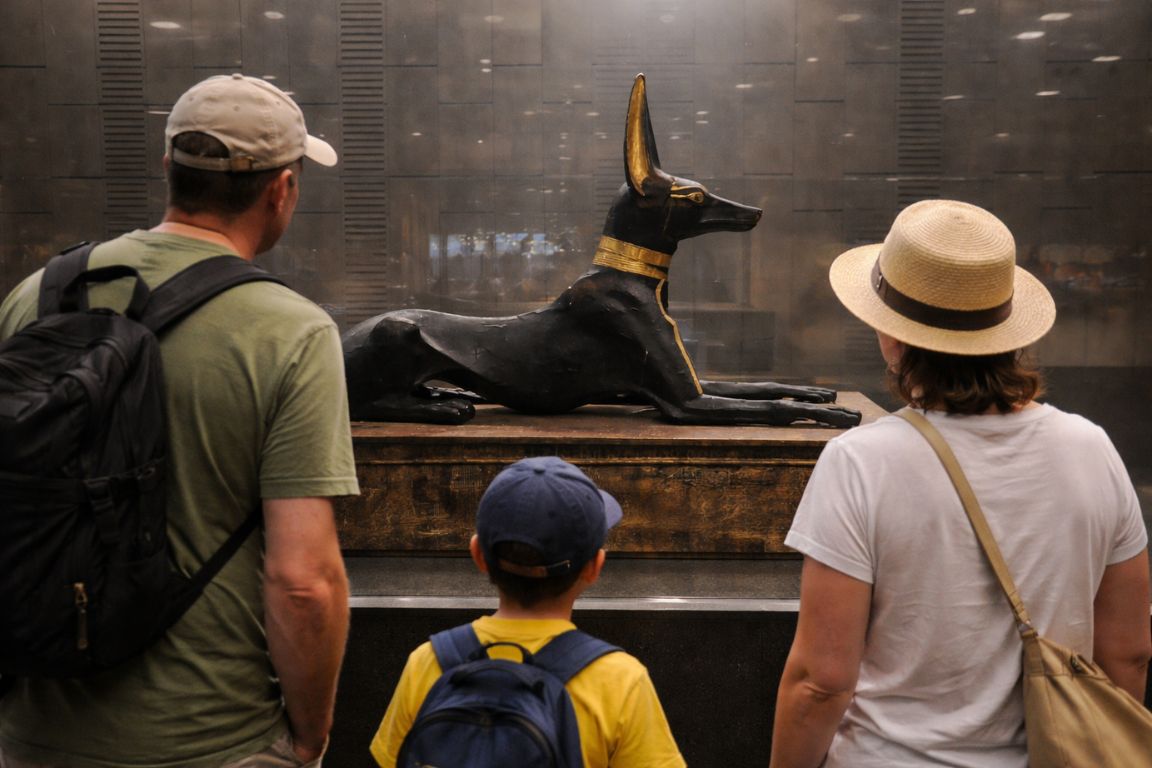 Winter visits to GEM are the most comfortable temperature-wise, but they come with their own clothing trap. Cairo winter mornings are cold. 8 AM in January can be 10 to 12°C, which catches many visitors from warmer climates completely off guard. The museum interior runs at 20°C, which will feel warm compared to the outdoor chill if you arrive in a heavy coat. The solution is true layering: a mid-weight base, a removable jacket, and shoes that handle both cool outdoor stone and several hours of gallery walking. You can buy entry ticket to GEM here.
The winter cold-to-warm transition inside GEM is the reverse of the summer problem. You arrive bundled and step into a building that’s noticeably warmer than outside. If your outer layer doesn’t come off cleanly, you’ll be carrying a coat through the Tutankhamun Galleries for six hours. Not a disaster, but uncomfortable. A jacket you can tie around your waist or stuff into a small backpack solves it immediately.
Winter evenings deserve specific attention for visitors doing extended Wednesday or Saturday visits. If you enter at 4 or 5 PM and stay until 8 or 9 PM, you came in during the afternoon when outdoor temps might be 18°C, comfortable enough. You leave into a Cairo evening that can be 8 to 10°C with wind off the desert. The esplanade walk back to the gate after dark in December or January is a different experience from the daytime version. A compact jacket in your bag specifically for the exit is not overthinking it.
One more winter note: GEM’s indoor temperature of roughly 20°C is perfectly comfortable for sustained walking in light layers. The temptation after a cold outdoor morning is to arrive in more than you need and then suffer for it. A mid-weight long-sleeve top plus a removable light jacket handles virtually the entire winter range. Anything heavier than that and you’ll be carrying it all day.
Planning a winter trip to Cairo? I’ve broken down visiting Grand Egyptian Museum in winter so you know what weather to expect and why cooler months actually make for a better museum experience.
What Shoes Are Best for the Grand Egyptian Museum?
GEM galleries involve 4 to 8 hours of walking on smooth marble and hard stone floors. The shoes that cause problems most consistently are two types: brand-new shoes worn for the first time, and sandals or flip-flops with no arch support. What works: any supportive closed shoe or low trainer you’ve already broken in, with a sole thick enough to cushion hard floors over several hours. Running shoes, broken-in walking shoes, Keens-style sandals with straps and support, and low hiking shoes all work. Heels, flimsy flat sandals, flip-flops, and dress shoes worn without cushioned insoles do not. You can buy entry ticket to GEM here.
The floors at GEM are the kind that look deceptively easy. Smooth, level, no obstacle. But smooth marble with no give transmits every step directly up through your feet and knees in a way that gravel or uneven stone doesn’t. By hour four, even people in good shoes start feeling it in their arches. By hour six or seven in a full-day visit, foot fatigue becomes a significant factor in how much attention a visitor can give the galleries.
The outdoor sections of GEM, including the esplanade walk in and the terraced gardens, add a different variable. Decorative stone paving, shallow steps, and some gravel paths mean open-toe shoes or flat sandals lose traction. Not dangerously so, but enough to make the walk annoying rather than pleasant.
The new shoe trap is specific and worth naming directly. Travelers who buy new walking shoes or sneakers for their Egypt trip and wear them for the first time at GEM are making a reliable mistake. Even the most comfortable sneakers money can buy are untested against your particular foot shape until you’ve worn them for 20 or more hours. One blistered heel at GEM means a compromised visit and a miserable week of sightseeing after. Wear shoes you know. If you’ve only packed new shoes, wear them for a full day of walking in Cairo or around your hotel area before the GEM visit.
Socks matter more than most clothing guides mention. Moisture-wicking socks add a meaningful buffer between your foot and a hard shoe interior over a long museum day. Thin cotton socks are fine in winter. In summer, consider a lightweight synthetic hiking sock rather than standard cotton: it breathes better and prevents the hot-foot friction that leads to blisters when feet swell slightly in heat.
What Bag Should You Bring to GEM?
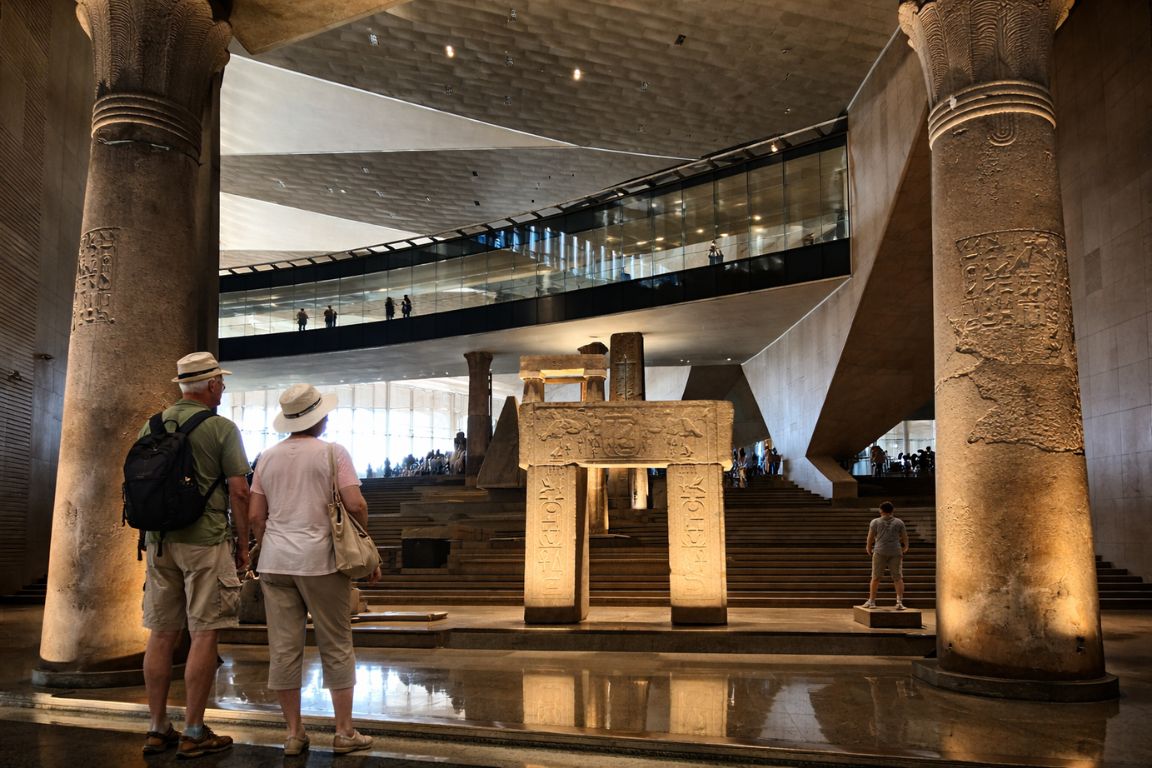 The official GEM bag rule is specific: bags larger than 40 × 40 cm (roughly 16 × 16 inches) are not permitted in the galleries and must be stored at the cloakroom near the entrance. A standard small day backpack, crossbody bag, or tote that fits within those dimensions is fine. Large travel backpacks, rolling luggage, and oversized day bags must be checked. Lockers are available and the process is straightforward, but it adds time on the way in. You can buy entry ticket to GEM here.
The 40 × 40 cm limit is roughly the size of a standard school bag laid flat. Most small day packs and crossbody bags fit easily. The visitors who run into problems are the ones arriving directly from their hotel or the airport with full-size travel backpacks they didn’t want to leave behind, or groups on day trips where bags have accumulated throughout the morning. If you know you’ll be carrying a larger bag for other reasons that day, allow 15 extra minutes for the cloakroom process before your entry slot.
Umbrellas are specifically named as prohibited items in GEM’s gallery regulations. They must be left at the bag check. This catches people who’ve packed an umbrella for the esplanade walk in uncertain Cairo weather, which is understandable but not practical for GEM specifically. If rain is a concern, a compact packable rain jacket is a better solution than an umbrella for a museum visit day.
For what to keep in your bag inside: a small water bottle (the only permitted beverage in the galleries), phone charging cable or power bank, any medication you need for the duration, and your ticket screenshot or QR code saved locally in case the museum’s QR scan has an issue. GEM’s ticketing platform has had documented technical issues since the December 2025 rollout. A saved screenshot rather than a live-load ticket URL is a practical hedge.
Getting the logistics right before you arrive makes the difference between a smooth visit and a frustrating one. If you’d rather not coordinate tickets and transport yourself, see the Grand Egyptian Museum experience with hotel pickup.
What Are the Most Common Clothing Mistakes Visitors Make at GEM?
The four patterns we see most often across 7,200 guided visits: arriving in summer clothing with no layer for the gallery air conditioning; wearing brand-new shoes for the first time on a 6-hour museum day; bringing an oversized bag that has to be checked and creates entry delay; and packing for Egypt’s outdoor heat without accounting for Cairo’s winter mornings in October through February. Each of these is preventable with a small adjustment before the visit. You can buy entry ticket to GEM here.
The air conditioning surprise is the most universal. GEM’s galleries are maintained at artifact conservation temperatures year-round, and year-round means even when Cairo outside is 40°C in August. Visitors who dress entirely for the outdoor heat arrive at the Tutankhamun Galleries in sleeveless tops and thin shorts and spend the first hour comfortable, the second hour noticeably cool, and the third hour genuinely cold. Not dangerous, just distracting. And in a gallery containing the most extraordinary collection of ancient gold objects in the world, distraction is a problem. A scarf, a light cardigan, a button-up worn over a thinner base: any of these weighs almost nothing and resolves it entirely.
The new shoe problem runs close behind. We’ve watched travelers arrive in spanking-new trainers still carrying the box crease and leave two hours later visibly limping. There’s no good solution once you’re inside. GEM’s gift shops don’t stock footwear. If you realize at the entrance that your shoes are going to be a problem, you can at least buy some basic blister plasters at the small pharmacy near the commercial zone and manage the damage.
The winter morning cold catches visitors who arrive in Egypt for peak season (October through April) expecting desert warmth all day. January in Cairo at 8 AM is often 10 to 12°C. That’s not extreme by northern European or North American standards, but most people traveling to Egypt in January aren’t expecting it, haven’t packed for it, and arrive at GEM’s gate shivering before they’ve even crossed the esplanade. A light down jacket or fleece for the morning that goes into the bag once you’re inside handles the full Cairo winter range.
We’ve analyzed the best time of day to visit Grand Egyptian Museum because arriving at the wrong time means dealing with bus tours, heat exhaustion, and overwhelmed exhibits.
One less common but worth mentioning: visitors who bring full-length extension tripods or large camera equipment in their bags and have them confiscated at security. Tripods, monopods, selfie sticks, and external lighting rigs are all explicitly prohibited. A DSLR camera body and a standard lens for personal photography is fine. Anything that looks like professional or commercial photography setup gets held at security. If you’re traveling with serious photography gear, leave the support equipment at the hotel.
What Do Our Travelers Actually Report About Clothing and Comfort?
 Across more than 7,200 travelers we’ve guided, clothing and footwear issues surface in post-visit feedback more than most practical concerns. The most frequently reported problem is underdressing for the gallery air conditioning in summer. The second most common is shoe-related discomfort during long visits. Both are almost entirely preventable with the simple adjustments described in this guide. You can buy entry ticket to GEM here.
| Felt cold inside galleries without a layer | 65-85% of summer visitors | May-September especially; Grand Hall less affected than enclosed galleries |
| Shoe discomfort affecting second half of visit | 50-70% of full-day visitors | More common in visitors wearing sandals or new shoes |
| Bag held at cloakroom due to size – caused entry delay | 40-60% of visitors | Higher in groups arriving from Pyramids same morning with accumulated day bags |
| Wished they’d brought a hat/sunscreen for esplanade walk | 70-90% of summer visitors | The 1.27-1.45 km esplanade is exposed; hat and sunscreen needed specifically for this section |
| Surprised by Cairo winter morning cold (Oct-Feb visitors) | 50-70% of peak-season visitors | Particularly travelers from tropical or warm climates expecting desert heat year-round |
| No clothing or comfort issues reported | 35-55% | Typically visitors who read preparation guidance and packed accordingly |
The visitors who have zero comfort issues almost always share a few things in common. They wore well-broken-in shoes. They brought a small bag within the 40×40 cm limit. They had at least one removable layer. And they didn’t try to manage the whole visit on a single bottle of water.
That last point is practical enough to state plainly: GEM is large and you’ll be walking more than you expect. Small water bottles are permitted in the galleries. Dedicated drinking fountains are limited. If you rely entirely on the museum cafes for hydration, you’ll find yourself waiting in a queue for 10 minutes every time you need water, which adds up over a long visit. Bring water from outside. Replenish it at the cafes during your lunch break.
What to Wear and Bring to GEM: The Complete Checklist
This is the no-frills version: what to bring, what to leave behind, and what the official GEM regulations actually say. Everything here is based on both official rules and the practical experience of guiding 7,200 travelers through this specific building.
Bring to GEM: Clothing and Footwear
| Clothing covering shoulders and knees | Expected at all major Egyptian heritage sites; official regulations require “appropriate attire” | All year |
| Light breathable fabric (cotton or linen) | Esplanade walk to museum is 15+ min in full sun with no shade; synthetics trap heat | Summer especially |
| One removable layer (scarf, cardigan, light jacket, button-up) | Galleries run ~20°C year-round; in summer this is 15-20 degrees cooler than outdoors | All year; critical in summer |
| Well-worn, supportive closed shoe or trainer | 4-8 hrs on hard marble floors; arch support matters more than style | All year |
| Moisture-wicking or light hiking socks | Reduces friction and hot-foot blisters in summer heat | Summer especially |
| Hat and sunglasses | Esplanade approach has almost no shade; useful also at Pyramids if combining in one day | Summer; useful year-round |
| Warm outer layer in bag | Cairo winter mornings (Oct-Feb) can be 8-12°C; evening exits after extended-hours visits get cold fast | Oct-Apr |
Bring to GEM: Bag Contents
| Small bag (max 40 × 40 cm) | Official limit; larger bags must go to cloakroom. Most small day packs and crossbody bags fit. |
| Water bottle | Small bottles permitted in galleries. Only beverage allowed beyond the security line. |
| Phone with ticket QR saved locally | GEM ticketing platform has had documented technical issues. Screenshot the QR before arriving. |
| Power bank | Long visits drain phone battery fast. Charging points are not in the galleries. |
| Sunscreen | Esplanade walk. Apply before entering the complex, not after. |
| Any medication needed | Pharmacy at commercial zone but supply is limited. Bring what you know you need. |
Leave at Home or in Your Hotel
| Umbrellas | Explicitly prohibited in GEM galleries; must be checked at entrance |
| Tripods, monopods, selfie sticks, drones | All prohibited; will be held at security. Personal camera body is fine. |
| Large bags or luggage exceeding 40 × 40 cm | Must be stored in cloakroom; creates entry delay if not planned for |
| Brand-new shoes you haven’t broken in | GEM is the wrong place to discover how your new shoes fit on a 6-hour day |
| Tight, sheer, or revealing clothing | Inconsistent with “appropriate attire” requirement; out of place in the cultural context |
| Flash photography attachments or external lighting | Prohibited throughout the museum; artifacts are damaged by flash |
| Weapons, sharp objects, flammable materials | Prohibited; airport-style security screening at GEM entrance |
Frequently Asked Questions
Is there a strict dress code at the Grand Egyptian Museum?
GEM’s official regulations state that “appropriate attire is required at all times” but do not specify individual garments. In practice, the expectation is the same as at other major Egyptian heritage sites: cover your shoulders and knees, avoid tight or transparent clothing. There is no requirement to cover hair and no religious dress code imposed on foreign visitors.
Can you wear shorts to the Grand Egyptian Museum?
Shorts are technically not banned by the published regulations, but they are out of place at a national government museum in a conservative Muslim-majority country. Long, loose trousers or lightweight travel pants covering the knees are the standard choice and will serve you better both culturally and practically, as the galleries are air-conditioned and bare legs can get cold in a long visit.
Is GEM cold inside?
The main galleries are maintained at approximately 20°C (68°F) year-round for artifact conservation. In Cairo summer when outdoor temperatures are 35 to 40°C, the transition is significant. Most visitors find the galleries comfortable initially but noticeably cool after 60 to 90 minutes without a layer. A scarf or light cardigan is the standard fix and takes almost no space in a bag.
What shoes should I wear to the Grand Egyptian Museum?
Wear comfortable, supportive closed shoes you have already broken in. You will be on hard marble and stone floors for 4 to 8 hours depending on your visit length. Running shoes, well-worn walking shoes, and Keens-style supportive sandals all work well. Avoid new shoes, thin flat sandals, flip-flops, and heels. The approach to the museum across the esplanade is 15 minutes of exposed outdoor walking, so the shoes need to handle both that and extended gallery time.
What size bag can you bring into GEM?
The official GEM rule is bags up to 40 × 40 cm (approximately 16 × 16 inches) are permitted in the galleries. Anything larger must be stored at the cloakroom near the entrance. Umbrellas are specifically prohibited in the galleries regardless of size and must also be left at the bag check. The cloakroom process is straightforward but adds time if you arrive with a larger bag unexpectedly.
Do you need to cover your hair at the Grand Egyptian Museum?
No. GEM is a secular national museum, not a mosque or religious site. There is no requirement to cover your hair for any visitor. A scarf is useful as a light layer for the air-conditioned galleries and as sun protection on the esplanade approach, but wearing one is purely optional.
Ready to book your visit?
For a combined museum and Pyramids day, see the private Pyramids and GEM tour (choose your inclusions). For a private vehicle, use the Giza Pyramids and Grand Egyptian Museum private tour.
Written by Omar Khalil
Egyptian tour guide since 2013 · Founder, The Grand Egyptian Museum Tickets
Omar has guided over 7,200 travelers through the Grand Egyptian Museum and Cairo’s ancient sites since founding the agency.