The Grand Staircase at the Grand Egyptian Museum
A six-storey ascent lined with more than 60 colossal pharaohs, ending at a wall of glass framing the three Giza pyramids. Here is what the Grand Staircase holds, how to climb it, and when to have it to yourself.
Booking choice: Private English-speaking Egyptologist and Cairo/Giza hotel transfers. Admission, lunch and tips are extra. Approximately 3.5 hours. Check Private GEM Egyptologist Visit Dates
Your next choice is how to visit: See the staircase and gallery sequence; pay for interpretation or self-paced museum access, never inferred accessible transport.
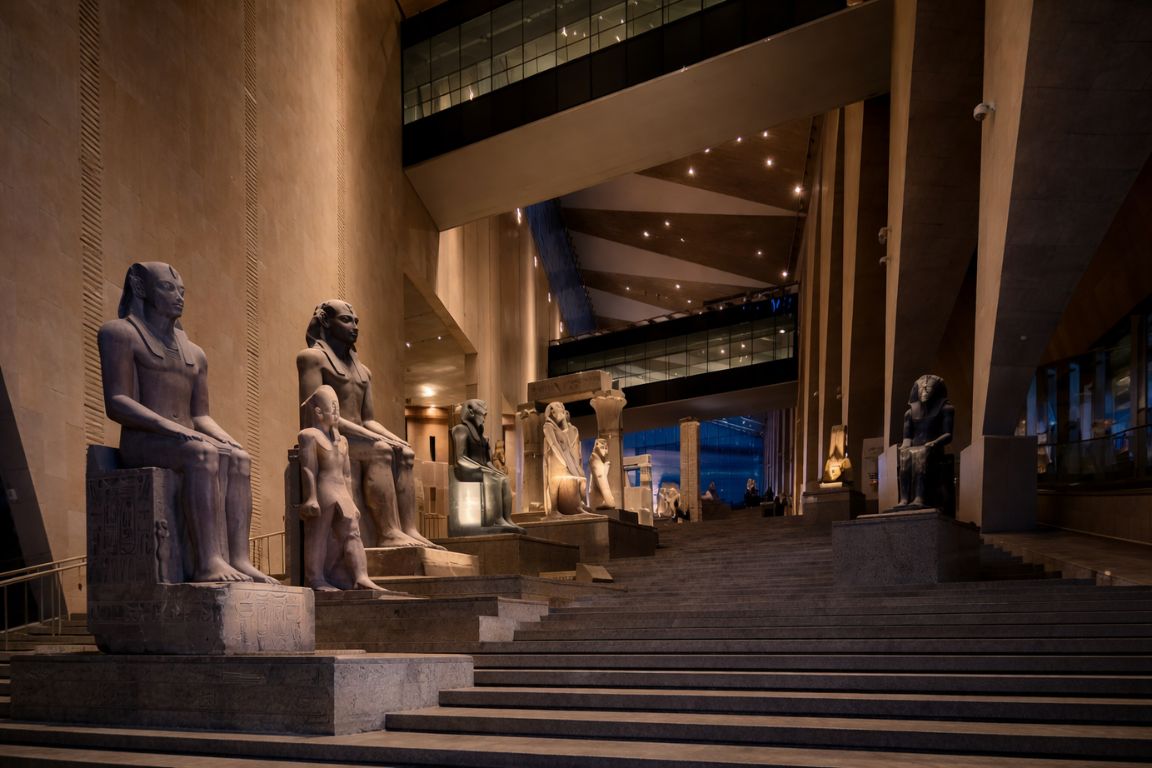
Most museums move you through corridors. The Grand Egyptian Museum moves you up. The Grand Staircase is the spine of the building, a wide ceremonial ascent lined on both sides with colossal statues and royal monuments, climbing six storeys from the entrance level toward the upper galleries. It doubles as the transition between the Grand Hall below and the Tutankhamun collection above, and it ends with the single most photographed moment in the museum: a glass wall framing the three pyramids of Giza. This guide walks through what the staircase is, the statues that line it, the view at the top, how to climb it if stairs are a problem, and when it is quietest.
What is the Grand Staircase at the Grand Egyptian Museum?
The Grand Staircase is a six-storey monumental stairway that forms the central route through the Grand Egyptian Museum. It rises from the entrance level past more than 60 colossal statues, sarcophagi, columns, and stelae arranged by theme, and finishes at a glass panorama of the Giza pyramids. It connects the Grand Hall at the bottom to the main galleries and the Tutankhamun halls above.
Architecturally it is doing something older museums rarely attempt. Instead of hiding the vertical movement in lifts and back stairs, the building makes the climb the exhibition. As you ascend, statues flank you on both sides, spaced so each has room and light, and the objects are organised across four thematic zones rather than strict chronology: royal identity, the world of the gods and sacred spaces, the relationship between gods and kings, and the journey to eternity. You are not just gaining height, you are moving through the ideas that structured pharaonic life, from kingship to the afterlife.
The staircase covers a large footprint, several thousand square metres of display woven into the ascent, and the scale is deliberate. The designers wanted the walk itself to build anticipation, so that by the time you reach the top and the pyramids appear through the glass, the payoff feels earned rather than handed to you. It sits directly above the Grand Hall, so the sequence reads as one continuous gesture: the colossal Ramesses II greets you at the bottom, the staircase carries you up through the dynasties, and the collection opens out above. To understand how the colossus at the foot of the stairs sets up the whole climb, see our guide to the Grand Hall.
There is a practical benefit to this design that visitors notice within the first few minutes. In a conventional museum, a room of colossal statues would crowd the objects together and force you to look across each one to see the next. Here the pieces are staggered up the incline, so each statue has open air above and around it, and you meet them one at a time as you climb. The natural pauses to catch your breath double as pauses to look. Very few museums manage to make the act of moving between exhibits feel like part of the exhibit, and this is the museum's clearest example of it. Take the ascent as an experience in itself rather than a stretch of stairs between two floors you actually care about.
| Detail | Figure |
|---|---|
| Height | Six storeys, full height of the building's public core |
| Statues and monuments | More than 60 colossal pieces |
| Organising themes | Royal identity, sacred spaces, gods and kings, journey to eternity |
| Connects | Grand Hall below to the main and Tutankhamun galleries above |
| Ends at | Glass panorama of the three Giza pyramids |
What are the colossi lining the staircase?
The staircase is lined with more than 60 colossal statues and royal monuments spanning Egypt's dynasties, from the Old Kingdom to the Greco-Roman era. The standout stops are ten statues of Senusret I in painted limestone, a colossal head of the heretic king Akhenaten, and a pairing of Hatshepsut and Thutmose III. Each was placed for a reason, not lined up at random.
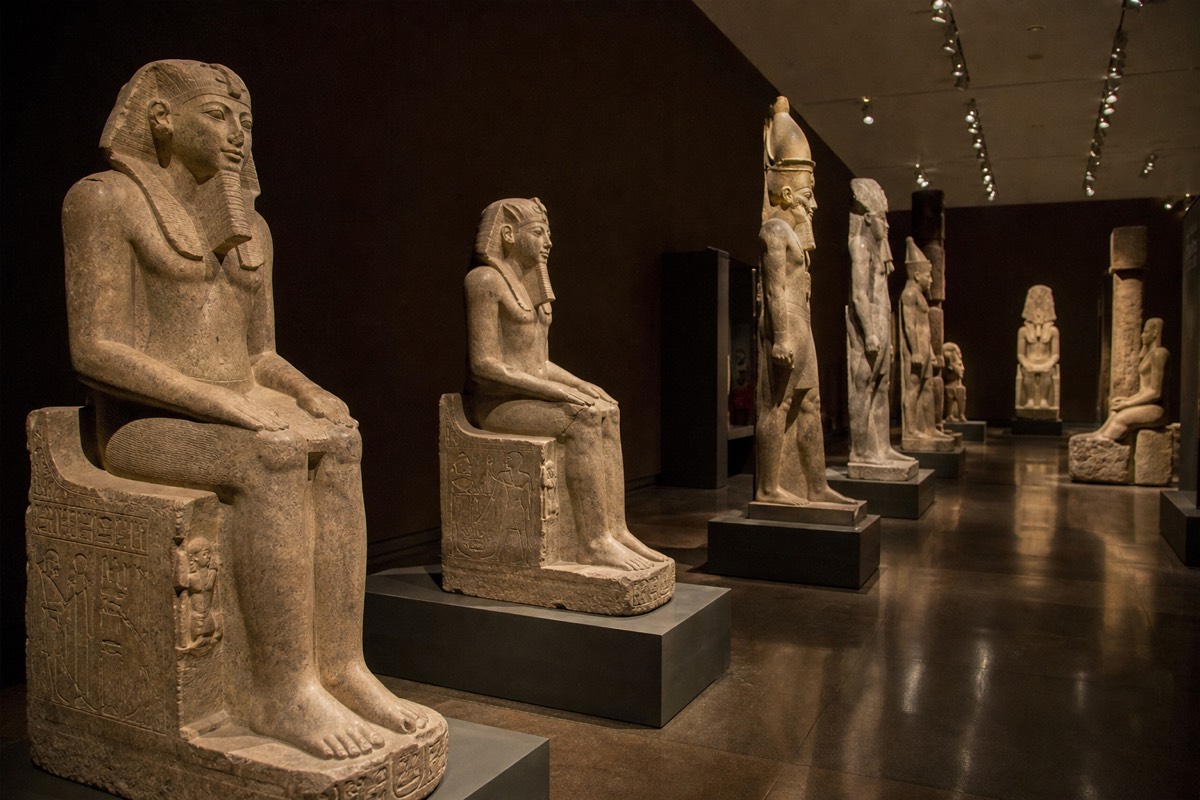
The ten Senusret I statues are among the first to catch the eye. Brought from his complex, carved in limestone, and still carrying traces of ancient colour after thousands of years, they are arranged in a tapering formation rather than a simple row. The effect is deliberate: your eye is drawn upward along the group toward the peak of the arrangement. It is one of the clearest moments where the display design and the ancient objects work together to pull you up the stairs.
The Akhenaten head is placed somewhat apart from the other New Kingdom rulers, which suits its subject. Akhenaten upended Egyptian religion, briefly replacing the old pantheon with worship of a single sun disk, and his artists portrayed him with an elongated face, a heavy jaw, and almond eyes that break every convention of idealised Egyptian portraiture. After his death his monuments were dismantled and his name struck from the official lists. He survives on the staircase as a head alone, which somehow reads as fitting. The Hatshepsut and Thutmose III pairing carries its own drama. Hatshepsut ruled for over two decades as a female pharaoh, and Thutmose III later erased her name from monuments across Egypt. In the display, she is set so she meets him at eye level rather than below him. Someone made that choice on purpose. If you want a fuller catalogue of the individual pieces and which ones reward the most time, our list of the must-see artifacts covers the staircase colossi in detail.
The wider point about the staircase statues is that they span periods a single gallery could never hold side by side. In the space of one climb you pass Old Kingdom monumental work, Middle Kingdom limestone figures with surviving paint, New Kingdom colossi from Egypt's imperial peak, and later pieces reaching toward the Greco-Roman age. The materials shift with the eras too, from limestone to granite to darker stones, and the styles shift with them, from stiff formal poses to the strange naturalism of the Amarna period and back again. Read that way, the staircase is a compressed history of how Egyptian rulers chose to present themselves in stone across roughly three thousand years, laid out along a route you can walk in under an hour.
| Statue or group | Period | Why it matters |
|---|---|---|
| Ten Senusret I statues | Middle Kingdom | Painted limestone, still coloured, in a tapering formation |
| Colossal Akhenaten head | New Kingdom, Amarna | The heretic king in radically un-idealised style |
| Hatshepsut and Thutmose III | New Kingdom | Female pharaoh set to meet the king who erased her |
| Seated and standing colossi | Old Kingdom to Greco-Roman | More than 60 pieces span the full sweep of dynasties |
What is the view from the top?
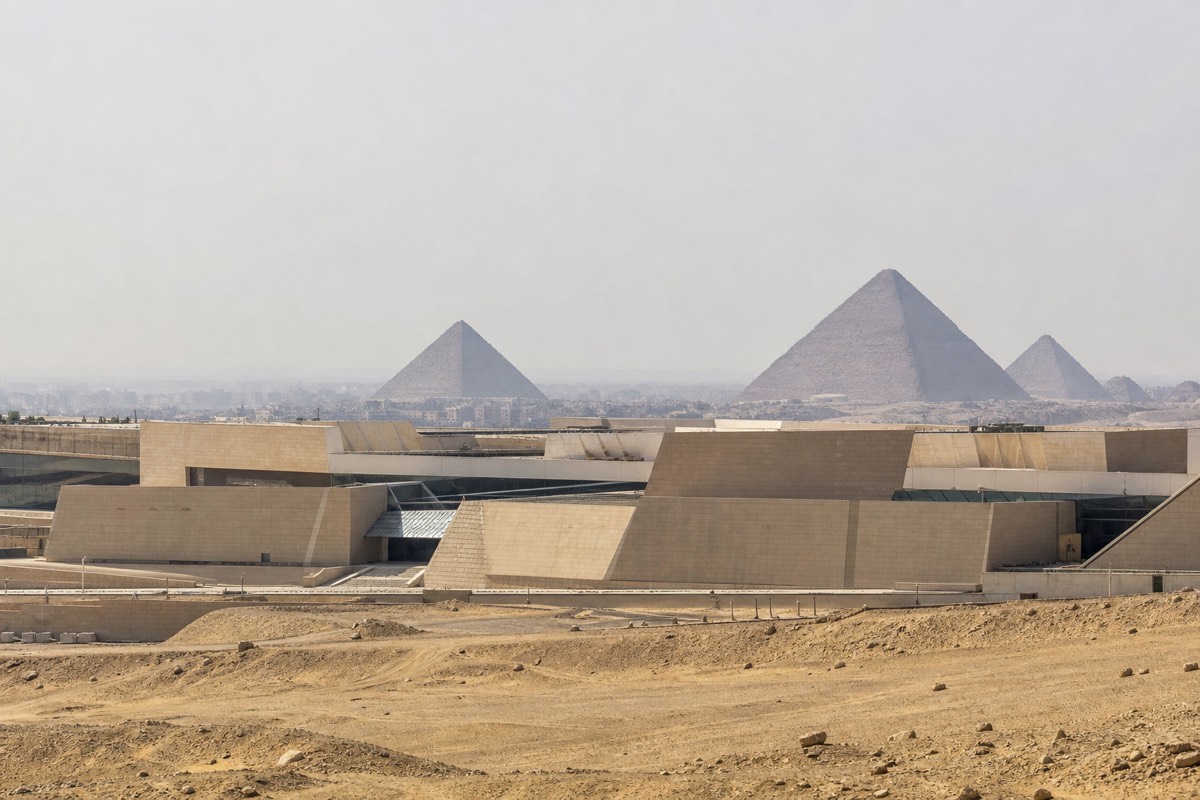
At the top of the Grand Staircase, a full glass wall frames the three pyramids of Giza roughly two kilometres away, sitting on the same plateau as the museum. It is the most photographed spot in the building. The alignment is intentional, so the climb through Egypt's statuary ends with the monuments those pharaohs were buried beneath, live and framed in daylight.
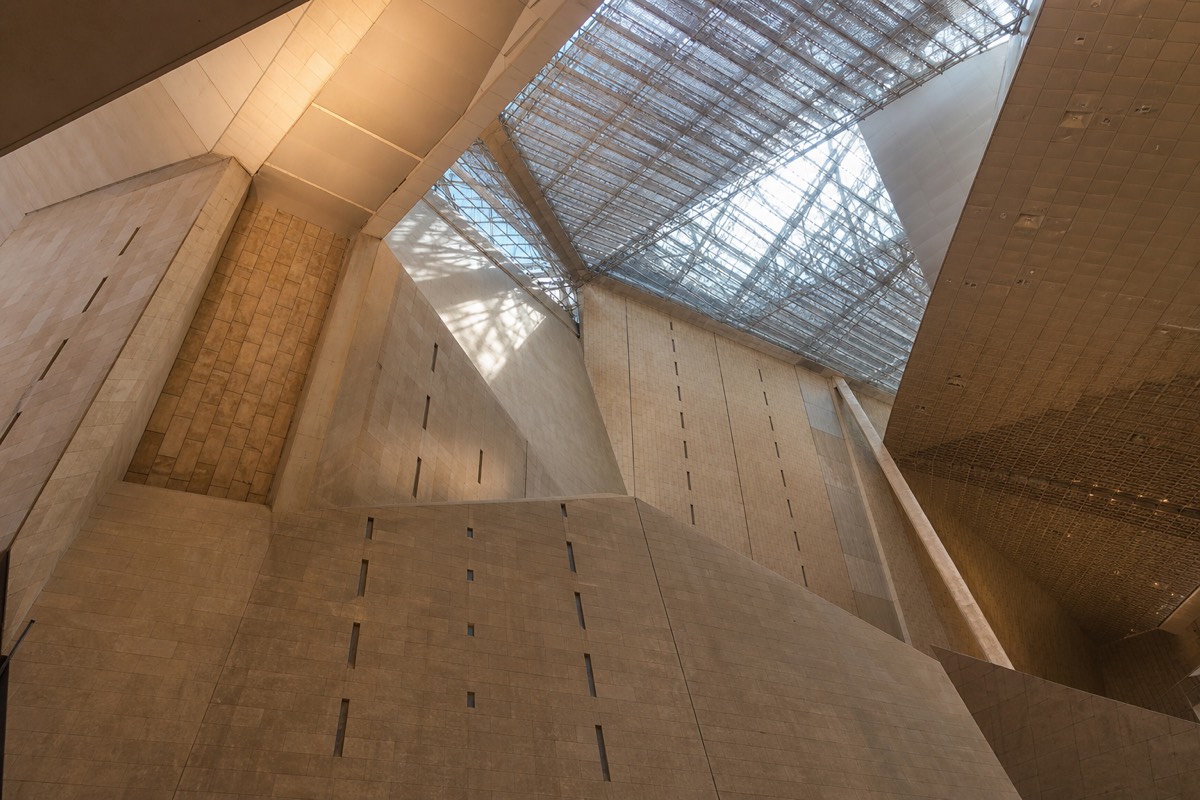
The moment works because of the build-up. You have spent the ascent among kings carved in stone, and then the glass opens onto the real thing: the Great Pyramid of Khufu, the Pyramid of Khafre with its cap of casing stone, and the smaller Menkaure, all lined up on the horizon. On a clear day the effect is genuinely striking, a direct visual line drawn between the artifacts inside and the tombs outside. The pyramids form part of a UNESCO World Heritage site, and the museum was positioned specifically to hold them in view from this point.
For photography, the light matters. Late morning through afternoon tends to light the pyramid faces well, while a very bright midday sun can wash the glass with glare and reflections. Stand slightly off-axis to cut the reflection of the interior behind you, or cup a hand against the glass to shade your lens. The view is free with any admission ticket, and it is the natural pause point before you move into the upper galleries. Plenty of visitors climb up, take the shot, and turn straight around, which is a waste of the statues they just passed. Treat the view as the reward at the end of the climb, not the only reason to make it.
The view also lands differently depending on when in your visit you reach it. Arrive at the top early in the day, before the pyramids have drawn the heat haze that builds over the plateau by midday, and the three silhouettes read sharp and clean against the sky. Come at the end of a long visit and the same window carries a different weight, because by then you have walked among the statues of the kings whose age produced those tombs, and the glass frames the payoff of everything you climbed past. Either way, give yourself a few minutes here rather than one quick photo. It is one of the few points in any museum where the collection and the world outside it are visible in a single frame, and that is worth standing still for.
| At the top | Detail |
|---|---|
| What you see | Khufu, Khafre, and Menkaure pyramids through glass |
| Distance | Roughly 2 km, same Giza plateau as the museum |
| Best light | Late morning to afternoon on the pyramid faces |
| Photo tip | Stand off-axis to cut interior glare on the glass |
| Cost | Included with any admission ticket |
Is the Grand Staircase accessible (elevators, walkway)?
Yes. The Grand Staircase is fully accessible. Elevators and a moving walkway run alongside the stairs at every level, so wheelchair users, families with strollers, and anyone who would rather not climb six storeys can reach the top and see the same statues and the same pyramid view. Using the walkway is normal and takes nothing away from the experience.
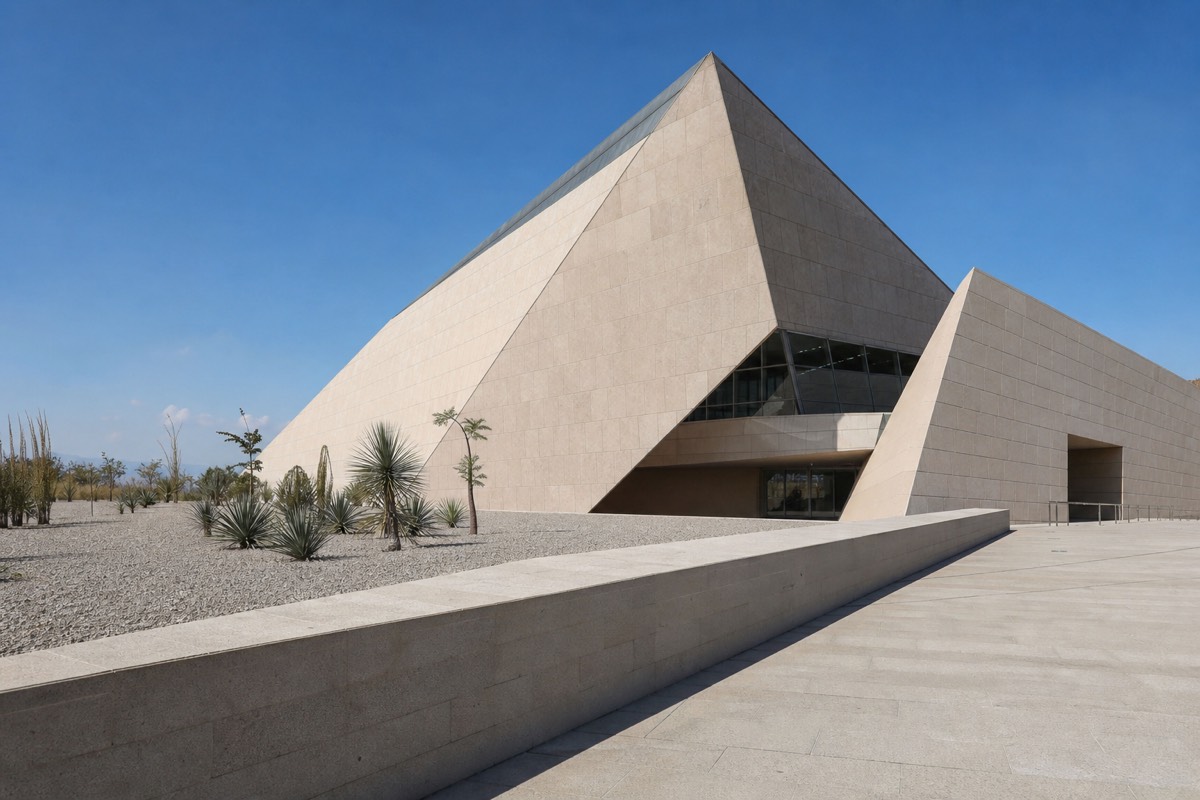
This is a genuine design strength. In many historic museums, monumental staircases are barriers, and step-free routes are tucked away and inconvenient. Here the accessible options run parallel to the main ascent rather than being hidden behind it. The moving walkway carries you up beside the statues, so you still pass the colossi and still arrive at the glass panorama. Elevators serve every level for those who need them, and the polished floors throughout are smooth for wheels.
A practical suggestion many visitors like: ride up and walk down. Taking the walkway or a lift to the top saves your energy for the galleries, and descending the stairs on foot lets you read the statue labels at your own pace with gravity helping rather than fighting you. There is no etiquette penalty for using the assisted routes. The staff expect it, the building was designed for it, and on a museum this large, conserving your legs for the galleries above is simply smart planning. If arranging your own transport and pacing feels like a lot, a hotel-pickup experience handles the door-to-door logistics so you can focus on the climb and the collection.
| Option | Who it suits | Note |
|---|---|---|
| The stairs | Visitors happy to climb | Closest to the statue labels on the way down |
| Moving walkway | Anyone saving energy | Runs alongside the statues at every level |
| Elevators | Wheelchair users, strollers | Serve every level, step-free |
| Ride up, walk down | Most first-time visitors | Saves legs for the galleries, reads labels descending |
How long does it take and when is it least crowded?
Plan 30 to 60 minutes on the Grand Staircase, depending on whether you read the statue labels or simply climb and photograph. It is quietest early, right at the 9:00 AM gallery opening, and on extended-hours evenings on Wednesday and Saturday when the museum stays open until 9:00 PM. Peak density runs 11:00 AM to 2:00 PM, worst on Friday and Saturday.
A quick ascent, riding up and pausing only for the pyramid view, takes 15 to 20 minutes. A proper visit, walking down among the statues and reading the panels for the Senusret group, Akhenaten, and Hatshepsut, is closer to an hour. Because the staircase is the main artery of the building, the crowd on it tends to flow upward and spread out naturally, so it rarely feels as packed as a single gallery can. Even so, timing helps. The first hour after the galleries open at 9:00 AM is the calmest, before the mid-morning tour groups arrive and before the busiest window sets in around 11:00 AM.
The Egyptian weekend falls on Friday and Saturday, and those are the most crowded days across the whole museum. If your schedule allows a weekday, take it. The extended-hours evenings, Wednesday and Saturday until 9:00 PM with last entry at 8:00 PM, open up a quieter late slot once the day crowds thin out, and the staircase under evening light is a different and calmer experience. During Ramadan the whole museum runs shorter hours, closing earlier, so check the live schedule at visit-gem.com before you plan a late visit. Hours and slots are confirmed on the official platform, so treat any timetable you read elsewhere as a starting point only.
The entry slots themselves are worth knowing when you time the staircase. The museum runs timed entries through the day, with the earliest at 8:30 AM and additional slots at 11:00 AM and 1:00 PM, plus later 3:00 PM and 5:00 PM slots on the extended Wednesday and Saturday evenings. Booking the first slot of the day is the single most effective move for the staircase, because you can be climbing it while the mid-morning arrivals are still queuing outside. The complex, including gardens and cafes, opens at 8:30 AM, but the galleries themselves open at 9:00 AM, so an early-slot visitor has a genuine head start on the quietest hour inside. If your booking is for a later slot, aim the staircase for the tail of your visit instead, once the busiest midday window has passed.
| When | Crowd level | Note |
|---|---|---|
| 9:00 AM, gallery opening | Lightest | Best window before tour groups arrive |
| 11:00 AM to 2:00 PM | Heaviest | Peak density across the museum |
| Wed and Sat evening | Lighter | Extended hours to 9:00 PM, last entry 8:00 PM |
| Friday and Saturday | Busiest days | Egyptian weekend, avoid if you can |
| Ramadan | Varies | Shorter hours, confirm on the official site |
How it connects to the main galleries
The Grand Staircase is the connector between the Grand Hall at the bottom and the museum's upper levels. At the top it opens toward the 12 main galleries and, on the second floor, the two dedicated Tutankhamun halls holding all 5,398 objects from the tomb. Reaching the King Tut collection means passing up the staircase first, so the climb is built into the standard visiting route.
This is worth understanding before you arrive, because it shapes how you route your day. The building is designed as an ascent: enter beside Ramesses II, climb through the staircase, and arrive at the galleries and the Tutankhamun halls above. The 12 main galleries trace Egyptian civilisation across periods and themes, and you can read more about how they are laid out in our guide to the 12 main galleries. The Tutankhamun collection sits on the upper floor, reached after the staircase, which is why so many visitors treat the climb as the gateway to the gold rather than a stop in its own right.
The smart sequence for a first visit is to move quickly up the staircase early, go straight to the quieter Tutankhamun halls before the mid-morning rush, then come back down through the main galleries and the staircase statues at a slower pace once you have secured the King Tut visit. That way you see the busiest upstairs rooms while they are calm, and you still give the staircase colossi the attention they deserve on the way down. Everything on this route is covered by the entry-only ticket, so there is no gate to pass or extra charge between the staircase and the galleries above it.
One more thing the staircase does well is orientation. Because it runs the full height of the building's public core, it works as a mental map. From the landings you can see down into the Grand Hall and out toward the galleries, so it is hard to get badly lost the way visitors sometimes do in older museums that sprawl sideways. If you lose your bearings during the day, returning to the staircase resets you. Think of it as the building's central column, the point every route eventually loops back to, and plan your day around passing it twice: once on the way up to the collection, and once on the way down when you finally give the colossi the slow look they were placed there to receive.
| Level | What is there |
|---|---|
| Entrance level | Grand Hall and the Ramesses II colossus |
| The ascent | Grand Staircase, 60-plus colossal statues, pyramid view at the top |
| Main galleries | 12 galleries tracing Egyptian history by period and theme |
| Second floor | Two Tutankhamun halls, all 5,398 tomb objects together |