The Colossal Ramesses II Statue and the Grand Hall
The first thing you meet inside the Grand Egyptian Museum is an 11-metre, 83-tonne granite pharaoh. Here is the full story of the colossal Ramesses II statue, the Grand Hall around it, and how to see it well.
Booking choice: Private English-speaking Egyptologist and Cairo/Giza hotel transfers. Admission, lunch and tips are extra. Approximately 3.5 hours. Check Private GEM Egyptologist Visit Dates
Your next choice is how to visit: See Ramesses statue and Grand Hall while gaining optional Egyptological context; no Abu Simbel excursion or guaranteed solar event.
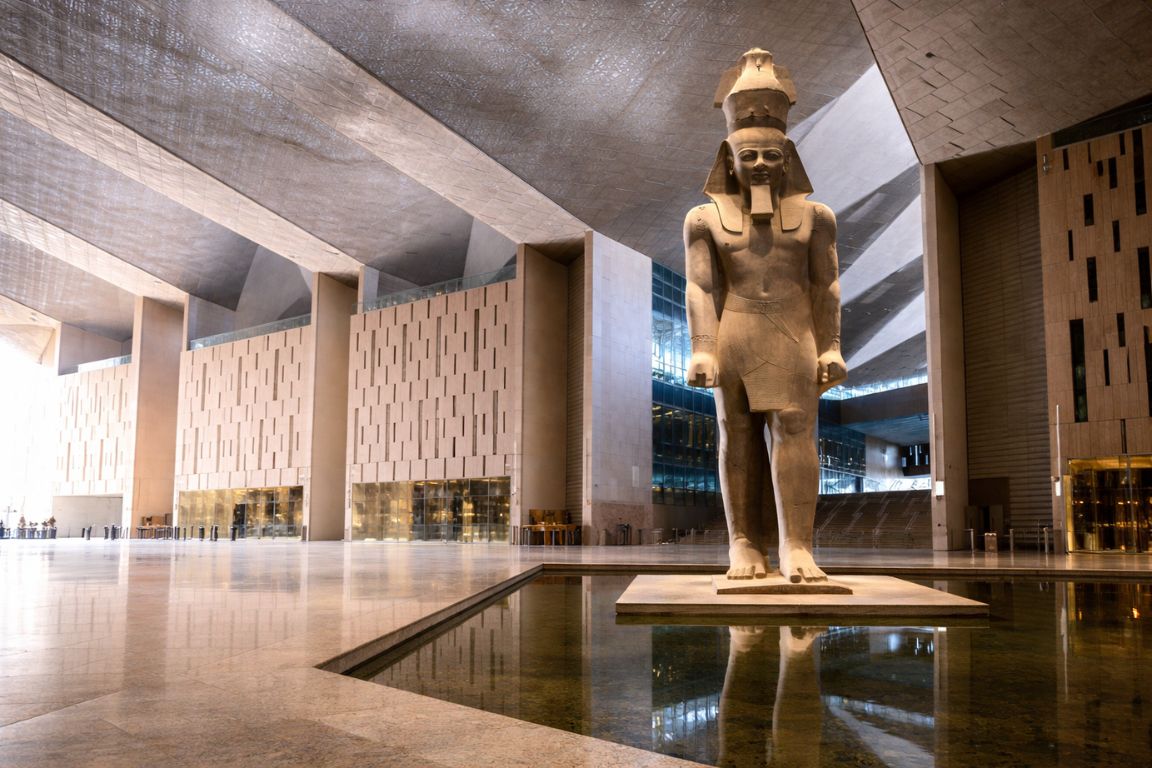
Walk through security, cross the entrance concourse, and the museum makes its opening argument before you reach a single gallery: an 11-metre pharaoh in red granite, weighing 83 tonnes, standing at the head of the Grand Hall. This is the colossal statue of Ramesses II, and it is the first artifact the Grand Egyptian Museum ever installed. Almost every visitor arrives now with pre-booked Grand Egyptian Museum tickets, because the museum moved to timed online entry, so the crowd around the statue arrives in waves rather than all at once. This guide covers what the statue is, how it travelled here across two centuries, the Abu Simbel light detail built into the ceiling above it, what else fills the Grand Hall, and how to photograph the whole thing without fighting the light.
What is the colossal Ramesses II statue in the Grand Hall?
The colossal Ramesses II statue is an 11-metre-tall figure carved from red granite, weighing about 83 tonnes, made during the reign of Ramesses II roughly 3,200 years ago. It stands at the entrance to the Grand Hall as the first object visitors meet, positioned so you look up at a full-length pharaoh before you reach the Grand Staircase or any gallery.
Scale is the point of it. Photographs never carry the size across, because a photograph flattens the height into something your eye can hold in one frame. In the hall you cannot. You tilt your head back, you step away, and the crown is still above your sightline. The figure wears the double crown of Upper and Lower Egypt, arms held to the sides, one leg forward in the standard striding pose of Egyptian royal statuary. Hieroglyphic inscriptions naming the king run across the base and body, and after more than three thousand years they still read clearly under the atrium light.
The statue was not made for this building. It was carved for a temple, spent centuries in fragments, and passed through several homes across Cairo and Giza before the museum was designed around it. That history is covered in the next section. What matters standing in front of it is the effect the architects were chasing: a single object large enough to reset your sense of scale before the collection proper begins. The Grand Hall does very little else. It is deliberately sparse, a wide stone volume with the colossus as its anchor, so the statue reads as a threshold rather than an exhibit.
If you want the wider list of showpieces before you arrive, our roundup of the must-see artifacts puts the Ramesses colossus in context alongside the golden mask, the solar boat, and the Heracleion statues.
| Detail | Figure | Note |
|---|---|---|
| Height | About 11 metres | Full-length standing figure |
| Weight | About 83 tonnes | Moved in one piece in 2006 |
| Material | Red granite | Quarried at Aswan in antiquity |
| Age | Roughly 3,200 years | Reign of Ramesses II, around 1279 BCE onward |
| Location in GEM | Grand Hall, at the entrance | First artifact you see inside |
| Crown | Double crown of Upper and Lower Egypt | Symbol of a unified kingdom |
Who was Ramesses II and why does he greet visitors first?
Ramesses II ruled Egypt for about 66 years, one of the longest reigns in ancient history. He fought at the Battle of Kadesh, built Abu Simbel, and covered Egypt in monuments to himself. Placing his colossus at the museum entrance frames the whole visit around the New Kingdom peak, the era that produced Tutankhamun and the treasures upstairs.
He is often called Ramesses the Great, and the title was largely self-awarded through sheer volume of building. He outlived at least twelve of his own sons. He signed what is frequently described as the first recorded peace treaty, with the Hittites, after Kadesh ended in a stalemate that his temple walls nonetheless recorded as a triumph. For visitors, none of that needs memorising. The relevant fact is simpler: when Egyptians and archaeologists talk about the ambition of pharaonic Egypt, Ramesses II is the name that carries it, and the museum wants that ambition to be the first thing you feel.
The choice also does quiet chronological work. You enter beside a New Kingdom king, climb past statues spanning the dynasties on the Grand Staircase, and arrive on the upper level at the Tutankhamun halls, another New Kingdom story. The building loops you through Egyptian time and lands you back among the boy king's gold. Ramesses at the door is the opening chord of that arrangement.
| Fact about Ramesses II | Detail |
|---|---|
| Reign length | Around 66 years |
| Best-known monument | Abu Simbel, in the far south of Egypt |
| Famous battle | Kadesh, against the Hittites |
| Dynasty | Nineteenth Dynasty, New Kingdom |
| Common epithet | Ramesses the Great |
Where did the statue come from and how was it moved?
The statue was carved for the Temple of Ptah at Memphis, rediscovered in fragments in 1820, and reassembled. In 1955 it was raised in Ramesses Square in central Cairo, where traffic and pollution surrounded it for half a century. It was moved to Giza in 2006 and installed permanently in the Grand Hall in 2018, before the museum around it was finished.
The 2006 move is the part people remember. Shifting an 83-tonne granite figure across a modern city is not a routine job. The statue was wrapped in protective foam, secured in a vertical cradle, and carried on heavy transport through Cairo in an operation that took hours and drew crowds along the route. Moving it upright was a deliberate decision, meant to reduce stress on the ancient stone compared with laying it flat. It sat at a holding site near Giza for years while the museum was built, and only in 2018 was it lifted into the Grand Hall as the first object of the permanent collection. In a real sense the museum was assembled around this statue rather than the statue slotted into a finished museum.
Its earlier life matters too. At Ramesses Square, the colossus stood in the open air at street level, ringed by buses and exhaust, a landmark so familiar that a whole Cairo district and its main railway station took an informal identity from it. Conservationists had argued for years that the pollution was slowly damaging the granite. The move to Giza was as much rescue as relocation. Seeing it now in filtered atrium light, clean and elevated, is a different experience from the one older Cairo residents grew up with, and many of them make a point of visiting to see it in its new home.
| Year | Location | What happened |
|---|---|---|
| Antiquity | Temple of Ptah, Memphis | Carved during the reign of Ramesses II |
| 1820 | Memphis area | Rediscovered in fragments |
| 1955 | Ramesses Square, Cairo | Raised as a public landmark in the city centre |
| 2006 | Giza plateau area | Moved upright across Cairo to a holding site |
| 2018 | GEM Grand Hall | Installed as the first artifact of the collection |
What is the Abu Simbel solar alignment detail?
The ceiling above the statue has a deliberate gap that lets sunlight fall onto the colossus on set dates, echoing the solar alignment at Abu Simbel. At Ramesses II's temple in the far south, the rising sun reaches the inner sanctuary twice a year, commonly given as around 22 February and 22 October. The Grand Hall design nods to that ancient light trick above his statue in Giza.
Abu Simbel is the reference point, so it helps to know what happens there. Ramesses II had a temple cut into a cliff face hundreds of kilometres south of Cairo, and its axis was engineered so that on two mornings a year the sun penetrates the entire length of the temple and illuminates the seated gods in the innermost chamber. This is genuine ancient astronomy built into stone, and it still draws crowds to the site on those dates. The exact modern dates shifted slightly when the whole temple was relocated in the 1960s to save it from the rising waters behind the Aswan High Dam, but the phenomenon survived the move.
In the Grand Hall, the architects folded a version of that idea into the roof. Rather than sealing the ceiling flat above the colossus, they left an opening aligned so that daylight tracks across the statue and, on particular dates, falls on it in a way that references the southern temple. You do not need to visit on a specific morning to appreciate it. On most clear days the light shifts noticeably across the red granite through the hours, and at certain times the stone takes on a warmer glow. The point is that the drama of Abu Simbel, a monument most visitors will never travel south to see, is quietly acknowledged above the statue in Giza.
Both Abu Simbel and the Giza pyramids next door carry UNESCO World Heritage status, and the museum leans on that lineage. The building does not just store Egypt's monuments, it borrows their design logic.
| Feature | Abu Simbel (south Egypt) | GEM Grand Hall (Giza) |
|---|---|---|
| Effect | Sun reaches the inner sanctuary | Daylight falls onto the Ramesses colossus |
| Timing | Twice a year, around 22 Feb and 22 Oct | Set dates plus daily shifting light |
| Origin | Ancient temple engineering | Modern architectural homage |
| Subject lit | Seated gods and the king | Standing statue of the same king |
What else is in the Grand Hall and atrium?
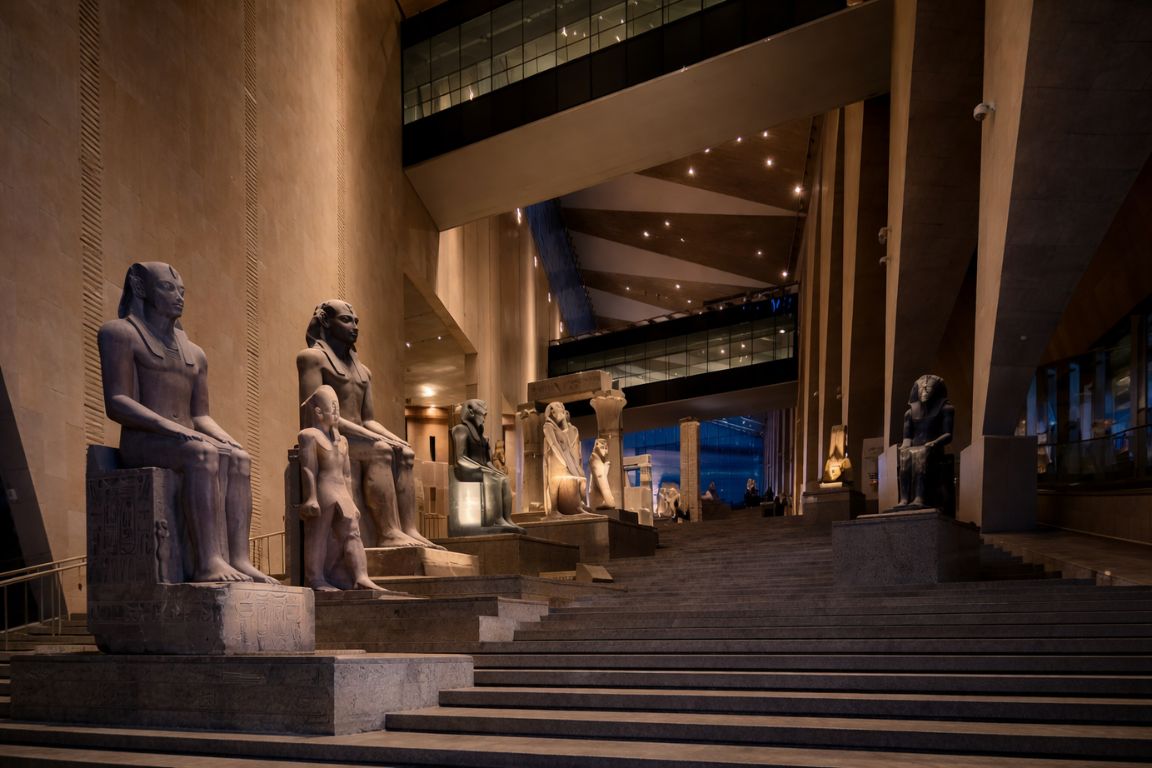
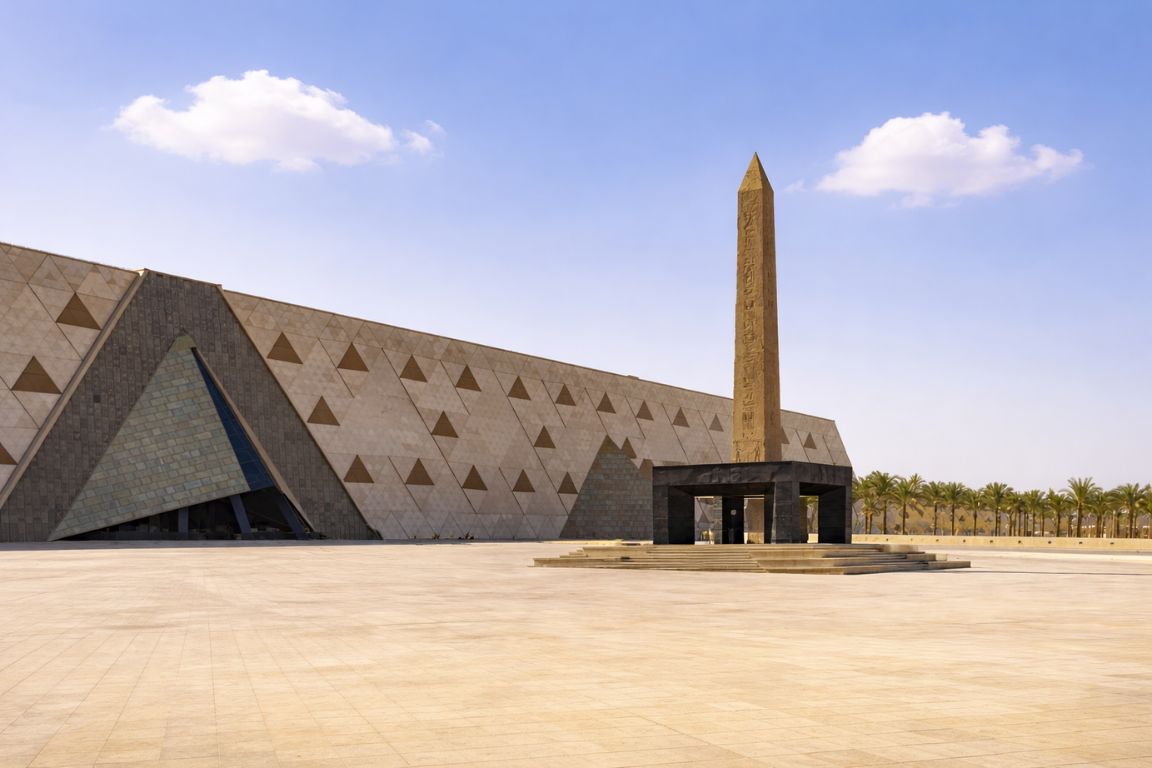
Beyond the colossus, the Grand Hall holds roughly 20 to 30 large artifacts from across the dynasties, including two Ptolemaic colossi about five metres tall raised from the sunken city of Thonis-Heracleion near Alexandria. On the exterior plaza, before you enter, stands the Hanging Obelisk of Ramesses II, the world's only suspended obelisk, at about 16 metres and 87 tonnes.
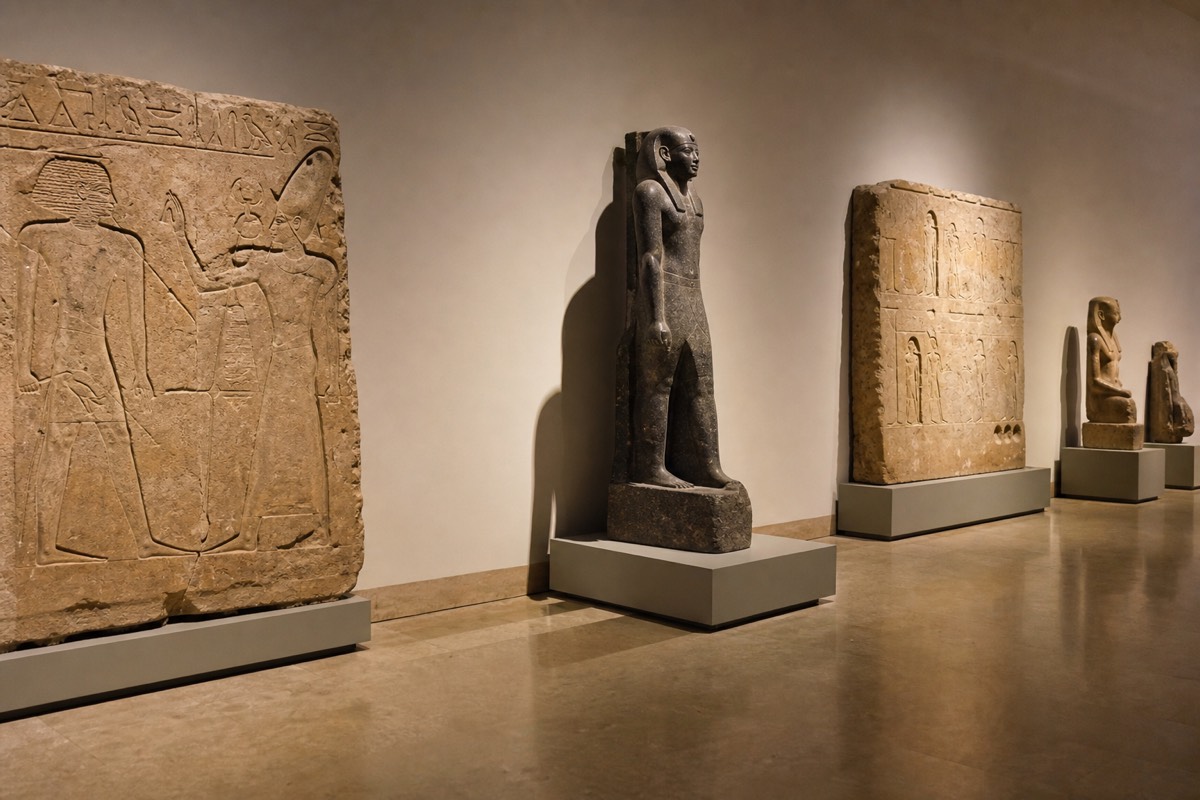
The Heracleion colossi are the objects most people walk straight past, which is a shame. Carved in pink granite and likely representing Ptolemy II and his sister-wife Arsinoe II, they spent well over a thousand years on the Mediterranean seabed after their port city subsided and sank. French archaeologists located the lost city in 2000, and these statues were raised, conserved, and eventually installed here. They stand at or near eye level in the Grand Hall, close to the towering Ramesses, and because everyone is looking up at him, the sunken-city statues get overlooked. Give them a minute. The surfaces still carry the texture of centuries underwater.
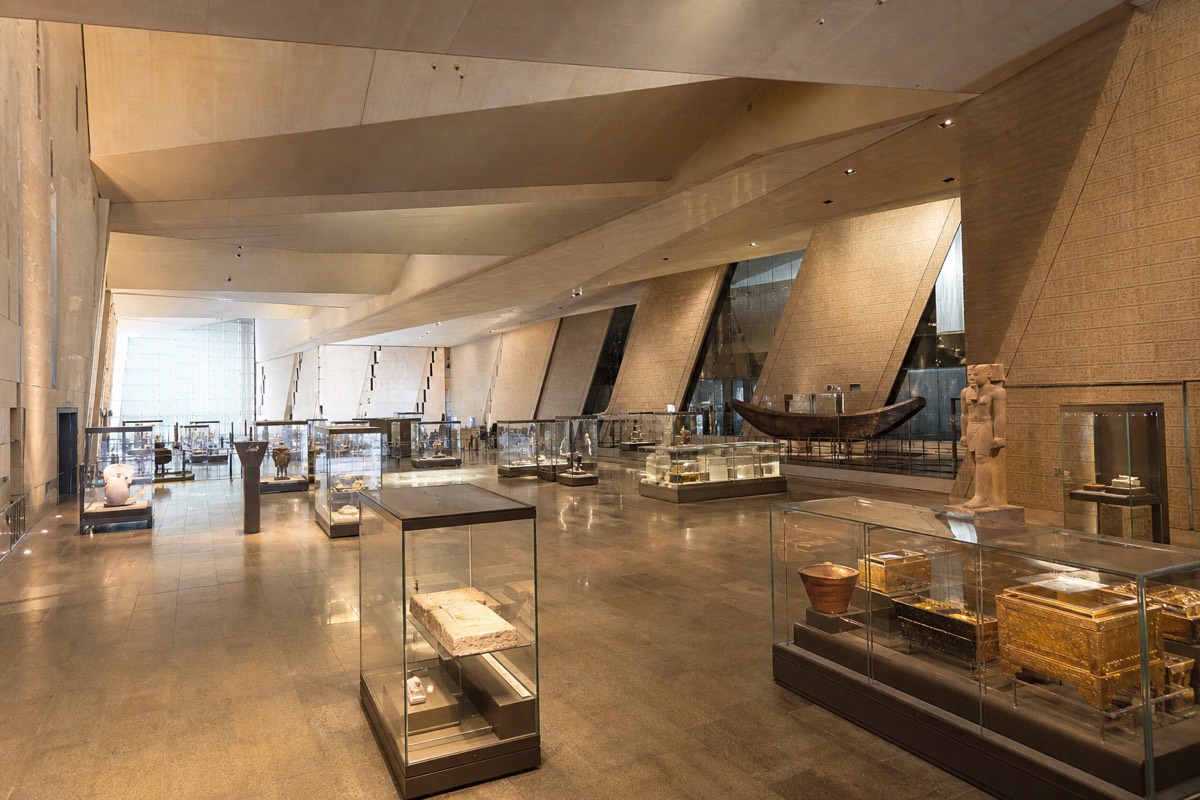
Outside, before the ticket check, the Hanging Obelisk deserves a deliberate stop. It came from Tanis in the Nile Delta and is raised on a steel frame so its underside is exposed, revealing a cartouche of Ramesses II that was originally carved to sit hidden between the base and the ground. Stand beneath it, look up, and you are seeing a royal name that was meant never to be seen. The Grand Hall itself is intentionally uncluttered, so the objects it does hold each get room to breathe. If you want the full inventory of headline pieces and where they sit, what to see maps the whole building section by section.
| Object | Where | Why stop |
|---|---|---|
| Ramesses II colossus | Head of the Grand Hall | 11 metres of red granite, the museum's opening statement |
| Heracleion colossi | Grand Hall floor level | Ptolemaic statues raised from a sunken Mediterranean city |
| Hanging Obelisk | Exterior plaza, before entry | Only suspended obelisk on earth, hidden cartouche now visible |
| Dynastic statuary | Around the hall | 20 to 30 large pieces spanning Egypt's periods |
Is the Grand Hall included in admission and how long to spend?
Yes. The Grand Hall, the Ramesses colossus, and the Hanging Obelisk are all covered by standard admission, currently around EGP 1,450, about 30 US dollars for a foreign adult, so no separate ticket is needed. Most visitors spend 20 to 40 minutes in the hall and atrium. Book online at visit-gem.com, since the museum sells timed entry only with no walk-up tickets.
There are two ticket types and both include the Grand Hall. Standard admission gives you self-guided access to every open area, the colossus included. The guided-tour ticket, currently around EGP 1,950, adds an official museum Egyptologist leading a group through the Grand Hall, the Grand Staircase, the Tutankhamun galleries, and the main galleries, and that walk-through runs roughly 90 minutes to two hours. Neither ticket treats the Grand Hall as an add-on. It is the entrance, so you pass through it regardless of which one you hold. Whichever you choose, prices and timed slots are set on the official platform, so always confirm the live figure before you travel.
On timing, the hall rewards a slower pass than most people give it. Twenty minutes covers the colossus and the Heracleion statues at a walk. Forty minutes lets you circle the Ramesses figure, catch it from the reflecting-pool angle, read the base inscriptions, and step outside to the obelisk. It is worth not sprinting through, because the hall is designed as a decompression space between the noise of arrival and the density of the galleries. If you would rather have the whole route handled, including transport and a guide who paces the hall for you, private GEM Egyptologist visit with hotel transfers starts in the Grand Hall before moving up to the Tutankhamun collection. For a self-paced day, the entry-only ticket lets you linger as long as you like.
| Ticket | Planning allowance | Grand Hall included? |
|---|---|---|
| Standard admission (foreign adult) | Around EGP 1,450 (about $30 USD) | Yes, self-guided |
| Guided tour ticket | Around EGP 1,950 | Yes, with an Egyptologist |
| Time for a quick pass | About 20 minutes | Colossus and Heracleion statues |
| Time for a full stop | About 40 minutes | Adds the obelisk and photo angles |
For the full breakdown of every ticket tier, including children, students, and the separate Giza plateau ticket, see our guide to GEM ticket prices.
How to photograph it
Photograph the Ramesses colossus from a distance first to capture its full height, then move close for the face and inscriptions. Personal photography is allowed in the Grand Hall, but flash, tripods, and selfie sticks are restricted. Morning light through the ceiling gap is the warmest. The reflecting-pool angle gives the cleanest mirror shot, and the escalator up the staircase offers an elevated wide view.
The single most common photo mistake is standing too close and trying to fit 11 metres of statue into a phone frame from the base. You end up with a distorted, bottom-heavy image and a cropped crown. Back up as far as the hall allows, hold the phone vertically, and let the surrounding space give the figure its scale, ideally with a person in shot for reference. Then, and only then, move in for the details: the carved cartouches on the base, the folds of the kilt, the serene set of the face. Two distances, two very different photographs.
Light is your other variable. The ceiling gap means the quality of light on the granite changes through the day, and early to mid-morning tends to be the warmest and most flattering, before the overhead sun flattens everything out. The reflecting element at the statue's base can double the figure in a still-water mirror if you crouch low and line up the reflection. For a wide establishing shot, the escalator running alongside the Grand Staircase lifts you to an angle looking back down over the hall. On the rules, keep it to a phone or handheld camera, switch flash off, and leave the tripod and selfie stick behind, since staff enforce those limits and being corrected mid-shot breaks your rhythm. The complete Tutankhamun collection upstairs has its own stricter photo rules, so read up on the complete Tutankhamun collection before you reach the gold.
| Goal | Where to stand | Tip |
|---|---|---|
| Full height | Far side of the hall | Phone vertical, add a person for scale |
| Face and inscriptions | Close to the base | Shoot after the wide shot, no flash |
| Mirror reflection | Low, by the reflecting element | Line up the water, crouch down |
| Elevated wide angle | Escalator beside the staircase | Look back over the hall as you rise |
| Warmest light | Anywhere, timed to morning | Light through the ceiling gap shifts all day |