Grand Egyptian Museum Map and Galleries Guide
The museum spans more than 500,000 square metres with 12 main galleries, the Grand Staircase and the Tutankhamun halls upstairs. Here is how it is laid out and how to route yourself through it.
Booking choice: Private English-speaking Egyptologist and Cairo/Giza hotel transfers. Admission, lunch and tips are extra. Approximately 3.5 hours. Check Private GEM Egyptologist Visit Dates
Your next choice is how to visit: Route a large museum coherently; decide independent depth versus a 3.5-hour private orientation.
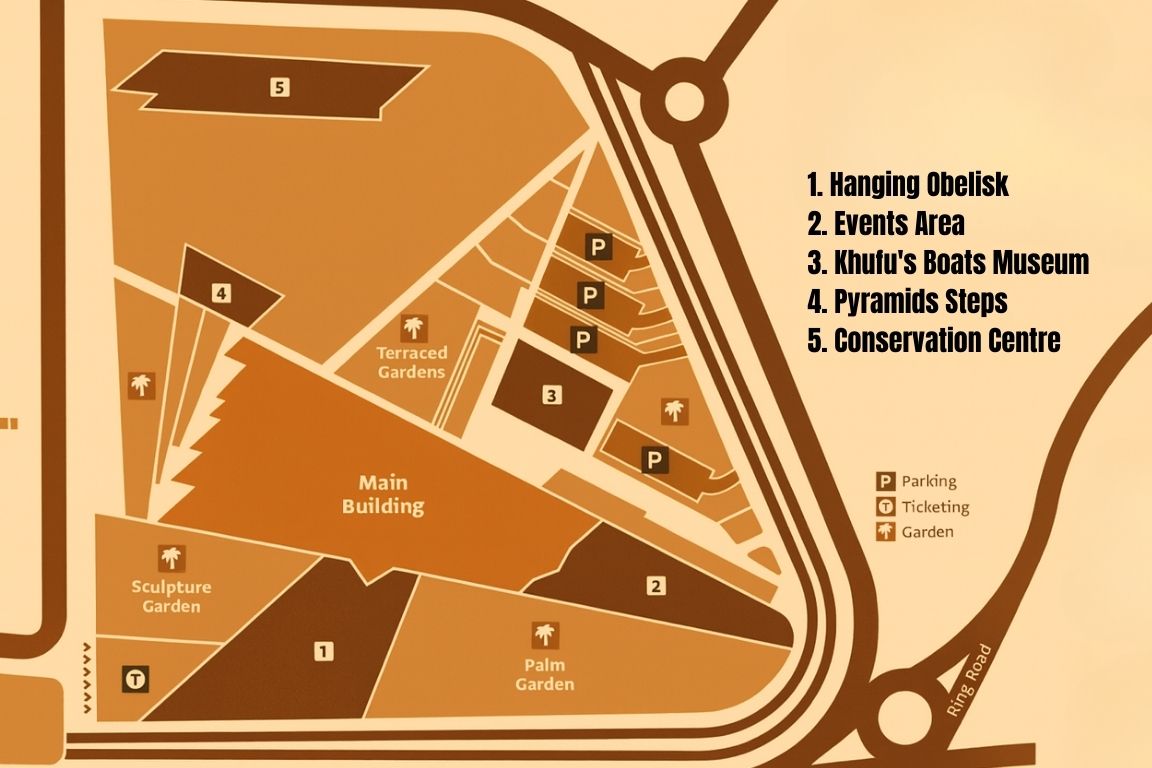
Walk in without a plan and the scale works against you. This is one of the largest museums on earth, and its 12 main galleries, the Grand Staircase and the Tutankhamun halls are spread across a building you cannot cross casually. Understanding the layout before you arrive is the difference between a coherent visit and an exhausted wander. This guide maps the museum room by room, level by level, and gives you routes tuned to how many hours you actually have. Confirm any specifics on the day at visit-gem.com, since the museum still fine-tunes what is open.
How is the Grand Egyptian Museum laid out?
The museum is organised around a vast entrance atrium holding the colossal Ramesses II statue, a Grand Staircase that climbs alongside the main galleries toward a glass panorama of the pyramids, and the Tutankhamun galleries on the upper level. The 12 main galleries run chronologically off the staircase, and Khufu's Solar Boat sits in its own separate hall.
The building was designed by Heneghan Peng, and the plan reads as a single rising journey rather than a maze of disconnected rooms. You arrive into the Grand Hall, where the 11-metre, 83-tonne Ramesses II statue anchors the space. From there the Grand Staircase draws you upward, lined with colossal pharaoh statuary, past the entrances to the 12 chronological galleries, and finishes at a window framing the three Giza pyramids. The Tutankhamun galleries occupy the second floor, reached after the staircase.
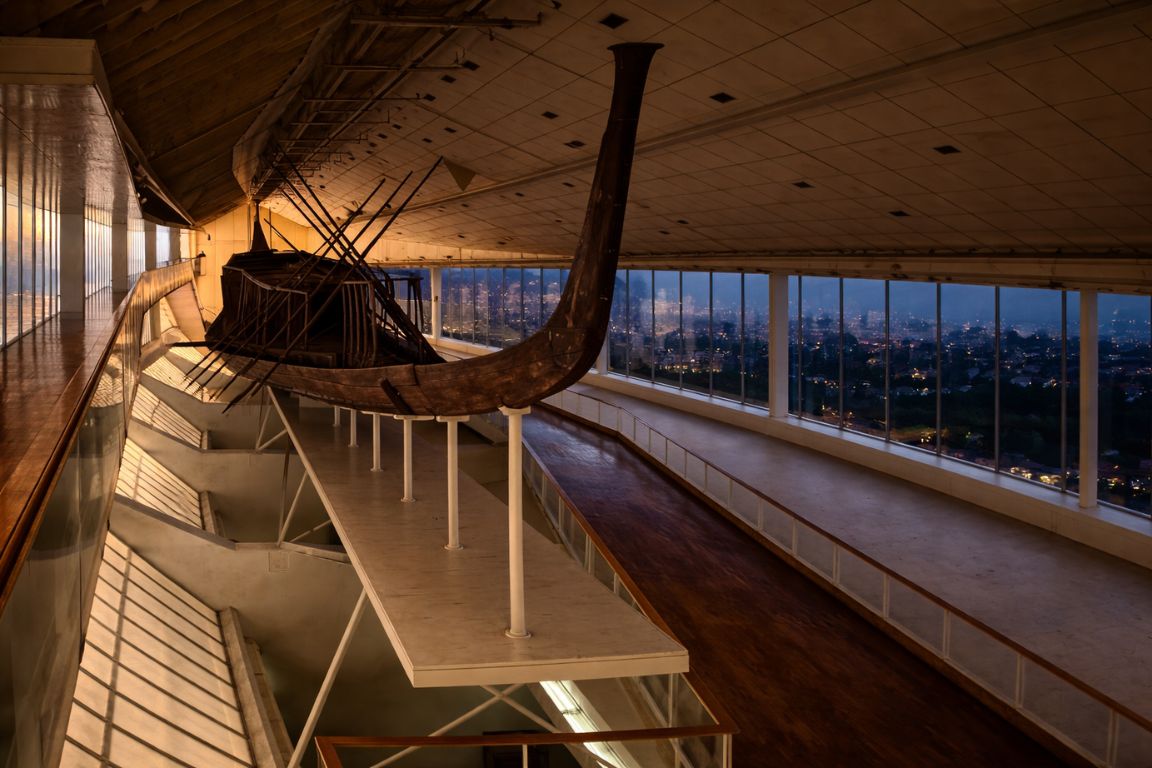
Two things sit slightly apart from that main spine. The Hanging Obelisk stands out on the exterior plaza, so you pass it before you even enter, and Khufu's Solar Boat lives in its own dedicated hall rather than inside the gallery sequence. Keeping that mental picture, atrium at the bottom, staircase up the middle, galleries off it, Tutankhamun at the top, boat off to the side, is enough to orient yourself the moment you walk in.
| Zone | Where it sits | What anchors it |
|---|---|---|
| Exterior plaza | Before the entrance | The Hanging Obelisk, originally from Tanis |
| Grand Hall / atrium | Ground level, entrance | Colossal Ramesses II statue |
| Grand Staircase | Rising through the core | 60-plus colossal statues, pyramid panorama at the top |
| 12 main galleries | Off the staircase | Chronological sweep of ancient Egypt |
| Tutankhamun galleries | Second floor, above the staircase | The complete 5,398-object tomb assemblage |
| Khufu's Solar Boat hall | Separate dedicated building | The reconstructed cedar boat |
Because everything flows from the staircase, the biggest routing decision you make is whether to climb straight to Tutankhamun first or work through the galleries on the way up. We come back to that under the best-route section below.
What are the 12 main galleries?
The 12 main galleries present ancient Egypt in chronological order, from the prehistoric and predynastic periods through the Old, Middle and New Kingdoms and on to the Greco-Roman era. Together they hold a large share of the museum's collection of over 100,000 artifacts, arranged so you can walk the arc of a civilisation that spanned much of ancient Egyptian history.
Think of the 12 as a timeline you walk rather than read. They open with the deep past: pottery, tools and the early markers of settled life before the pharaohs. Then comes the Old Kingdom, the age of the pyramid builders, followed by the Middle and New Kingdoms, each with its own visual language of kingship, belief and daily life. The final galleries carry you into the Ptolemaic and Roman centuries, where Egyptian and classical styles blend in the same object.
The museum groups the galleries by period and by cross-cutting themes such as society, kingship and belief, so a single era may occupy more than one room. Exact gallery numbering and which halls are open can shift, so treat the table below as the shape of the sequence and confirm the current arrangement at visit-gem.com when you arrive. For a sense of scale, the whole collection dwarfs comparisons: the museum is often measured against the Louvre's roughly 35,000 exhibits, and here you are looking at more than 100,000 artifacts.
| Gallery group | Period covered | What you see |
|---|---|---|
| Prehistoric and predynastic | Earliest eras | Pottery, tools, the first signs of settled society |
| Old Kingdom | Age of the pyramid builders | Statuary and objects of the pyramid age |
| Middle Kingdom | Reunification and renewal | Royal and private sculpture, funerary goods |
| New Kingdom | Empire and its great pharaohs | Monumental works and temple-era artifacts |
| Late and Greco-Roman | Final dynasties onward | Objects blending Egyptian and classical styles |
| Thematic threads | Across all periods | Society, kingship and belief woven through the halls |
What surprises many first-time visitors is how much these galleries hold beyond the famous names. For every golden mask there are rooms of everyday things: pottery, tools, jewellery, statues of officials and scribes, funerary goods that show how ordinary Egyptians lived and how they prepared for death. That mix is the point. The galleries are not a highlights reel, they are a civilisation laid out end to end, and the quieter objects often say as much as the monumental ones about who these people were.
The chronological order also does something useful for the visit itself. Because the halls run oldest to newest, you can read the arc of ancient Egypt as a story rather than a scatter of treasures, watching styles of kingship, belief and craft shift from the pyramid age through empire to the Greco-Roman centuries. If you have any background reading in you before the trip, even a little, these galleries reward it, because the labels place each room in its moment rather than treating every object in isolation.
Standing inside admission is everything in these galleries, along with the Tutankhamun halls, the Solar Boat and the staircase. There is no separate ticket for the headline pieces, a point worth knowing before you arrive.
What is on each level?
On the ground level you find the Grand Hall with Ramesses II, the entrances to the main galleries and access to the Grand Staircase. The staircase rises through the building past the colossal statuary to a top-level viewpoint over the pyramids, and the Tutankhamun galleries sit on the second floor above it. Khufu's Solar Boat occupies its own separate hall reached from the complex.
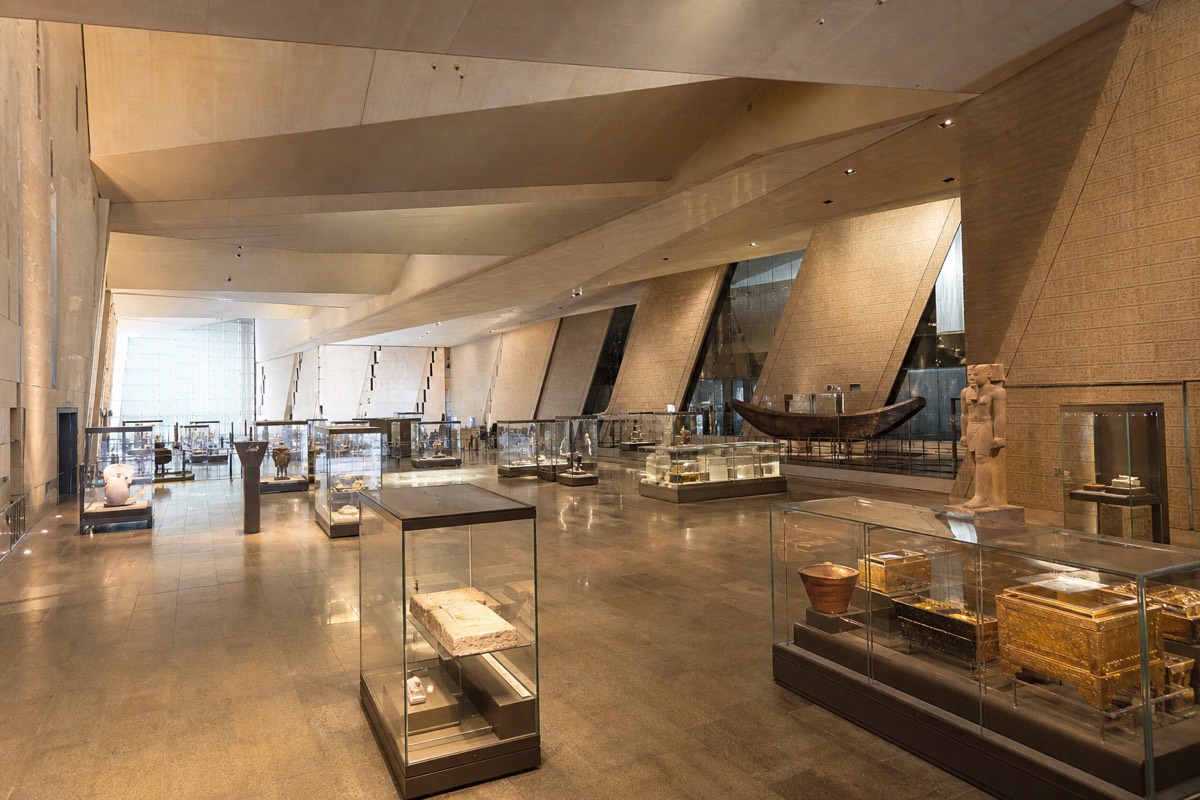
The vertical logic is the key to not getting lost. You enter low, into the atrium, where the Ramesses II statue sets the tone and the gallery doors open off the concourse. As you climb the Grand Staircase you pass more than 60 colossal statues of pharaohs, and the higher you go the broader the view becomes, ending in a glass panorama that lines the museum up with the three great pyramids in the distance. That view is the payoff at the top.
The Tutankhamun galleries wait on the second floor, reached after the staircase, and they are large in their own right, occupying around 7,000 square metres across two dedicated halls. This is where the golden death mask, the solid gold coffin, the Golden Throne and the meteorite-iron dagger are displayed together. Getting there involves height, which is why access matters, and the museum handles it well: elevators and a moving walkway run alongside the staircase at every level, so no one has to climb the full flight to reach the top or the Tutankhamun floor.
| Level | What is there | Access |
|---|---|---|
| Exterior plaza | Hanging Obelisk, approach and gardens | Ground, before the entrance |
| Ground level | Grand Hall, Ramesses II, gallery entrances | Step-free from the concourse |
| Grand Staircase | 60-plus colossal statues, pyramid panorama | Stairs, plus elevators and a moving walkway alongside |
| Second floor | Tutankhamun galleries, two halls, about 7,000 sq m | Elevators and walkway at every level |
| Separate hall | Khufu's Solar Boat and the Boat 2 restoration | Own building within the complex |
If mobility is a concern in your group, the elevators and moving walkway mean the whole vertical journey, including the Grand Staircase and the Tutankhamun floor, stays reachable without stairs.
What is the best route through the museum?
The route that works best for most visitors inverts the obvious one: climb straight to the Tutankhamun galleries first thing, before the tour groups arrive, then work back down through the Grand Staircase and the 12 chronological galleries, and finish at Khufu's Solar Boat. Doing the headline rooms first trades a slightly steeper start for far quieter sightlines at the collection's busiest point.
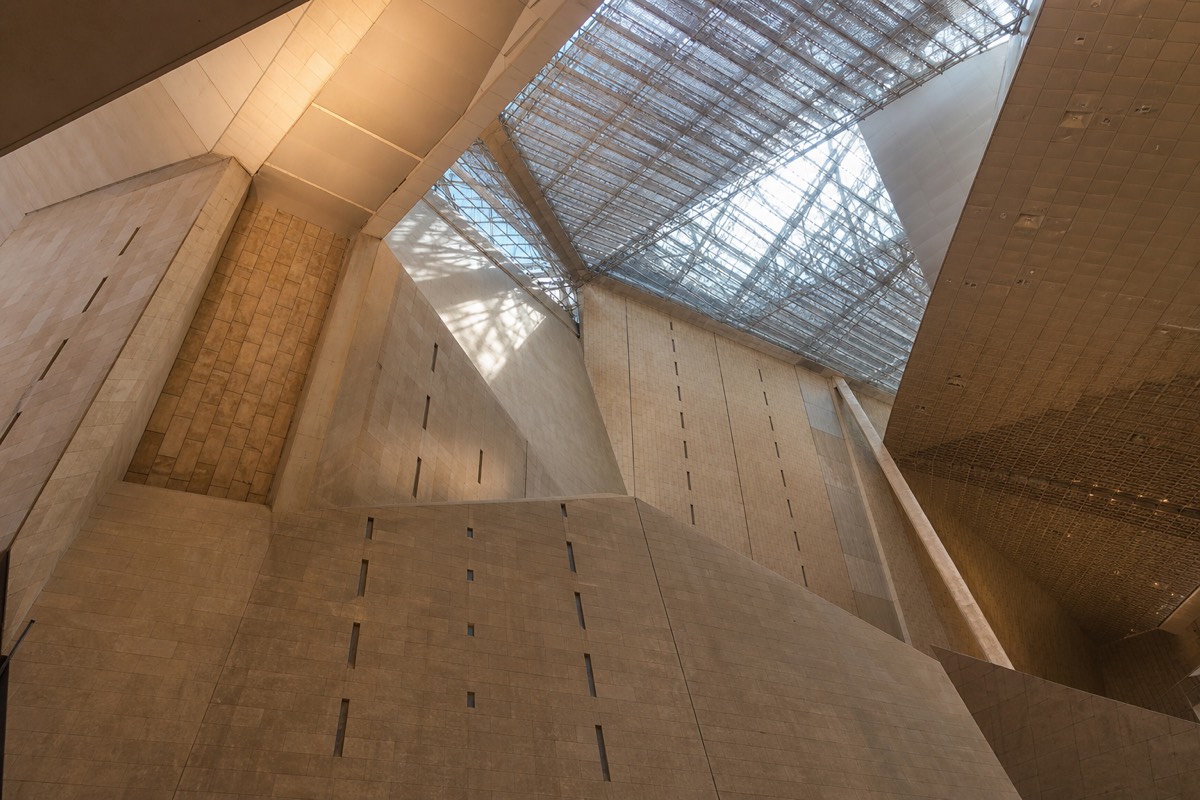
The instinct on arrival is to linger in the Grand Hall, photograph Ramesses II, then drift up the staircase gallery by gallery. The trouble is that everyone does exactly that, so the Tutankhamun halls fill from late morning onward while you are still on the lower steps. Beating the crowd to the golden mask is the single highest-value move inside the building, and the elevators make an early climb painless.
Once you have had the Tutankhamun floor at something close to its quiet best, the rest of the museum rewards a downhill, chronological read. Walk the staircase down through the colossi, drop into the 12 galleries in period order so the history lands in sequence, and save the Solar Boat, in its own hall, for near the end when the main galleries are at their busiest. That sequencing is also how our private GEM Egyptologist visit with hotel transfers centred on King Tut tends to run, for the same reason.
| Order | Stop | Why here |
|---|---|---|
| 1 | Straight up to Tutankhamun | Emptiest in the first hour; the crowd's eventual destination |
| 2 | Grand Staircase, walking down | See the colossi without fighting uphill traffic |
| 3 | The 12 main galleries in order | History reads cleanly oldest to newest |
| 4 | Khufu's Solar Boat hall | Separate building, good late-visit reset |
| 5 | Grand Hall and Ramesses II | Return for photos as you exit |
There is a second reason the inverted route works: energy. Fatigue is the real limiting factor in a building this size, and the Tutankhamun galleries deserve you at your freshest, not after two hours on your feet. Doing them first means you meet the collection's emotional peak with attention to spare, then spend your tiring hours on the broader galleries where a slower, more selective pace is fine. Save the headliners for last and you risk arriving at the mask footsore and rushed, in the busiest room of the day.
If your group includes anyone who tires easily, plan the rest stops into the route rather than hoping to find them. The natural place to pause is after the Tutankhamun floor and before the long chronological walk, when a coffee and a sit-down reset you for the second half. The moving walkway and elevators mean the vertical parts of the route cost little effort, so spend your legs on the galleries, not the stairs.
Timing the day around the crowd curve matters as much as the route itself, which we break down in our guide to the best time of day to visit.
What can you realistically see in 3, 4 or 6 hours?
In three hours you can cover the headline stops: Tutankhamun, the Grand Staircase and the Grand Hall at a brisk pace. Four hours lets you add the Solar Boat and a proper pass through several of the 12 galleries. Six hours or a full day is what serious museum-goers need to read the labels, rest, and give the whole chronological sweep the time it deserves.
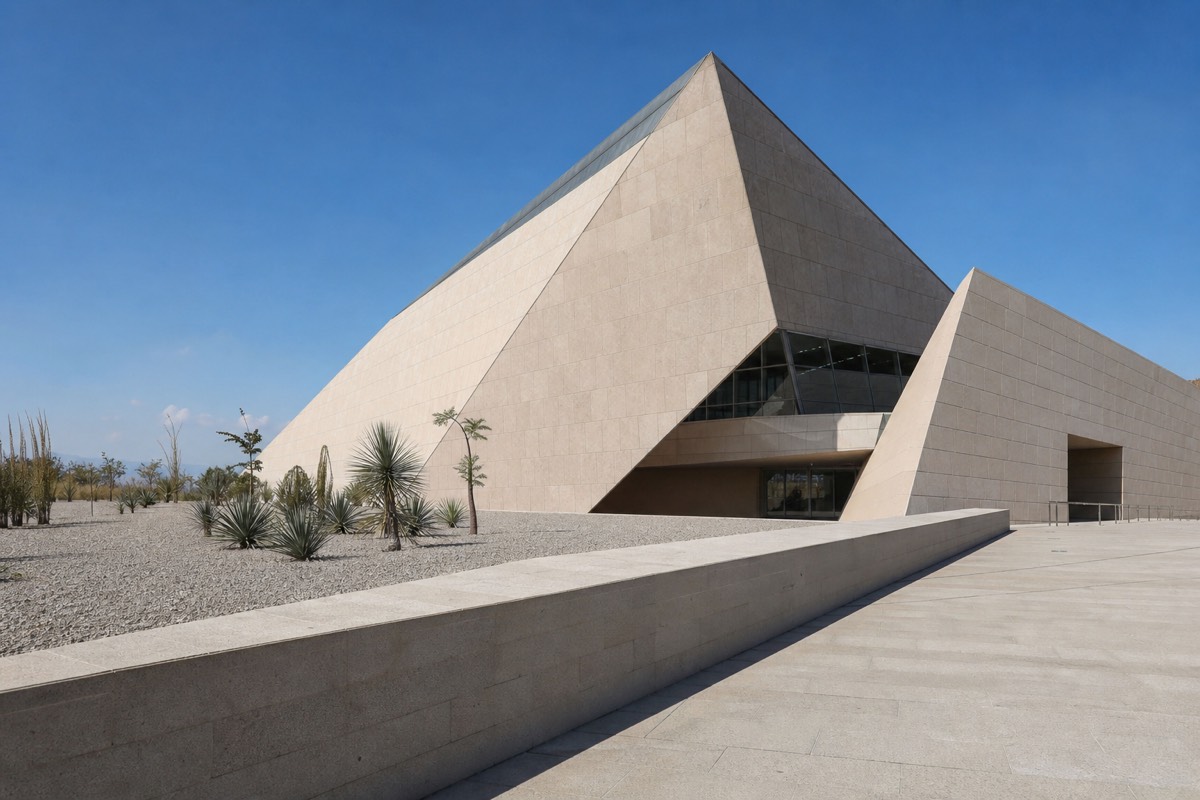
The recommended allowances are grounded and worth respecting. Three to four hours covers the highlights for a half-day visit. Four to six hours suits a proper first visit that does not feel rushed. A full day is realistic for enthusiasts who slow down in the galleries. Undershoot that and the building punishes you: people who plan two hours almost always leave wishing they had given themselves twice as long.
The variable you cannot ignore is walking. This is a vast building of polished stone floors, and fatigue, not opening hours, is what usually ends a visit early. Budget a genuine break, use the cafes, where a meal runs roughly 8 to 15 US dollars, and pace yourself. If you are weighing how long to set aside against everything else in your Cairo days, our companion piece on how many hours you need goes deeper on the trade-offs.
| Time budget | What you can cover | Best for |
|---|---|---|
| 3 hours | Tutankhamun, Grand Staircase, Grand Hall | A focused half-day on the headliners |
| 4 hours | The above plus the Solar Boat and several main galleries | A comfortable first visit |
| 6 hours or a full day | All 12 galleries, unhurried, with breaks | History enthusiasts and repeat visitors |
| Guided visit (about 2 hours) | Grand Hall, staircase, Tutankhamun, main galleries with context | Anyone wanting the story, not just the objects |
Whatever your budget, book the timed slot that gives you the hours you need before you fix the rest of the day. If you would rather have the route and the ticket handled for you, our team runs both a self-paced standard entry and guided options, and our overview of how to plan your visit ties the logistics together.
What else is in the complex beyond the galleries?
The museum is a full complex, not just exhibition halls. Beyond the 12 galleries and the Tutankhamun floor you have the exterior gardens and plaza, cafes and restaurants, retail and gift areas, a dedicated children's museum, and a conservation centre where much of the collection was restored. Planning a break and a meal into your route matters, because the walking distances are real and fatigue ends more visits than closing time does.
Spread across more than 500,000 square metres, the complex is built to hold a whole day rather than a quick loop. The gardens and plaza give you the outdoor approach, with the Hanging Obelisk and, in the distance, the pyramids framed from the grounds. Inside, the commercial area collects the cafes and restaurants, where a meal runs roughly 8 to 15 US dollars, along with the gift shops that most people drift through near the end. Building one proper stop into your route, ideally after the Tutankhamun floor and before the main galleries, keeps energy up for the second half.
Two further spaces are easy to overlook. The children's museum makes the visit workable for families, though it can keep more limited hours, so confirm the day's timing at visit-gem.com if young children are the reason you came. The conservation centre is where a large share of the collection was cleaned, stabilised and prepared for display, and it speaks to why the museum took shape over roughly two decades of work. You will not wander all of these in a rushed three-hour visit, which is another argument for the fuller time budgets above.
| Space | What it is | Worth planning for |
|---|---|---|
| Gardens and plaza | Outdoor approach and grounds | Pyramid views and the Hanging Obelisk |
| Cafes and restaurants | Commercial area dining | A meal runs about 8 to 15 US dollars |
| Gift and retail shops | Books, replicas, souvenirs | Best saved for the end of the route |
| Children's museum | Family-focused space | Can keep limited hours; confirm ahead |
| Conservation centre | Where the collection was restored | Context for the museum's long build |
Add these to the gallery time rather than instead of it, and a half-day plan quietly becomes a full one. That is the honest shape of the place: generous, and best met with a matching amount of time.
If all of this makes the museum sound daunting, it should not. The layout is more legible than its size suggests precisely because it rises along a single spine: atrium at the bottom, staircase up the middle, galleries branching off, Tutankhamun at the top, the boat off to one side. Fix that picture in your head, pick the route and time budget that suit you, and you can walk in confident rather than overwhelmed. The scale is the attraction, not the obstacle, and a little planning is all it takes to meet it on your own terms.